
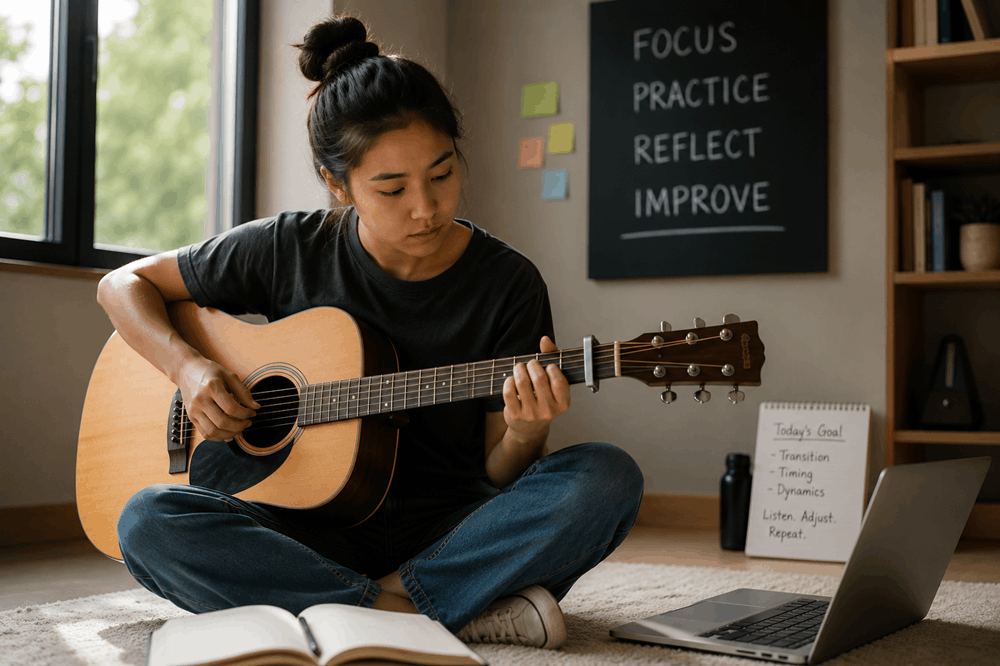
The Surprising Value of Practicing Alone
During a group dance lesson, a learner follows the instructor and completes the routine without much trouble. The music establishes the rhythm, nearby dancers provide visual cues, and each movement seems to lead naturally into the next.
Later, the learner tries the same routine alone.
Without anyone to follow, one transition disappears from memory. The rhythm becomes less stable, and a sequence that seemed familiar suddenly feels uncertain.
The group lesson was not wasted. It introduced the movements, supplied feedback, and allowed the learner to experience the full routine. Practicing alone simply revealed how much of the performance still depended on external cues.
That is the surprising value of solo practice. It shows us what we can do without the usual prompts, assistance, and social momentum. It gives us control over pace and repetition, creates room for experimentation, and requires us to take greater responsibility for our own improvement.
Practicing alone is not automatically effective, however. Without clear standards and reliable feedback, people can repeat mistakes or become confident in techniques that fail under real conditions.
The purpose is not to remain alone. It is to return to the class, team, audience, or real situation better prepared.
What Solo Practice Reveals and Makes Possible
Other people support our performance in ways we do not always notice.
A musician follows the ensemble’s tempo. A student recognizes an answer after hearing the first part of another person’s explanation. A speaker relies on slides to remember the structure of an argument. A team member lets a more confident colleague handle the difficult part of a discussion.
These supports are not harmful. Modeling, prompting, collaboration, and correction are important parts of learning.
The problem is that support can make recognition feel like mastery.
Recognizing the correct next step when someone demonstrates it is different from producing that step independently. Understanding an explanation while reading it is different from reconstructing it after closing the book. Following a group is different from maintaining timing and sequence alone.
Research on memory offers a clear example. In influential experiments on test-enhanced learning, students who practiced retrieving information retained more of it after a delay than students who repeatedly studied the material. Repeated study sometimes produced greater confidence and stronger immediate performance, even though retrieval led to better long-term retention.
Those experiments concerned memory for written material, not dance, leadership, or physical technique. Motor and interpersonal skills involve additional processes. Still, the research illustrates a useful distinction: seeing or recognizing the right response does not prove that we can produce it independently.
Removing a support can therefore serve as a diagnostic test.
A learner might close the book and explain the idea from memory. A presenter might rehearse without reading the slides. A dancer might perform without watching another person. A manager might practice the opening of a difficult conversation without relying on a written script.
The difficulty that appears is not evidence that the earlier learning was worthless. It identifies what still needs attention.
Solo practice also gives us control over how that weakness is addressed.
A group must divide its time among several people and priorities. It may repeat an entire performance when one participant needs to work on only a few difficult seconds. It may move forward because most people are ready even though one person still lacks a basic component.
Alone, the learner can slow down, divide a complex action into smaller parts, repeat one transition, remove a prompt, or stop to compare an attempt with a standard.
That control makes practice more precise.
“Practice the presentation” is vague.
A more useful target would be:
Deliver the opening in less than 90 seconds, without reading, and make the central argument clear.
Instead of repeating everything, the person works on one observable result.
Independent Practice Develops Self-Regulation
When a coach, teacher, or manager is present, that person often decides what needs attention.
They identify errors, assign exercises, increase the difficulty, and determine when the learner should move on. During solo practice, more of those decisions belong to the learner.
This creates an opportunity to develop self-regulation: the ability to plan, monitor, and evaluate one’s own learning.
Music research offers a particularly clear example because musicians complete much of their preparation independently. Work on self-regulated learning in musical practice describes effective practice as involving goals, strategy selection, self-observation, reflection, and adjustment. It also suggests that these abilities benefit from instruction rather than appearing automatically whenever someone practices alone.
A useful solo session moves through three stages.
Plan
Decide what needs attention before beginning.
A manageable plan identifies the target, the method, and the evidence that would indicate improvement.
For example:
I will rehearse my response to a difficult customer complaint three times. In each attempt, I will acknowledge the concern before explaining the policy, and I will keep the response under two minutes.
That is more useful than deciding to “practice communication.”
Monitor
Pay attention to what happens during the attempt.
Where does hesitation appear? When does the explanation become unclear? Does physical tension interfere with the movement? Does the performance fall apart after one mistake?
Monitoring is difficult because attention may be consumed by the activity itself. Recording the attempt or making notes immediately afterward can preserve details that memory would otherwise simplify.
Adjust
Use the evidence to decide what should change in the next attempt.
The learner might slow down, isolate one section, replace an unclear example, remove an unnecessary movement, or seek help from someone who can diagnose the problem more accurately.
This turns repetition into a learning cycle:
Attempt, observe, adjust, and try again.
The aim is not constant self-criticism. It is to make each repetition responsive to what happened in the previous one.
Solitude Creates Room to Experiment
Practicing in front of other people introduces social pressure.
A learner may avoid slowing down because others are waiting. They may hesitate to try an unusual method because failure will be visible. They may continue performing the whole task rather than repeatedly returning to the awkward section that needs attention.
Private practice reduces some of those immediate costs.
A speaker can test several openings without consuming an audience’s time. A musician can change the phrasing. A dancer can simplify a movement to locate where balance is lost. A manager can rehearse different ways to raise a concern before entering a sensitive conversation.
Solo practice allows questions such as:
- Can I explain this without jargon?
- What happens when I remove the usual prompt?
- Which part is actually producing the error?
- Is there a simpler movement or method?
- Can I recover without starting over?
- Does the skill still work when I change the example?
These experiments are inexpensive. An ineffective approach can be abandoned privately before it affects a customer, teammate, audience, or public performance.
Private mistakes may also be easier to examine because the learner can focus on the task rather than on embarrassment. They can pause, repeat an awkward attempt, and make changes without feeling that they are disappointing or delaying anyone else.
That safety has limits.
Someone may deliver a strong presentation in an empty room but struggle when facing an audience. A dancer may know the steps alone but find it difficult to adapt to a partner. A manager may rehearse calm language but become defensive when the other person responds unexpectedly.
Solo practice develops competence under controlled conditions. It does not prove that the skill will survive pressure, uncertainty, or interaction.
Private competence is a foundation, not the final test.
Solo and Shared Practice Serve Different Purposes
Practicing alone is not necessarily an individualistic activity. It can be part of becoming more dependable to other people.
A musician prepares their part so an ensemble can work on timing and interpretation rather than basic notes. A team member studies the material before a meeting so the group can debate decisions instead of repeating background information. A speaker rehearses privately so colleagues do not have to compensate during the presentation.
Group time is most valuable when it is used for work that genuinely requires other people:
- Coordinating separate contributions
- Responding to different perspectives
- Testing handoffs
- Adjusting timing
- Resolving disagreements
- Making shared decisions
- Adapting to unpredictable behavior
When people arrive without adequate individual preparation, the group may spend its limited time addressing weaknesses that could have been isolated earlier.
That does not mean everyone should perfect their work privately before sharing it. Early collaboration can prevent people from practicing the wrong approach or developing contributions that do not fit together.
Solo and shared practice perform different jobs:
- Instruction provides models, standards, and correction.
- Solo practice isolates and strengthens individual components.
- Partner or team practice develops coordination and responsiveness.
- Real performance tests whether the skill transfers to authentic conditions.
Problems arise when one stage is expected to replace all the others.
Instruction without independent practice can create dependence on prompts. Solo practice without feedback can reinforce mistakes. Group practice without individual preparation can waste collective time. Rehearsal without real application can produce skills that work only under controlled conditions.
Practice alone is where we strengthen our contribution. Practice together is where we learn how that contribution fits with everyone else’s.
Feedback Remains Essential
The greatest weakness of solo practice is that we are not always good judges of our own performance.
We may overlook errors that have become familiar. We may misunderstand the standard, remember what we intended rather than what we actually did, or mistake comfort for competence.
Research on self-assessment has repeatedly questioned the accuracy of unaided self-ratings. One review of the literature argued that self-assessment should be informed by external evidence rather than treated as a completely independent judgment. The review focused on professional education, so its conclusions should not be applied identically to every skill, but the practical warning is widely relevant: we cannot reliably correct every weakness we are unable to see.
Useful evidence may come from:
- A checklist or scoring guide
- A timer or metronome
- A trusted model
- Test questions with verified answers
- Performance data
- A recording
- A coach, teacher, colleague, or peer
Recording can be helpful because it separates the attempt from the immediate experience of performing it. A presenter may discover that an explanation was much longer than it felt. A musician may hear an unstable tempo that was difficult to notice while playing.
A recording does not automatically create accurate judgment, however. A systematic review of video-based interventions in physician training found mixed results, suggesting that recordings are most useful when learners compare them with clear criteria or informed feedback rather than merely watching themselves.
The lesson is not that self-reflection is useless. It is that reflection improves when grounded in evidence.
Instead of concluding, “That presentation was bad,” ask:
- Did I state the central point within the first minute?
- Where did I rely on the slides?
- Which example failed to support the argument?
- Did I pause after the most important ideas?
- Could someone unfamiliar with the subject follow the explanation?
Specific observations lead to specific adjustments. General self-criticism does not.
Independence should increase responsibility for evidence, not eliminate feedback.
A Five-Step Method for Practicing Alone
Solo practice becomes more useful when it follows a simple process.
1. Choose one observable target
Do not try to practice an entire field at once.
Choose one component: the first minute of a presentation, a difficult musical transition, the opening of a feedback conversation, a paragraph that must be explained without notes, or a particular physical movement.
A narrow target makes problems easier to identify.
2. Define the standard
Decide what a successful attempt should include.
Use a trusted example, rubric, checklist, timing goal, technical standard, or previous feedback from someone qualified.
Without a standard, practice can become repetition of personal preference.
3. Remove the support hiding the weakness
Attempt the skill without the cue that may be doing too much of the work.
Close the book, hide the notes, turn off the demonstration, simplify the slide, or perform without following another person.
The point is not to make practice unnecessarily difficult. It is to discover whether the learner can now supply what the support previously supplied.
4. Capture evidence and correct one important issue
Record the attempt, time it, score it against a checklist, or describe what happened immediately.
Focus on observable details:
I paused for ten seconds before explaining the second point.
That is more useful than:
I was terrible.
Choose the issue with the greatest effect and work on it specifically. Changing everything at once makes it difficult to know what produced improvement.
5. Add variation, feedback, and real conditions
Once the component becomes more stable, alter the conditions.
Begin from a different point, change the example, reduce the prompt, increase the speed, add a timer, or introduce mild pressure.
Then seek outside feedback and return the skill to the setting where it will be used. A presentation must eventually face an audience. A movement must fit the complete routine. A rehearsed conversation must respond to another person.
The final question is not whether the skill worked alone. It is whether it remains useful when conditions become less predictable.
More Hours Do Not Automatically Mean Better Practice
The value of solo practice should not become an argument for relentless repetition.
Practice quality matters. So do instruction, motivation, health, opportunity, resources, prior knowledge, and the environment in which learning occurs.
Researchers also disagree about how deliberate practice should be defined and how much of expert performance it explains. K. Anders Ericsson emphasized highly structured training focused on improving specific weaknesses, often designed with teachers or coaches.
A later meta-analysis reported that measured deliberate practice explained meaningful but incomplete proportions of performance differences, with considerable variation across games, music, sports, education, and professions. The authors concluded that practice matters but should not be treated as the sole explanation for achievement. Critics have continued to debate whether that analysis used the original definition of deliberate practice consistently.
The responsible conclusion is not that practice is unimportant. It is that accumulating hours is not enough.
Poor solo practice can produce repeated errors, physical overuse, frustration, false confidence, avoidance of outside evaluation, or performance that works only under familiar conditions.
Attention also has limits. Continuing after concentration and quality have declined may add time without producing much useful adjustment.
A good session does not need to be long. It needs a clear target, focused effort, evidence, correction, and a reasoned next step.
Practice Alone, Then Return Better Prepared
The dancer who followed the group successfully but struggled alone has not failed.
They have discovered where the learning still depends on support.
Solo practice gives them time to isolate that point, slow it down, try another method, and examine the result without holding anyone else back. Feedback then helps confirm whether the adjustment is working. Returning to the group reveals whether the improved component fits the complete performance.
That cycle is the real value of practicing alone.
Solitude does not replace teachers, teammates, partners, or audiences. It prepares us to use their time—and our own—more deliberately.
Practice alone shows us what we can do without the usual cues. Practice with others teaches us how to make that ability useful.