
What Is PI Planning? A Simple Guide for Agile Teams
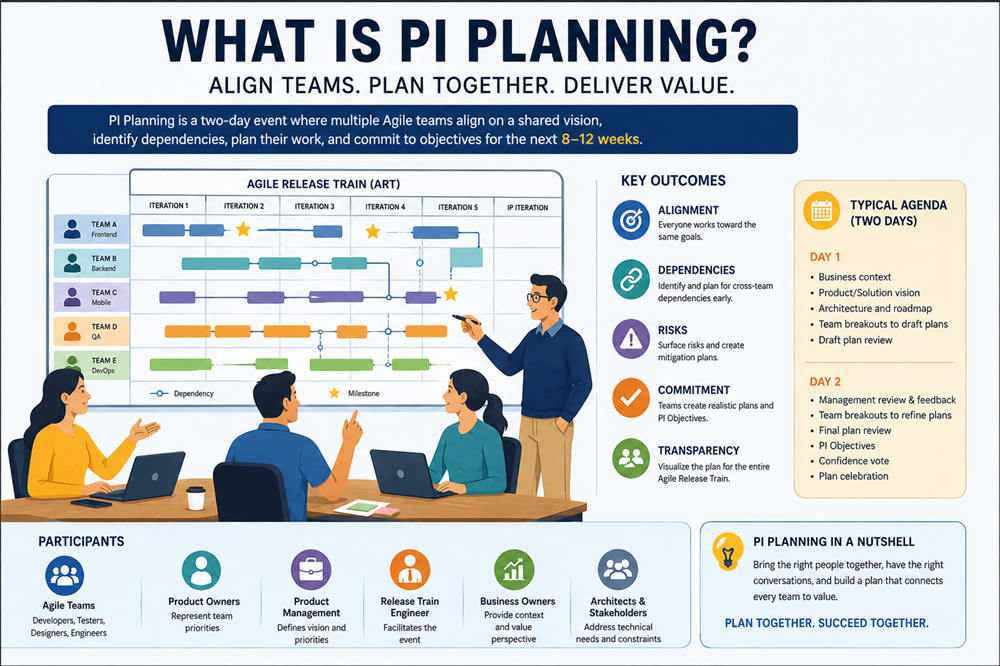
PI Planning is a structured event where several Agile teams come together to plan their work for the next few months. It helps teams agree on priorities, identify dependencies, discuss risks, and understand how their work supports larger business goals.
The practice is a core part of the Scaled Agile Framework, commonly called SAFe. It is especially useful in large organizations where many teams contribute to the same product, service, or business initiative.
Without shared planning, teams can easily work in different directions. One team may be waiting for another to finish an important feature, while a third team may not even know the dependency exists. PI Planning brings these conversations forward before work begins.
What Does PI Planning Stand For?
PI traditionally stood for Program Increment, although SAFe now uses the term Planning Interval.
A Planning Interval is usually an 8- to 12-week period during which Agile teams work toward shared objectives. It often includes several development iterations followed by an Innovation and Planning iteration.
PI Planning takes place before this interval begins. During the event, teams decide what they can realistically complete, how their work connects, and which risks need attention.
The goal is not to create a perfect plan that cannot change. It is to give everyone a clear and practical direction for the weeks ahead. This flexibility also reflects the principles behind the Agile Manifesto, which encourage teams to respond to changing needs rather than follow plans blindly.
Why Is PI Planning Important?
Planning is relatively simple when one small team controls all the work. It becomes harder when several teams are involved.
Imagine that a mobile application team needs a new API from a platform team. The platform team must first complete a security review, and the testing team needs the finished API early enough to run performance tests.
If those teams plan separately, the dependency may not become clear until work is already delayed.
PI Planning gives teams a chance to identify these connections early. It also allows leaders to compare business priorities with actual team capacity.
The event helps answer questions such as:
- What are the most important outcomes for the next interval?
- Which teams need support from one another?
- Is the planned workload realistic?
- Are there technical or business risks?
- Which deadlines and milestones matter most?
By the end of the event, teams should understand both their own responsibilities and how their work fits into the wider plan.
Official PI Planning guidance describes it as a shared event for aligning teams and stakeholders around a mission, vision, and coordinated plan. It is commonly held over two days every 8 to 12 weeks.
What Is an Agile Release Train?
PI Planning usually takes place within an Agile Release Train, or ART.
An ART is a long-term group of Agile teams working together to deliver value for the same product, solution, or business area. It is often described as a “team of teams.”
Each team may handle a different part of the work. One might focus on design, another on software development, and another on testing or infrastructure. However, their results often depend on one another.
PI Planning gives the entire ART a shared planning process instead of allowing each team to create an isolated schedule.
Who Participates in PI Planning?
The event includes the people who plan, complete, support, and approve the work.
Common participants include:
- Agile team members, such as developers, testers, designers, engineers, and analysts
- Product Owners, who explain team priorities and clarify backlog items
- Product Management, which presents product goals and major features
- The Release Train Engineer, who organizes and facilitates the event
- Business Owners, who provide business context and evaluate expected value
- Architects and technical leaders, who explain technical requirements and constraints
- Other stakeholders, such as representatives from security, operations, compliance, marketing, or customer support
Having the right people available makes it easier to resolve questions during the event. Teams do not have to pause planning while waiting days for someone to approve a decision or clarify a requirement.
What Happens During PI Planning?
PI Planning is commonly held over two days, although organizations may adjust the schedule to suit their needs.
Day One: Business Context and Draft Plans
The event usually begins with presentations that give participants a shared understanding of the upcoming work.
Leaders and product managers may discuss:
- Current business conditions
- Customer needs
- Product priorities
- Major features
- Technical direction
- Deadlines and important milestones
Teams then move into breakout sessions to build their draft plans.
During these sessions, each team reviews the proposed work and compares it with its available capacity. Team members place work into upcoming iterations, discuss possible challenges, and identify dependencies on other teams.
For example, one team may discover that it cannot begin a feature until another team completes a database update. Both teams can then agree on timing and responsibilities.
At the end of the first planning round, teams present their draft plans. This review helps reveal overloaded schedules, missing information, and conflicts between teams.
Day Two: Refinement and Final Plans
The second day focuses on improving the draft plans.
Leaders may provide updated guidance based on issues found during the first day. Teams then return to their breakout sessions and make changes.
They may:
- Remove lower-priority work
- Adjust delivery dates
- Reassign responsibilities
- Negotiate dependencies
- Clarify requirements
- Reduce risks
Each team then presents its final plan and PI Objectives.
The event often ends with a confidence vote. Participants rate how confident they are that the overall plan can be completed.
A low-confidence vote is not a failure. It is a sign that the group needs to discuss unresolved concerns, unrealistic workloads, or unclear dependencies before moving forward.
What Are PI Objectives?
PI Objectives are short statements that describe what a team expects to achieve during the Planning Interval.
Good objectives focus on outcomes rather than internal tasks.
For example:
Task-focused objective:
Complete the customer dashboard stories.
Outcome-focused objective:
Give customers a dashboard where they can view their current orders and delivery updates.
The second version explains why the work matters.
PI Objectives help leaders understand what each team plans to deliver. They also give teams a clear reference point when priorities change during the interval.
Some objectives may be marked as uncommitted. These are valuable goals that teams may complete but cannot confidently promise because of uncertainty, outside dependencies, or technical risk.
What Is an ART Planning Board?
Another important result of PI Planning is the ART planning board, sometimes called a program board.
This visual board shows how work is expected to move across the Planning Interval. It may include:
- Major features
- Planned delivery dates
- Important milestones
- Cross-team dependencies
- Work involving outside groups or suppliers
The board makes connections between teams easier to see.
For instance, if Team B needs a service from Team A before beginning its own work, the board should show that dependency. Both teams can then track it throughout the interval.
The board is not meant to replace every team’s backlog. It provides a high-level view of the work that requires coordination.
How Are Risks Managed?
Teams often discover risks while building their plans.
Common examples include:
- Limited staff availability
- Unclear requirements
- Vendor delays
- Difficult system integrations
- Security or compliance reviews
- New technology that has not been tested
- Dependence on another department
SAFe commonly uses the ROAM method to discuss these risks:
- Resolved: The issue has already been addressed.
- Owned: A person or team is responsible for managing it.
- Accepted: The group understands the risk and chooses to proceed.
- Mitigated: Steps have been identified to reduce the risk.
Not every risk can be removed. The important thing is to make it visible and decide how it will be handled.
PI Planning vs. Sprint Planning
PI Planning and sprint planning serve different purposes.
Sprint planning focuses on what one team will complete during a short sprint, which lasts one month or less under the official Scrum Guide.
PI Planning looks across several teams and covers a longer period, usually 8 to 12 weeks.
PI Planning sets the broader direction. Sprint planning turns that direction into detailed, short-term work.
The PI plan does not eliminate the need for sprint planning. Teams still review priorities, select stories, and adjust their work at the start of each sprint.
Benefits of PI Planning
When it is well prepared, PI Planning can help organizations:
- Align teams around the same priorities
- Find dependencies before they cause delays
- Match planned work with available capacity
- Make risks and assumptions visible
- Resolve important questions more quickly
- Improve communication between teams and leaders
- Connect technical work to business outcomes
One of its biggest advantages is that the people doing the work help create the plan. This usually produces a more realistic result than a schedule created only by senior leadership.
Common PI Planning Problems
PI Planning can become frustrating when the event is poorly prepared or treated as a formality.
Unclear Priorities
Teams cannot build useful plans when every feature is described as urgent. Leaders need to make clear choices about what matters most.
Too Much Presentation Time
Business and product context are important, but long presentations can leave too little time for actual team planning.
Unrealistic Workloads
Teams should plan according to their real capacity, including vacations, support work, and other responsibilities. Filling every available hour with feature work creates an unreliable plan.
Missing Decision-Makers
Planning slows down when no one present can answer important product, technical, or business questions.
Hidden Dependencies
Teams may focus only on their own work and overlook what they need from others. Dependencies should be discussed openly and shown on the planning board.
Treating the Plan as Fixed
A PI plan is based on the information available during the event. Customer needs, technical findings, and business conditions may change. Teams should update the plan when necessary rather than following it blindly.
How to Prepare for PI Planning
Good preparation makes the event more focused and productive.
Before PI Planning, organizations should:
- Clarify business and product priorities
- Prepare major features and backlog items
- Confirm team capacity and planned absences
- Identify known dependencies
- Invite the people needed to make decisions
- Prepare physical or digital planning boards
- Review technical and regulatory constraints
Remote PI Planning can also work well. Teams need reliable video communication, shared digital boards, clear facilitation, and enough time for breakout discussions.
Is PI Planning Only Used in SAFe?
PI Planning is an official part of SAFe, but its basic approach can be useful in other organizations.
Any company with several teams working toward the same outcome may benefit from meeting regularly to compare priorities, capacity, dependencies, and risks.
An organization does not have to copy every SAFe role or term. The most useful part is bringing connected teams together to build one realistic plan.
Final Thoughts
PI Planning helps multiple Agile teams agree on what they are trying to achieve and how they will work together.
A successful event should produce clear objectives, visible dependencies, practical risk plans, and a schedule that reflects real team capacity. It should guide the work without preventing teams from adjusting when new information appears.