Which Part of Your Brain Is Involved in Motivation and Goal-Directed Behavior?
Motivation does not come from one part of your brain. It develops through a connected network that evaluates rewards, measures effort, remembers past experiences, and helps you decide whether to act.
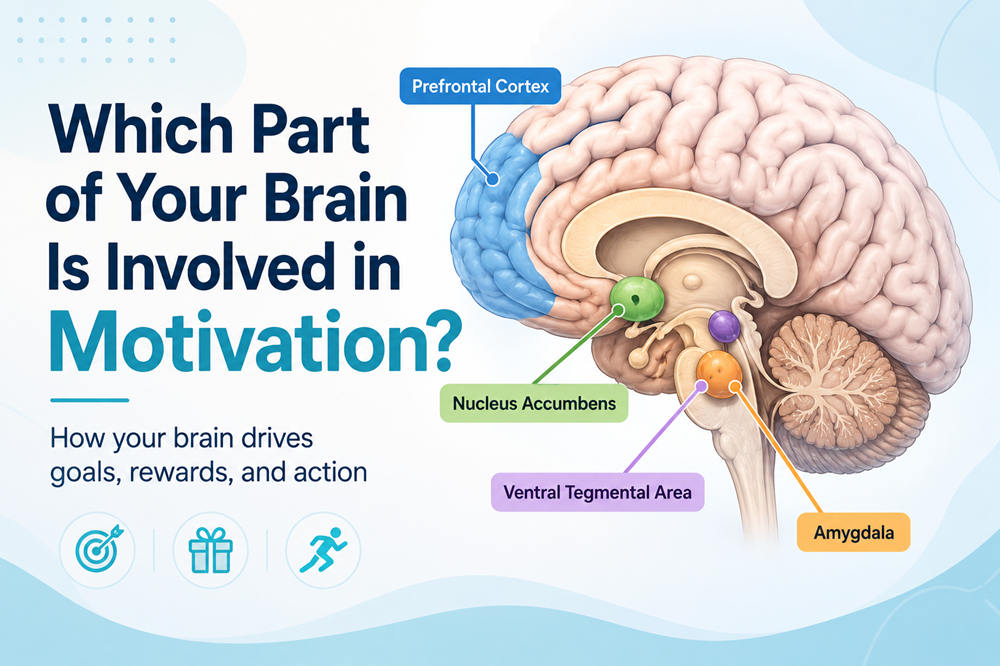
The most important areas include the ventral tegmental area, nucleus accumbens, and prefrontal cortex. Other regions influence motivation by managing emotion, physical needs, memory, habits, and persistence.
Which Part of the Brain Controls Motivation?
No single brain region controls motivation on its own. Instead, several areas work together to answer practical questions such as:
- Is this goal rewarding?
- How much effort will it require?
- Is the reward worth pursuing?
- What happened when I tried this before?
- Should I act now or choose something easier?
- Can I delay an immediate reward for a better future result?
The brain’s reward network creates interest and drive, while regions involved in planning and self-control help you turn that drive into purposeful behavior.
The three central parts of this process are the ventral tegmental area, nucleus accumbens, and prefrontal cortex.
The Ventral Tegmental Area Supports Dopamine Signaling
The ventral tegmental area, or VTA, is a small region in the midbrain. It contains many neurons that produce dopamine, a chemical messenger involved in motivation, learning, attention, and reward anticipation.
When your brain notices something potentially valuable, the VTA can send dopamine signals to other regions. These signals help direct your attention toward the opportunity and encourage you to learn from the experience.
The VTA may respond when you:
- Expect positive feedback
- Notice progress toward a goal
- Anticipate food when you are hungry
- See an opportunity to earn money
- Receive a message from someone important
- Encounter something new or interesting
The VTA does not act like an on-and-off motivation switch. It works with other brain areas to signal that a reward, goal, or experience may deserve attention.
The Nucleus Accumbens Helps Evaluate Rewards and Effort
The nucleus accumbens is strongly involved in reward-seeking behavior. It receives signals from the VTA and helps your brain decide how attractive a possible reward feels.
This region is closely connected to “wanting.” Wanting is not the same as enjoying.
You can strongly want to check a notification, buy something, or eat a snack even when the final experience brings little lasting satisfaction. Your brain may respond more strongly to the expectation of the reward than to the reward itself.
The nucleus accumbens also helps weigh potential benefits against the effort required to obtain them.
For example, you may want to exercise because you value better health, improved energy, or a sense of accomplishment. At the same time, your brain recognizes that exercising requires time and physical effort. Your motivation depends partly on how those benefits and costs are evaluated.
A reward that feels distant, uncertain, or too difficult to reach may produce less drive than one that feels immediate and achievable.
The Prefrontal Cortex Supports Planning and Self-Control
The prefrontal cortex is located at the front of the brain. It helps you plan, make decisions, manage attention, control impulses, and think about future consequences.
The reward system may make a goal feel attractive, but the prefrontal cortex helps you decide how to pursue it.
It supports your ability to:
- Set a clear goal
- Compare different options
- Organize the steps required
- Resist distractions
- Delay immediate gratification
- Adjust your plan when something goes wrong
- Continue working toward a future reward
Suppose you need to complete an important work assignment. Part of your brain may be drawn toward the immediate reward of checking social media or watching a video. Your prefrontal cortex helps you remember the deadline and choose the action that supports your longer-term goal.
This is why motivation is not only about desire. You also need planning, attention, and enough self-control to act on what matters.
The Anterior Cingulate Cortex Helps You Judge Effort
The anterior cingulate cortex helps monitor effort, errors, conflict, and changing conditions. It becomes especially important when a task is difficult or when two choices compete for your attention.
This region helps your brain notice that:
- A task is becoming harder
- Your current approach is not working
- You are making progress
- You have made a mistake
- Another choice may be more rewarding
- Continuing will require additional effort
Imagine that you are learning a difficult skill. You may begin with interest, but your motivation can fall when progress is slower than expected. The anterior cingulate cortex helps evaluate whether continuing is worth the mental or physical cost.
Visible improvement can make persistence easier because your brain receives evidence that the effort is producing a result.
The Hypothalamus Drives Basic Physical Needs
Some forms of motivation begin with your body rather than a personal goal.
The hypothalamus helps regulate hunger, thirst, sleep, body temperature, sexual behavior, stress responses, and other basic functions. It monitors signals from the body and helps create the drive to restore balance.
When you are hungry, for example, your motivation to find food becomes stronger. When you are exhausted, your need for sleep may overpower your desire to work, exercise, or study.
These physical signals can affect every other form of motivation. It is harder to concentrate on a long-term goal when your body needs food, water, rest, or relief from stress.
Taking care of basic needs is not separate from productivity. It helps create the conditions your brain needs for focused, goal-directed behavior.
The Amygdala Gives Goals Emotional Importance
The amygdala helps your brain evaluate emotional importance. It responds not only to fear and danger but also to rewards, excitement, uncertainty, and socially meaningful experiences.
Emotions affect which goals capture your attention.
You may feel motivated to prepare carefully for a presentation because success matters to you. You may also avoid giving the presentation because you fear embarrassment or judgment. The same situation can activate both approach and avoidance responses.
The amygdala helps your brain learn which experiences feel safe, rewarding, threatening, or emotionally significant. Those associations can strengthen motivation or make you hesitate.
This is one reason logic alone does not always change behavior. You may understand that an action is useful while still feeling emotionally resistant to it.
The Hippocampus Uses Memory to Shape Motivation
The hippocampus plays a major role in memory. It helps you remember what happened during past experiences and use that information when making new decisions.
If completing a difficult task previously gave you a sense of pride, that memory may encourage you to try again. If a similar situation led to failure, rejection, or stress, you may be less willing to begin.
The hippocampus also connects rewards with particular places, people, and situations. Walking into a kitchen may remind you of food. Opening a certain app may trigger the urge to scroll. Entering a familiar workspace may make it easier to settle into a productive routine.
Your motivation is therefore influenced by both the current opportunity and what your brain has learned from the past.
The Basal Ganglia Support Action and Habit Formation
The basal ganglia are involved in movement, action selection, learning, and habit formation. They help your brain choose a behavior and make repeated actions easier to perform over time.
A new behavior often requires conscious effort. You must remember what to do, decide when to do it, and push yourself to begin. With repetition, the behavior can become more automatic.
For example, you may initially need reminders to take a daily walk. After following the same routine for several weeks, starting the walk may require less thought and negotiation.
Habits matter because motivation changes from day to day. When a useful behavior becomes part of a routine, you do not need to feel inspired every time you do it.
What Does Dopamine Actually Do?
Dopamine is commonly called the brain’s pleasure chemical, but that description is too simple.
Dopamine is involved in:
- Reward anticipation
- Attention
- Learning
- Effort
- Movement
- Habit formation
- Goal-directed behavior
It helps your brain recognize clues that predict a reward. Over time, dopamine activity may shift from the reward itself to the signal that tells you the reward is coming.
For example, the sound of a notification may create an immediate urge to check your phone. Your brain has learned that the sound could lead to a message, update, or other rewarding information.
Dopamine activity can also change when an outcome is better or worse than expected. This helps the brain update its predictions and decide which actions are worth repeating.
However, higher dopamine does not automatically mean greater happiness. A person can feel a powerful desire for something without gaining much pleasure or satisfaction from it.
Why Can Motivation Suddenly Drop?
Motivation can change because your brain constantly reevaluates rewards, effort, risk, and available energy.
You may lose motivation when:
- The task feels too large
- The next step is unclear
- The reward seems too far away
- Progress is difficult to see
- You expect failure
- Distractions offer faster rewards
- You are mentally overloaded
- You are physically tired
- Stress makes the task feel threatening
- The goal no longer feels personally meaningful
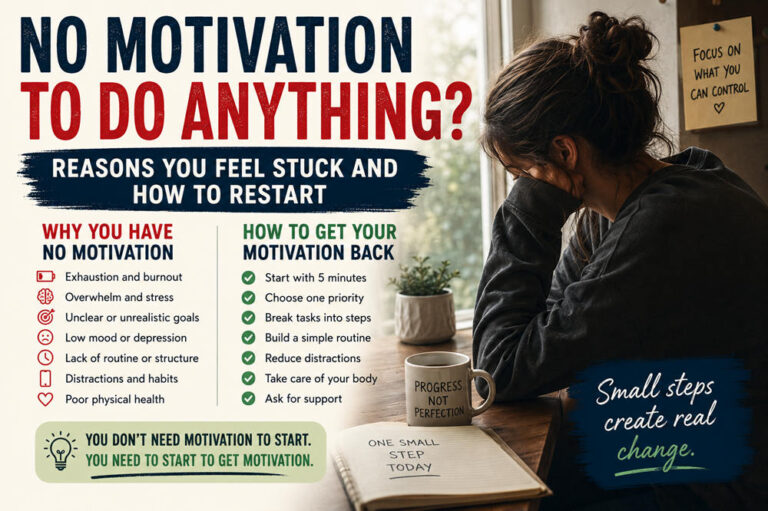
Temporary periods of low motivation are common. They often improve when you rest, clarify the goal, reduce the difficulty of the first step, or change your environment.
A persistent loss of motivation that affects work, relationships, enjoyment, or basic self-care may be connected to a physical or mental health condition. Depression, chronic stress, sleep disorders, ADHD, substance use, and some neurological conditions can all affect motivation.
Professional support may be appropriate when the problem is severe, lasts for several weeks, or interferes with everyday life.
How to Support Your Brain’s Motivation System
You cannot force motivation to appear, but you can make a goal easier for your brain to approach.
Make the First Step Smaller
A large task can feel expensive before you even begin. Reduce it to an action that requires little time or effort.
Instead of planning to exercise for an hour, begin with a five-minute walk. Instead of trying to write an entire report, open the document and create the first heading.
A small start reduces resistance and creates a clear path forward.
Make Your Progress Visible
Distant rewards can feel abstract. A checklist, calendar, tracker, or progress bar gives your brain immediate evidence that you are moving forward.
Track actions you can control rather than only final results. For example, record the number of workouts completed instead of focusing only on changes in body weight.
Create Immediate Rewards
Many important goals offer benefits months or years in the future. Small immediate rewards can help close that gap.
You might listen to a favorite podcast while exercising, take a short break after completing a work session, or mark each finished step on a visible chart.
The reward does not need to be large. It simply needs to make progress feel noticeable.
Reduce Competing Rewards
Phones, games, videos, and social media provide quick and unpredictable rewards. They can feel more attractive than tasks with slower benefits.
Make distractions less convenient. Place your phone out of reach, turn off unnecessary notifications, close unused tabs, or work in a quieter space.
Changing the environment is often easier than relying entirely on willpower.
Use Consistent Cues
Choose a reliable time, place, or event that signals when a behavior should begin.
Examples include:
- Walking after lunch
- Reading before bed
- Reviewing your budget every Friday
- Planning tomorrow before finishing work
- Practicing a skill after breakfast
Repeated cues help your brain connect a situation with a specific action.
Protect Sleep and Recovery
Lack of sleep weakens attention, decision-making, emotional control, and self-regulation. A tired brain is more likely to choose immediate comfort over a demanding long-term goal.
Rest also helps you manage frustration and maintain effort when progress is slow.
Sleep, food, movement, and breaks are not rewards you must earn. They support the brain systems that make focused action possible.
Motivation Comes From Several Connected Brain Regions
The brain regions most directly associated with motivation include the ventral tegmental area, nucleus accumbens, and prefrontal cortex. Together, they help you recognize rewards, evaluate effort, make plans, and take purposeful action.
The anterior cingulate cortex, hypothalamus, amygdala, hippocampus, and basal ganglia add information about difficulty, physical needs, emotions, memories, and habits.
Motivation is not simply a feeling that appears before you act. In many situations, it grows after you take a small step, notice progress, and repeat the behavior. Clear goals, manageable actions, healthy routines, and fewer distractions can make it easier for your brain to keep moving.