Fixed Mindset vs Growth Mindset: Key Differences and How They Affect Learning
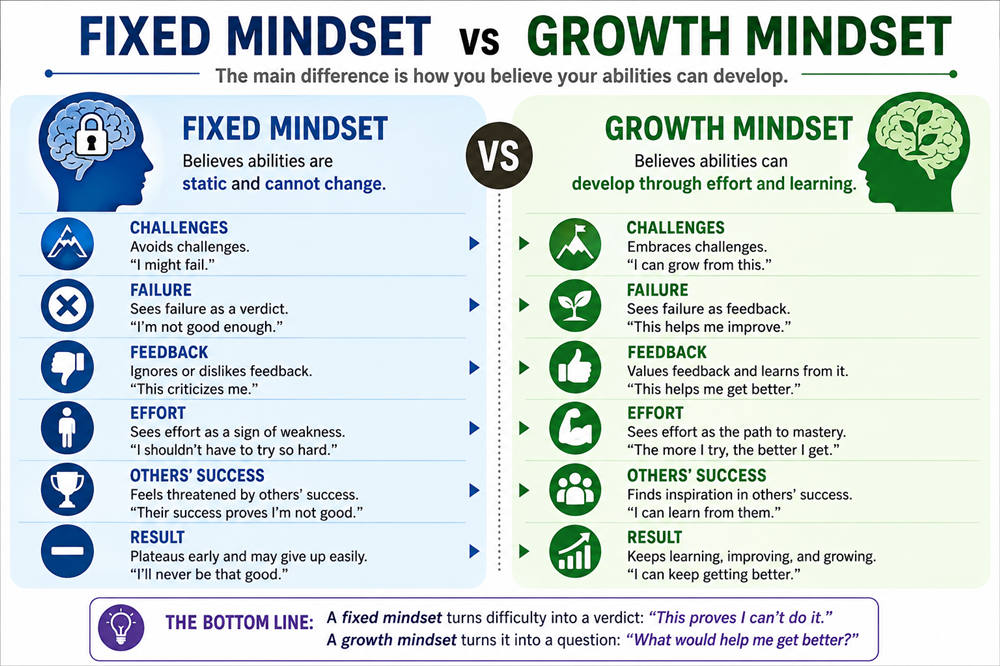
The difference between a fixed mindset vs growth mindset is mainly about how you view your ability to improve. With a fixed mindset, you tend to see intelligence, talent, or skill as relatively set. With a growth mindset, you believe those abilities can develop through learning, practice, better strategies, feedback, and experience.
Neither mindset guarantees failure or success. The important difference is often what happens when you face something difficult. Do you see the struggle as proof that you are not good enough, or as a sign that you still have something to learn?
What Is a Fixed Mindset?
A fixed mindset is the belief that abilities such as intelligence or talent are relatively stable and difficult to change.
You may notice fixed-mindset thinking in statements like:
- “I’m just bad at math.”
- “I’m not a creative person.”
- “I’m not good at public speaking.”
- “If I were talented, this wouldn’t be so hard.”
- “I failed, so maybe I’m not capable of doing this.”
The problem is not having an occasional negative thought. Everyone does that.
The bigger issue is what you do because of the thought. If you believe your ability cannot improve much, you may avoid difficult tasks, hide mistakes, or quit sooner because struggling feels like evidence that you simply do not have what it takes.
What Is a Growth Mindset?
A growth mindset is the belief that your abilities can develop.
It does not mean that everyone can become equally good at everything. People have different strengths, opportunities, resources, interests, and limitations.
Instead, a growth mindset means recognizing that where you are now does not necessarily determine where you can end up.
Your thoughts might sound more like:
- “I don’t understand this yet.”
- “I need more practice.”
- “Maybe I need a different approach.”
- “What can I learn from this mistake?”
- “Who could give me useful feedback?”
The Stanford Center for Teaching and Learning explains growth mindset in terms of seeing intelligence and talent as abilities that can develop while treating challenges and failures as opportunities to continue learning.
Fixed Mindset vs Growth Mindset at a Glance
| Situation | Fixed Mindset | Growth Mindset |
|---|---|---|
| A task feels difficult | “Maybe I’m not good at this.” | “What do I need to learn?” |
| You make a mistake | “I messed up because I’m bad at it.” | “What caused the mistake?” |
| You receive criticism | “They’re saying I’m not good enough.” | “Is there useful feedback here?” |
| You need to work hard | “Maybe I don’t have the talent.” | “Learning this may take practice.” |
| Someone else succeeds | Their success may feel threatening | Their approach may offer useful ideas |
| Your strategy fails | You may want to stop | You try another method |
| You are learning something new | “I’m not naturally good at this.” | “I’m still learning this.” |
These are tendencies, not permanent personality types.
You can have a growth mindset in one part of your life and a fixed mindset in another.
How Each Mindset Handles Challenges, Failure, and Feedback
The differences become especially clear when things stop going smoothly.
Imagine you start a new job and have trouble learning unfamiliar software.
A fixed-mindset response might be:
“Everyone else understands this. Maybe I’m just not technical.”
You may feel embarrassed about asking questions because doing so seems to confirm that you lack ability.
A more growth-oriented response would be:
“I don’t know how to use this efficiently yet. I need more practice or someone to show me the parts I don’t understand.”
The software has not become easier. What changed is how you interpret the difficulty.
Failure
A fixed mindset can turn failure into a judgment about who you are.
For example:
“I failed the exam because I’m not smart enough.”
That leaves you with few useful next steps.
A growth mindset looks for specific causes:
“I didn’t understand two of the main topics.”
“My study method wasn’t effective.”
“I started studying too late.”
Once you identify what went wrong, you have something you can work on.
Feedback
The same difference can appear when someone criticizes your work.
If you feel that you must prove you are already talented or competent, criticism can feel personal. Your first reaction may be to defend yourself or dismiss the person giving the feedback.
A growth mindset does not mean enjoying criticism or agreeing with all of it.
It simply encourages you to ask:
“Is there anything here that can help me improve?”
Some feedback is poor. Some is unfair. But useful criticism becomes easier to consider when you do not treat comments about your current performance as permanent judgments about your ability.
Growth Mindset Does Not Mean “Just Try Harder”
This is one of the most common misunderstandings about growth mindset.
Effort matters, but effort by itself is not enough.
Imagine studying for six hours using a method that does not help you remember the material. Studying for another six hours in exactly the same way may not produce a much better result.
Improvement can require:
- practice,
- effective strategies,
- helpful feedback,
- good instruction,
- access to resources,
- asking for help,
- and changing your approach when something is not working.
Stanford’s guidance on growth mindset and learning also cautions against reducing the idea to praising effort alone. Effective strategies, practice, constructive feedback, and opportunities to improve all matter.
Instead of only asking, “Did I try hard enough?”, ask:
“What could I do differently next time?”
That question is usually more useful.
Can a Growth Mindset Improve Performance?
A growth mindset can be helpful, but research does not support treating it as a guaranteed path to higher grades or success.
A large national growth-mindset experiment published in Nature involving U.S. ninth-grade students found benefits for lower-achieving students and an increase in advanced mathematics enrollment. The results also showed that the surrounding school environment influenced how well the intervention worked.
However, the broader research picture is more complicated.
One 2023 systematic review and meta-analysis found that the average academic effects of growth-mindset interventions were very small and that effects were not statistically significant when researchers restricted their analysis to the highest-quality evidence.
Another systematic review and meta-analysis of growth-mindset interventions found small academic benefits under certain conditions, particularly when interventions targeted groups expected to benefit and were implemented with high fidelity.
So growth mindset is best understood as one useful part of learning and improvement, not a magic technique.
Your environment matters. Teaching quality matters. Resources matter. Health, finances, opportunities, support, and other circumstances matter too.
Thinking differently cannot remove every barrier.
Everyday Examples of Fixed Mindset vs Growth Mindset
You can see the difference in ordinary situations.
At School
Fixed mindset:
“I’m terrible at writing.”
Growth mindset:
“My essays aren’t organized well yet. I need to work on structure.”
The second response turns a broad label into a specific skill you can practice.
At Work
Fixed mindset:
“I’m not leadership material.”
Growth mindset:
“I need more experience handling difficult conversations and making decisions.”
You are no longer treating leadership as something you either naturally have or do not have.
Learning Technology
Fixed mindset:
“I’m too old to understand this.”
Growth mindset:
“This is unfamiliar, so I may need more time to learn it.”
Exercise
Fixed mindset:
“I’ve never been athletic.”
Growth mindset:
“My fitness level is low right now, so I’ll start gradually.”
After Making a Mistake
Fixed mindset:
“I always mess things up.”
Growth mindset:
“What caused the mistake, and how can I prevent it next time?”
The growth version does not pretend the mistake did not happen. It simply gives you something useful to do with it.
How to Develop More of a Growth Mindset
You do not need to completely change your personality.
Start by noticing how you talk to yourself when something becomes difficult.
Notice Permanent-Sounding Statements
Watch for phrases such as:
- “I can’t do this.”
- “I’ve never been good at this.”
- “I’m just not that kind of person.”
- “I’ll never understand it.”
Then make the statement more specific.
Instead of:
“I’m bad at presentations.”
Try:
“I get nervous during presentations and need more practice speaking in front of people.”
The second statement describes a problem you can actually work on.
Use “Yet” When It Makes Sense
Compare:
“I don’t understand this.”
with:
“I don’t understand this yet.”
The word does not magically solve the problem. It simply stops you from treating your current difficulty as the final result.
Using “yet” is also one of the practical strategies included in Stanford’s growth mindset guidance for students.
Ask Better Questions After a Setback
Rather than asking:
“Why am I so bad at this?”
try questions such as:
- What went wrong?
- What did I do well?
- What am I missing?
- Do I need more practice?
- Should I try a different strategy?
- Who could help me understand this?
- What will I do differently next time?
These questions shift your attention from judging yourself to solving the problem.
Choose Challenges You Can Learn From
Growth does not mean choosing the hardest possible task every time.
A challenge should stretch your ability while still giving you a realistic opportunity to learn.
If you have just started running, for example, gradually increasing your distance makes more sense than attempting a marathon immediately.
Treat Mistakes as Information
You do not need to celebrate mistakes.
You need to learn from them.
When something goes wrong, ask what caused it. If you can identify the reason, you may be able to change your preparation, technique, timing, or strategy the next time.
You Can Have Both Mindsets
You do not have to label yourself as either a “fixed-mindset person” or a “growth-mindset person.”
Most people show both patterns. Stanford’s teaching guidance similarly notes that people can have a combination of fixed and growth mindsets depending on the situation.
You may have a growth mindset about your career because you have watched your skills improve over several years. At the same time, you might insist that you could never learn to draw, dance, cook, or speak another language.
Your response can also change depending on the situation.
Stress, embarrassment, competition, repeated setbacks, or fear of judgment can make fixed thinking more likely.
The goal is not to maintain a perfect growth mindset every minute.
It is to notice when fixed thinking is stopping you from trying, learning, asking for help, or changing your approach.
Why the Difference Matters
The biggest difference between a fixed mindset and a growth mindset is not whether you struggle.
Everyone struggles.
A fixed mindset can turn difficulty into a verdict:
“This proves I can’t do it.”
A growth mindset turns it into a question:
“What would help me get better?”
That question does not guarantee success. But it gives you a practical next step—and often, that is what keeps learning moving forward.