What Is Logistic Growth? How Populations Grow, Slow Down, and Reach Limits
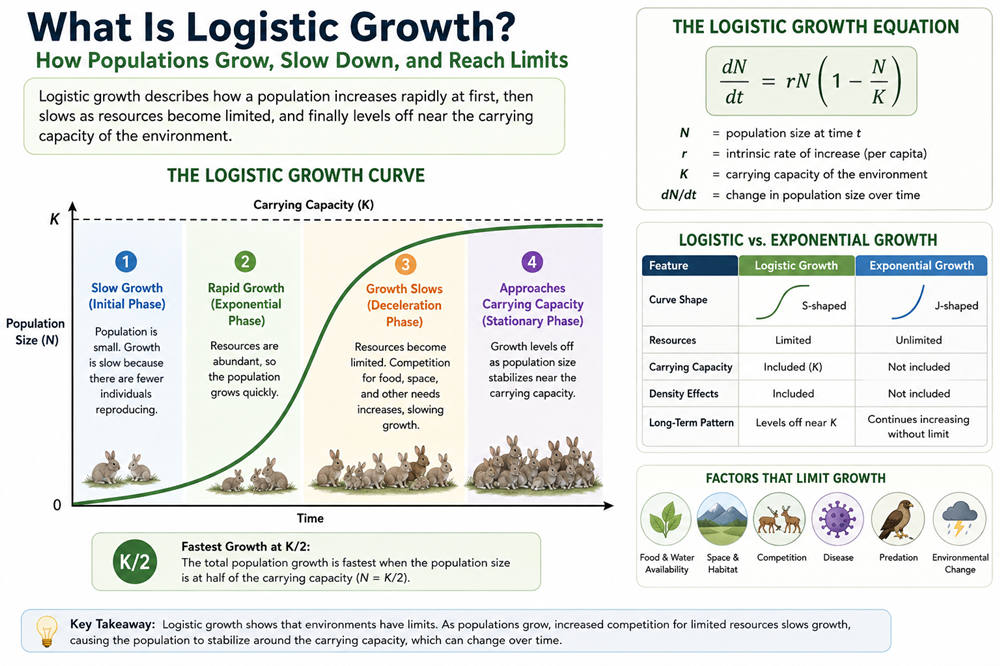
Logistic growth describes a pattern in which a population increases quickly when resources are plentiful, then grows more slowly as food, space, water, or other resources become harder to obtain. Instead of growing without limit, the population approaches the maximum level its environment can support.
When shown on a graph, logistic growth usually produces an S-shaped, or sigmoid, curve. The standard logistic growth model starts with rapid growth and gradually approaches a limit called carrying capacity.
What Is Logistic Growth?
Logistic growth is population growth that becomes slower as population density increases and the population approaches carrying capacity.
Imagine a small population entering a habitat with abundant food and plenty of space. At first, there is little competition, so reproduction can increase the population rapidly.
Conditions change as the population becomes larger. More individuals depend on the same limited resources, and factors such as competition, disease, or shortages begin to affect survival and reproduction.
The result is not unlimited growth. Instead, the growth rate gradually declines as the population approaches the level the environment can support.
Researchers commonly describe this density-dependent population growth using two important parameters: r, the intrinsic growth rate, and K, the carrying capacity.
How the Logistic Growth Curve Works
A logistic growth graph has a characteristic S shape, but you can understand it without memorizing the graph.
Growth Starts Slowly
A very small population may increase slowly simply because there are relatively few individuals reproducing.
For example, ten animals cannot produce as many total offspring during a given period as a population of several hundred animals, even if each individual has the same reproductive potential.
Growth Becomes Rapid
As the population becomes larger, more individuals are capable of reproducing.
If resources are still abundant, the population may enter a period of rapid growth that looks similar to exponential growth.
When population size is much smaller than carrying capacity, the limiting effect in the logistic model is weak, so growth can initially resemble exponential growth.
Growth Begins to Slow
Rapid growth cannot continue indefinitely in an environment with finite resources.
As population density rises, individuals may face greater competition for food, water, shelter, territory, nutrients, or other necessities. Research on resource availability and density dependence illustrates how resources can influence population density and population dynamics.
The Population Approaches Carrying Capacity
Eventually, population growth becomes very small as the population approaches carrying capacity.
In the basic logistic model, the population approaches this limit rather than continuing upward forever. The upper part of the curve therefore becomes progressively flatter.
What Is Carrying Capacity?
Carrying capacity is the population level an environment can support under a given set of conditions. In the logistic equation, it is represented by K.
Carrying capacity depends on resources and environmental conditions. Food availability, water, habitat, nutrients, shelter, and other factors can influence how many individuals an area can support.
For example, suppose a habitat can support roughly 800 rabbits under its current conditions. A rabbit population of 100 may have plenty of room to expand. As the population moves closer to 800, however, competition for available resources becomes stronger.
It is important not to treat carrying capacity as a permanent number carved into nature. Research on carrying capacity in heterogeneous environments shows that resource distribution, movement, growth rates, and environmental differences can make carrying capacity more complicated than a single fixed number.
A drought might reduce available food and water, lowering the number of animals a habitat can support. Improved habitat or increased resources could have the opposite effect.
The Logistic Growth Equation
The standard logistic growth equation is:
dN/dt = rN(1 − N/K)
The terms mean:
- N = current population size
- r = intrinsic rate of population increase
- K = carrying capacity
- dN/dt = change in population size over time
This equation captures the main idea behind logistic growth. The factor (1 − N/K) reduces growth as N becomes larger relative to K. The same basic relationship appears in mathematical research using logistic population models.
If N is very small compared with K, N/K is close to zero. The limiting effect is therefore weak, and the population can grow rapidly.
If N gets close to K, N/K approaches 1. That makes (1 − N/K) approach zero, so net population growth slows.
At N = K, the standard equation gives a net growth rate of zero.
When Is Logistic Population Growth Fastest?
One useful detail is often missed in basic explanations of logistic growth.
The total increase in population is greatest when the population is at half of carrying capacity, or:
N = K/2
You can see this from the logistic equation because the growth term N(1 − N/K) reaches its maximum at K/2.
For example, if carrying capacity is 1,000 individuals, the model predicts the fastest total population increase around a population size of 500.
After that point, the population can still increase, but the amount added during each unit of time becomes smaller as the population approaches K.
This does not mean individual organisms suddenly reproduce fastest at K/2. It refers to the net increase of the population as a whole under the assumptions of the logistic model.
A Simple Logistic Growth Example
Suppose 20 rabbits are introduced into a large habitat with plenty of grass, water, shelter, and few competitors.
At first, the population is small. As the rabbits reproduce, their numbers rise more quickly.
The population might grow from 20 to 50, then 100, 200, and several hundred.
Eventually, however, the rabbits begin competing more heavily for grass, territory, and shelter. Food may not replenish as quickly as it is consumed, and crowding can make other population pressures more important.
If the habitat’s carrying capacity is around 800 rabbits, population growth should slow as the number approaches that level.
The population would not necessarily remain at exactly 800 animals. Real populations can move above and below their estimated carrying capacities as conditions change.
Logistic Growth vs. Exponential Growth
Logistic and exponential growth describe two different ways a population can increase.
| Feature | Logistic Growth | Exponential Growth |
|---|---|---|
| Curve shape | S-shaped | J-shaped |
| Resources | Limited | Treated as effectively unlimited |
| Carrying capacity | Included | Not included |
| Density effects | Included | Not included in the basic model |
| Long-term pattern | Growth slows near K | Growth continues accelerating |
Exponential Growth
Exponential growth assumes that the population can keep increasing at a constant per-capita rate without a density-dependent limit stopping it.
As the population becomes larger, more individuals reproduce, so the number added during each period becomes larger.
This produces a J-shaped growth curve.
Logistic Growth
Logistic growth adds a limit to that process.
When the population is small relative to carrying capacity, logistic and exponential growth can look very similar. The difference becomes much clearer as the population increases and density-dependent effects begin slowing growth.
What Limits Logistic Growth?
The logistic model represents the general effect of increasing population density, but real ecosystems contain many specific limiting factors.
Food and Water
More individuals consuming a limited food or water supply creates competition. Shortages can reduce survival, reproductive success, or both.
Space and Habitat
Animals may need territory, nesting areas, shelter, or access to feeding grounds.
Plants also compete for space, sunlight, water, and soil nutrients.
Competition
Competition can occur between members of the same species or between different species using similar resources.
As population density rises, competition within a species often becomes more intense.
Disease
Crowded populations may create conditions in which some infectious diseases spread more easily.
Disease can therefore influence survival and population growth, although the effect varies greatly between species and ecosystems.
Predation
Predator-prey relationships can also affect population numbers.
An abundant prey population may support larger predator populations, which can increase pressure on the prey species.
Environmental Change
Droughts, fires, floods, severe winters, habitat loss, changing nutrient supplies, and other environmental changes can alter both population growth and the resources available to support a population.
Do Real Populations Follow Perfect Logistic Curves?
Usually not.
The logistic equation is a model, which means it simplifies reality so that an important pattern is easier to understand and analyze.
The basic model assumes a relatively simple relationship between population density and growth. Natural populations deal with changing weather, migration, age structure, predators, disease, delayed responses, habitat differences, and many other influences.
Modern studies of logistic-growth models and fluctuating carrying capacity show why real population dynamics can be more complicated than a smooth textbook S-curve.
Populations may overshoot carrying capacity, fall below it, or fluctuate rather than settling smoothly at one number. Carrying capacity itself may also vary as resources and environmental conditions change.
That does not make the logistic model useless. It simply means the S-shaped curve is a simplified framework for understanding how density and limited resources can slow population growth.
Why Logistic Growth Matters
Logistic growth helps explain one of the basic limits on population increase: a population cannot keep expanding at the same rate when the resources supporting it are finite.
The model gives ecologists a simple way to connect population size, growth rate, density dependence, and carrying capacity.
It is especially useful for understanding why a population may grow almost exponentially when small but slow considerably after becoming more crowded.
The key distinction is simple: exponential growth assumes continuing growth without a density-dependent ceiling, while logistic growth includes a limiting effect that becomes stronger as the population approaches carrying capacity.