
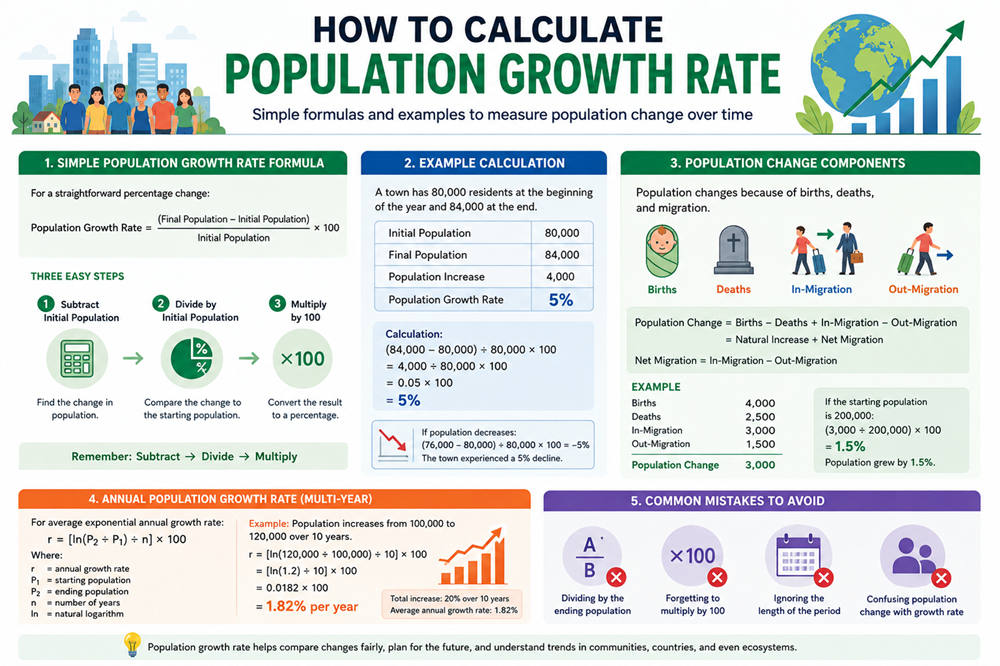
How to Calculate Population Growth Rate With Simple Formulas and Clear Examples
Population growth rate helps you see how much a population has increased or decreased over a specific period. Instead of looking only at the number of people gained or lost, the growth rate expresses that change as a percentage.
For a simple population percentage change, you subtract the starting population from the ending population, divide by the starting population, and multiply by 100. If you need an average annual rate covering several years, the calculation is slightly different.
What Is Population Growth Rate?
Population growth describes a change in the size of a population over time. A population can grow, decline, or remain relatively stable.
A positive rate means the population increased. A negative rate means it decreased, while 0% means the starting and ending populations were the same.
For a simple comparison between two population totals, you are essentially calculating percentage population change. Formal demographic datasets may use an annualized exponential growth rate when reporting population growth across time. The United Nations describes average annual population change as an exponential rate of growth over a given period, while the World Bank also uses exponential methods for population growth indicators.
How to Calculate Population Growth Rate
For a straightforward percentage change, use:
Population Growth Rate = [(Final Population − Initial Population) ÷ Initial Population] × 100
You only need three steps.
1. Subtract the Initial Population
First, find how much the population changed.
Population Change = Final Population − Initial Population
If a population rises from 50,000 to 52,500:
52,500 − 50,000 = 2,500
The population increased by 2,500 people.
2. Divide by the Initial Population
Divide the amount of change by the population you started with:
2,500 ÷ 50,000 = 0.05
Always use the initial population as the denominator when calculating a simple percentage increase or decrease.
3. Multiply by 100
Convert the decimal to a percentage:
0.05 × 100 = 5%
The population increased by 5% over the period.
A simple way to remember the process is:
Subtract → Divide by the starting population → Multiply by 100
Population Growth Rate Example
Suppose a town has 80,000 residents at the beginning of a year and 84,000 residents at the end.
Start by finding the population change:
84,000 − 80,000 = 4,000
Then divide by the original population:
4,000 ÷ 80,000 = 0.05
Convert it to a percentage:
0.05 × 100 = 5%
So, the town’s population grew by 5% during the year.
| Population Information | Amount |
|---|---|
| Initial population | 80,000 |
| Final population | 84,000 |
| Population increase | 4,000 |
| Population growth | 5% |
The same formula also works when the population decreases.
If a town falls from 80,000 residents to 76,000:
76,000 − 80,000 = -4,000
Then:
(-4,000 ÷ 80,000) × 100 = -5%
The town experienced a 5% population decline.
Calculating Population Change Using Births, Deaths, and Migration
Population totals change mainly because of births, deaths, and people moving into or out of an area. The U.S. Census Bureau Population Estimates Program uses current data on births, deaths, and migration to calculate population change after the most recent census.
A useful basic equation is:
Population Change = Births − Deaths + In-Migration − Out-Migration
Here:
- Births add people to the population.
- Deaths reduce the population.
- In-migration means people moving into an area.
- Out-migration means people moving away.
The difference between in-migration and out-migration is called net migration.
You can therefore simplify the equation to:
Population Change = Natural Increase + Net Migration
Natural increase is:
Births − Deaths
Net migration is:
In-Migration − Out-Migration
The Census Bureau’s population-estimation approach follows this basic logic by starting with a population base, adding births, subtracting deaths, and accounting for net migration.
Example
Imagine a community begins the year with 200,000 residents and records:
- 4,000 births
- 2,500 deaths
- 3,000 people moving in
- 1,500 people moving out
Natural increase:
4,000 − 2,500 = 1,500
Net migration:
3,000 − 1,500 = 1,500
Total population change:
1,500 + 1,500 = 3,000
Now calculate the percentage change:
(3,000 ÷ 200,000) × 100 = 1.5%
The community’s population grew by 1.5% during the year.
Using in-migration and out-migration rather than only immigration and emigration is useful when discussing cities, counties, or states. Migration within the same country can change a local population even though it does not change the country’s total population. The Census Bureau’s population estimates and projections include demographic components such as births, deaths, and migration.
How to Calculate Annual Population Growth Rate
A common mistake is treating total growth over several years as if it were the growth rate for each year.
Suppose a city’s population increases from 100,000 to 120,000 over 10 years.
Using the simple percentage-change formula:
[(120,000 − 100,000) ÷ 100,000] × 100 = 20%
The population increased 20% over the entire 10-year period.
It did not grow by 20% every year.
For an average exponential annual growth rate, you can use:
r = [ln(P₂ ÷ P₁) ÷ n] × 100
Where:
- r = annual growth rate
- P₁ = starting population
- P₂ = ending population
- n = number of years
- ln = natural logarithm
The World Bank explains that population is among the demographic indicators for which an exponential growth model can be used to calculate growth between two points in time.
Using our example:
P₁ = 100,000
P₂ = 120,000
n = 10 years
The average exponential growth rate is approximately:
1.82% per year
That means the population increased by 20% overall, while its average exponential annual growth rate was about 1.82% per year.
This distinction matters whenever you compare population changes across periods of different lengths.
You can also explore reported annual population growth figures through the World Bank population growth data, which provides country-level annual percentage data.
What Does Population Growth Rate Tell You?
A growth rate makes it easier to compare populations of different sizes.
Imagine two towns each gain 5,000 people.
Town A starts with 50,000 residents:
(5,000 ÷ 50,000) × 100 = 10%
Town B starts with 500,000 residents:
(5,000 ÷ 500,000) × 100 = 1%
Both towns added exactly 5,000 residents, but Town A grew much faster relative to its original size.
Population trends also matter when planners consider housing, transportation, schools, infrastructure, and public services. The Census Bureau notes that population projections are based on assumptions about future births, deaths, domestic migration, and net international migration.
Population growth is important outside human demographics as well. Ecologists study changes in plant and animal populations to understand whether populations are growing, shrinking, or staying relatively stable.
More advanced ecological models may consider reproduction, mortality, competition, available resources, and carrying capacity. The U.S. Geological Survey describes carrying capacity as an important concept in population ecology and population-growth modeling.
Common Mistakes When Calculating Population Growth Rate
The math is simple, but a few errors can easily produce the wrong answer.
Dividing by the Ending Population
For simple percentage change, divide by the initial population, not the final population.
If a population grows from 10,000 to 11,000, the increase is 1,000.
Correct:
(1,000 ÷ 10,000) × 100 = 10%
The starting population is the baseline from which you measure the change.
Forgetting to Multiply by 100
Your first answer may appear as a decimal.
For example:
500 ÷ 10,000 = 0.05
To express it as a percentage:
0.05 × 100 = 5%
Ignoring the Length of the Period
A 20% increase over two years is very different from a 20% increase over 20 years.
Always check the dates attached to your starting and ending populations before comparing growth rates. When a source reports an annual growth rate, check its methodology rather than assuming it simply divided the total percentage change by the number of years.
Confusing Population Change With Population Growth Rate
Population change is the actual number of people gained or lost.
Population growth rate expresses that change relative to the original population.
For example, growing from 40,000 to 42,000 means:
Population increase = 2,000 people
Population growth = 5%
Both numbers describe the same population change, but they answer different questions.
A Quick Way to Remember the Formula
For a basic population percentage-change question, remember:
Subtract → Divide → Multiply
Subtract the starting population from the ending population, divide the result by the starting population, and multiply by 100.
If the figures cover several years and the question specifically asks for an average annual population growth rate, check whether an annualized or exponential formula is expected instead.
Knowing that difference helps you calculate population growth correctly without confusing the total change over a period with the rate of growth per year.