
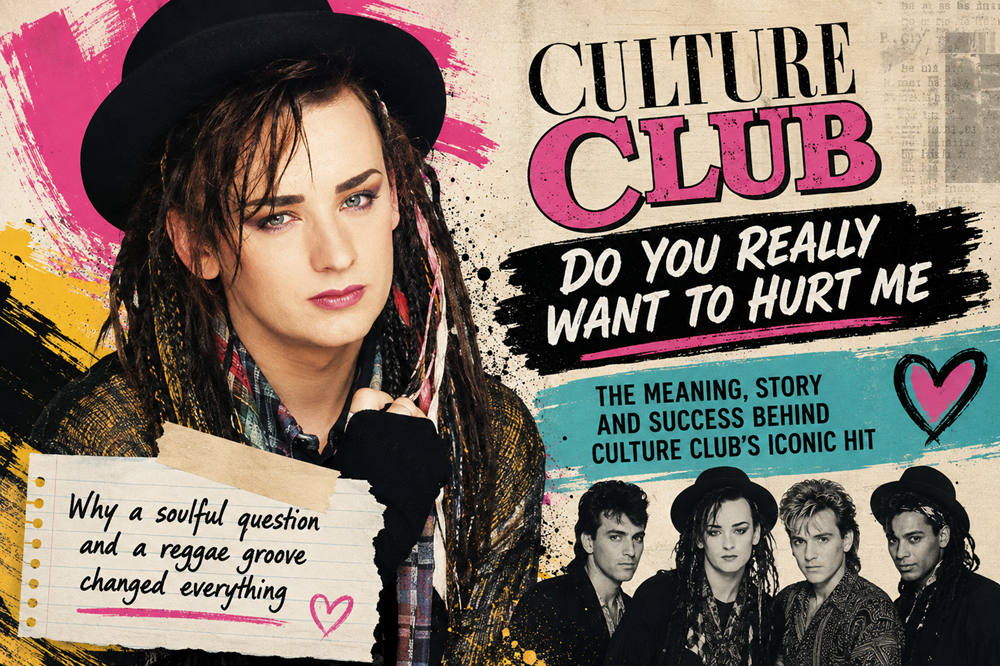
Culture Club’s Do You Really Want to Hurt Me Meaning, Story, and Success Explained
Culture Club’s “Do You Really Want to Hurt Me” pairs a soft reggae-influenced groove with a much heavier subject: being emotionally hurt by someone you still love. Released in 1982, the song became Culture Club’s breakthrough and introduced Boy George’s distinctive voice and image to a worldwide audience.
What makes the song last, though, is not simply its chart success. Its central question captures something painfully familiar—the confusion of caring about someone while wondering why that person keeps hurting you.
What Is “Do You Really Want to Hurt Me”?
“Do You Really Want to Hurt Me” appeared on Culture Club’s debut album, Kissing to Be Clever. It was the group’s third single after “White Boy” and “I’m Afraid of Me,” neither of which had made much commercial impact. Producer Steve Levine later described the third release as the record that finally pushed Culture Club to another level.
The song entered the UK singles chart in September 1982 and quickly climbed from No. 66 to No. 38, No. 15, No. 3, and No. 2 before reaching No. 1. According to Official Charts, it remained at the top for three weeks and spent 19 weeks on the UK chart.
In the United States, it became Culture Club’s first single release and eventually reached No. 2 on the Billboard Hot 100.
The success was especially surprising because Boy George had not wanted the song released as a single.
What Does “Do You Really Want to Hurt Me” Mean?
At its heart, “Do You Really Want to Hurt Me” is about vulnerability inside a troubled romantic relationship.
The narrator is not looking back calmly after everything has ended. He still feels emotionally connected to the other person and is trying to understand why someone he cares about is causing him pain.
That gives the song its mixture of sadness, confusion, longing, and frustration.
The title itself works because it sounds like a genuine question rather than an angry accusation. The narrator is asking whether the hurt is intentional and whether the other person understands what their behavior is doing to him.
Boy George later described many of his early songs as coming from a period when he often saw himself as the wounded person in relationships. In a 2015 interview with The Guardian, he looked back on how those personal experiences shaped his songwriting.
That perspective helps explain why the song feels so exposed. It is not a revenge song or a celebration of moving on. It captures the point where someone knows a relationship is painful but has not yet emotionally detached from it.
Who Was “Do You Really Want to Hurt Me” About?
The answer is less clear than it might appear because Boy George has given different accounts over the years.
In a 2007 retrospective for The Guardian, George connected the song to Culture Club drummer Jon Moss, with whom he had been romantically involved. He also described the song in the context of difficult relationships from that period of his life.
Eight years later, George gave a different account.
During a 2015 interview alongside Moss, Moss said he assumed the song was about him. George directly disagreed and said he had written it about another former partner, Kirk Brandon.
Because George’s own explanations have changed, it is more accurate to treat the exact inspiration as disputed rather than definitively naming one person.
What remains consistent is that the lyrics grew from George’s real experiences with difficult relationships. That personal foundation is more important to understanding the song than settling exactly which relationship inspired every line.
The Story Behind the Song
Boy George remembered the idea developing while he was in a flat in central London. He wrote down some early lyrics and kept them with him as the song gradually took shape.
Yet once Culture Club had recorded it, George was far from convinced it should become a single.
He considered it too personal, too slow, and too far removed from the dance-oriented music he assumed Culture Club’s audience wanted. He even protested the record company’s decision to release it.
He was wrong—and he later admitted as much.
The enormous response showed him that writing about something deeply personal could actually make a song easier for strangers to relate to. Instead of limiting its audience, the vulnerability became one of its strengths.
That lesson became important to George as a songwriter. The specific relationship belonged to him, but the emotion did not.
How Culture Club Created the Song’s Reggae Sound
The musical arrangement is a major reason “Do You Really Want to Hurt Me” stands apart from many early-1980s pop hits.
Rather than placing Boy George’s emotional vocal over a heavy rock arrangement, Culture Club built the song around a relaxed rhythm influenced by reggae and lovers rock.
Jon Moss recalled that the group had been experimenting with an early drum machine when a rhythm caught their attention. Since the members already loved reggae, they began developing the song in that direction.
The recording story documented by Mix provides an even clearer picture of how the track evolved.
An early demo used a Roland CompuRhythm CR-78 drum machine, while Mikey Craig’s reggae-influenced bass line helped define the groove from the beginning. Roy Hay added the clipped guitar rhythm, and Boy George was interested in the dub-style vocal echoes he had heard on reggae records.
Levine said the band never formally decided that they were making a reggae song. Instead, those elements naturally pushed the recording in that direction.
The result was a clever contrast. The rhythm is warm and unhurried, while the lyrics deal with rejection and emotional pain.
Boy George’s Vocal Was Recorded Live With the Band
Boy George’s vocal gives the song much of its emotional character.
Instead of belting every line, he sings with restraint. That makes the vulnerability feel more convincing because the performance never needs to become overly dramatic.
According to Steve Levine’s account of the original recording sessions, the main vocal on the finished studio recording was captured in one continuous take while the band played live. There were no edits piecing together different lead-vocal performances.
Levine also used dub-style echo on George’s voice, helping it sit naturally inside the reggae-influenced arrangement. The production leaves plenty of space around the vocal rather than burying it beneath instruments.
Helen Terry’s backing vocals were added separately and became another important part of the Culture Club sound.
The production is detailed, but it never distracts from the central performance. You mostly hear the voice, bass, rhythm, and atmosphere working together.
How “Do You Really Want to Hurt Me” Became Culture Club’s Breakthrough
A major turning point came when Culture Club appeared on the British television show Top of the Pops.
Boy George later recalled the appearance and the intense reaction that followed. His clothing, makeup, and androgynous appearance attracted almost as much attention as the music.
George performed barefoot, wearing makeup and presenting an image that immediately caught the attention of the British press. While some newspaper coverage focused heavily on his appearance, audiences responded enthusiastically.
The song’s chart movement was dramatic. It went from No. 66 in its first UK chart week to No. 38, then No. 15, No. 3, No. 2, and finally No. 1. Its complete UK chart history shows just how quickly the single gained momentum.
Suddenly, a band whose first two singles had struggled had one of the biggest records in the country.
International success followed. The single eventually reached No. 2 in the United States, helping establish Culture Club as one of the prominent British pop acts of the early 1980s.
The “Do You Really Want to Hurt Me” Music Video
The music video gave the song another layer of meaning.
Rather than simply showing Culture Club performing, it presents Boy George as someone repeatedly being judged and treated like an outsider. Courtroom scenes reinforce the idea of a person facing judgment from people who do not understand or accept him.
That makes the video broader than the romantic story suggested by the lyrics. The feeling of being hurt becomes connected to social rejection as well as a difficult relationship.
One element of the video has aged particularly poorly. A courtroom sequence includes performers in blackface. Director Julien Temple later explained the imagery as satire directed at prejudice and hypocrisy, but the choice was controversial, particularly when the video reached American audiences. A GRAMMY retrospective on Kissing to Be Clever also discusses the video’s imagery and its reception.
It is an uncomfortable part of the video’s history, but one that should not be left out when discussing how the visual is viewed today.
Why “Do You Really Want to Hurt Me” Still Works
The song succeeds because nothing about its emotional message is complicated.
It asks a question almost anyone who has experienced a painful relationship can understand: Does someone who says they care about you realize how much they are hurting you?
Culture Club wrapped that question in an arrangement that does not sound bitter or confrontational. The bass moves gently, the percussion stays light, and Boy George delivers the lyrics with more sadness than anger.
That restraint is what gives the record much of its power.
Commercially, the song also changed Culture Club’s future. “Do You Really Want to Hurt Me” received a Grammy nomination for Pop Performance by a Duo or Group with Vocals, while Culture Club won Best New Artist at the 1984 awards. The Recording Academy lists the band’s complete GRAMMY Awards and nominations.
More hits followed, including “Time (Clock of the Heart)” and “Karma Chameleon,” but “Do You Really Want to Hurt Me” was the record that made the wider public pay attention.
More than four decades later, it remains closely associated with Culture Club because the song combines several things unusually well: a memorable reggae-pop groove, Boy George’s soulful vocal, an instantly recognizable question, and lyrics drawn from genuine emotional conflict.
The details surrounding who inspired the song may remain unsettled, but its meaning is much clearer. It is about wanting love from someone who is also capable of causing pain—and wondering whether they truly understand the damage they are doing.
