Go-To-Market Strategy Template for Planning and Executing a Successful Product or Service Launch
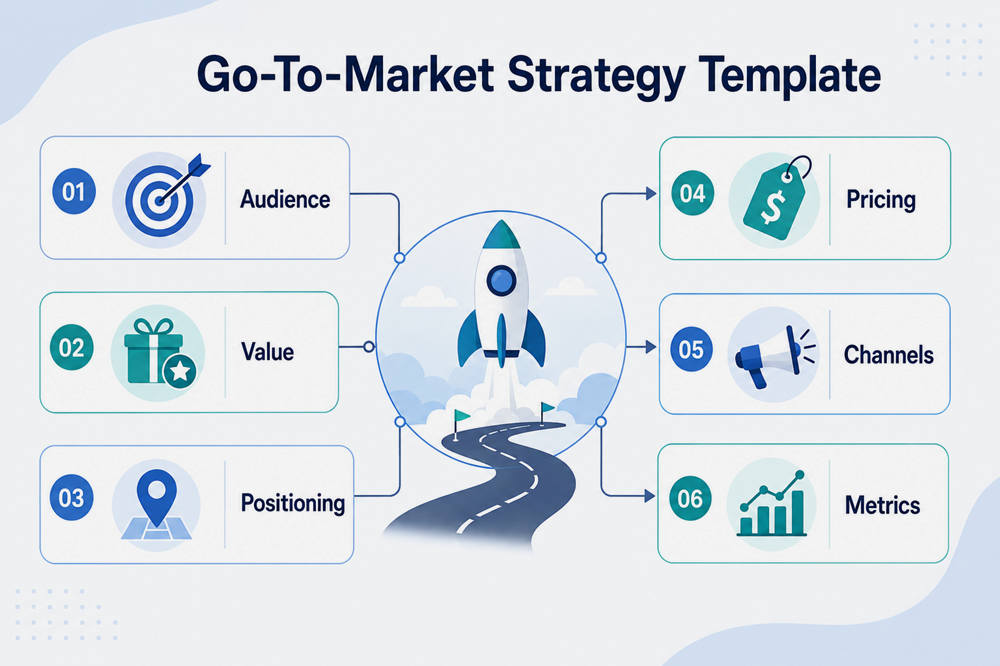
A go-to-market strategy template gives you a practical roadmap for bringing a product or service to the right customers. It defines who you want to reach, what problem you solve, why buyers should choose you, how you will sell, and how you will measure success.
Whether you are launching a startup, introducing a new product, entering another market, or repositioning an existing service, you can use the template below to keep product, marketing, sales, and leadership working toward the same goals.
What Is a Go-To-Market Strategy Template?
A go-to-market strategy, often shortened to GTM strategy, explains how a specific product or service will reach customers and generate sales.
Unlike a broad business plan, a GTM strategy concentrates on one market opportunity. It covers your target customer, value proposition, positioning, pricing, sales channels, marketing approach, launch activities, and performance goals.
Go-To-Market Strategy Template
Use the following sections as a working document for your launch.
1. Product or Service Overview
Start by defining exactly what you are taking to market.
Product or service:
[Name]
Product category:
[Category]
What it does:
[One- or two-sentence description]
Problem it solves:
[Main customer problem]
Primary benefit:
[Main outcome for the customer]
Key features:
[Most important features]
Planned launch date:
[Date]
Keep this description straightforward. Someone outside your product team should be able to understand the offer without additional explanation.
2. Go-To-Market Goals
Define what you want the launch to accomplish.
Your goals should be specific enough that you can tell whether the strategy worked.
Primary business goal:
[Goal]
Revenue target:
[Amount]
Customer acquisition target:
[Number]
Sales or subscription target:
[Number]
Launch period:
[Time frame]
For example, a new software company might aim to acquire 500 paying customers within six months. A consumer brand might focus on first-quarter sales, retailer adoption, or repeat purchases.
Choose a few meaningful goals rather than trying to measure everything.
3. Target Market and Ideal Customer
Your GTM strategy becomes much easier to build once you know exactly who you want to reach. Good market research can help you identify potential customers, understand demand, and narrow your initial audience.
Target market:
[Market]
Primary customer segment:
[Segment]
Ideal customer:
[Description]
Location:
[Region]
Industry:
[If relevant]
Company size:
[For B2B products]
Buyer role:
[For B2B products]
Relevant demographics:
[For consumer products]
Main pain points:
[Problems]
Buying triggers:
[What causes the customer to start looking for a solution?]
Common objections:
[What might prevent a purchase?]
Avoid describing your customer as simply “everyone who needs the product.” A narrower starting audience lets you create clearer positioning and more relevant marketing.
4. Customer Problem and Value Proposition
Customers buy outcomes, not a list of features.
Your value proposition should connect the problem they face with the result your product helps them achieve.
Customer problem:
[Problem]
How customers handle it today:
[Current solution or alternative]
How your product helps:
[Solution]
Most important benefit:
[Result]
Why your approach is different:
[Differentiator]
Core value proposition:
[One concise statement]
A simple formula is:
For [target customer] who wants [desired outcome], our [product or service] provides [main benefit] by [key difference].
The final wording can change later. At this stage, clarity matters more than clever marketing language.
5. Competitive Analysis and Positioning
Your competitors are not limited to companies selling almost the same product.
A customer may compare you with another brand, a cheaper workaround, an existing tool, an internal process, or the option of doing nothing. A basic competitive analysis can help you identify competing alternatives and find areas where your offer can stand apart.
List the most relevant alternatives:
Competitor or alternative 1:
[Name]
Competitor or alternative 2:
[Name]
Competitor or alternative 3:
[Name]
Compare areas such as:
- Pricing
- Features
- Target customers
- Strengths
- Weaknesses
- Customer experience
- Distribution
- Brand positioning
Then define your own position.
Strongest competitive advantage:
[Advantage]
Main differentiator:
[Difference]
Desired market position:
[How customers should think about your offer]
Specific positioning is more useful than saying your product is simply “better,” “innovative,” or “high quality.”
6. Pricing Strategy
Pricing strategy affects how customers perceive your offer as well as how you acquire and serve them.
Base price:
[Price]
Pricing model:
[Subscription, one-time purchase, usage-based, freemium, etc.]
Pricing tiers:
[Tiers]
Free trial or free version:
[Details]
Discount policy:
[Details]
Competitor price range:
[Range]
Reason customers will consider the price worthwhile:
[Explanation]
Your pricing should make sense for the customer you are targeting, the value you provide, your competitive position, and the economics of the business.
7. Sales and Distribution Channels
This section answers one straightforward question: Where and how will customers buy?
Possible channels include:
- Your website
- Direct sales
- Retail stores
- Online marketplaces
- Distributors
- Resellers
- Strategic partners
- Mobile apps
- Self-service software
Primary sales channel:
[Channel]
Secondary channel:
[Channel]
Purchase method:
[How customers buy]
Distribution requirements:
[Requirements]
Partners needed:
[Partners]
Choose channels based on customer buying behavior rather than trying to distribute through every available option.
8. Marketing and Messaging Plan
Now decide how customers will discover your product and understand why it matters.
Core marketing message:
[Message]
Primary benefit to emphasize:
[Benefit]
Supporting message 1:
[Message]
Supporting message 2:
[Message]
Proof:
[Results, demonstrations, reviews, data, credentials, etc.]
A strong marketing message should speak to the audience you want to reach, address a recognizable problem, and make the value of your offer easy to understand.
Possible marketing channels include:
- Search
- Content marketing
- Social media
- Paid advertising
- Events
- Public relations
- Partnerships
- Webinars
- Direct outreach
- Creator or influencer campaigns
The right mix depends on where your audience already looks for information. Testing different combinations of audience, messaging, and channels can help you determine what deserves more investment.
Primary marketing channel:
[Channel]
Secondary channel:
[Channel]
Content needed:
[Content]
Campaign start date:
[Date]
Marketing budget:
[Amount]
Owner:
[Person or team]
9. Sales Process
Your distribution channels determine where people buy. Your sales process explains how interested prospects become customers.
For a simple ecommerce product, that process may happen almost entirely through a website. A complex B2B product may require qualification, demonstrations, proposals, negotiation, and follow-up.
Sales model:
[Self-service, inside sales, field sales, partner sales, etc.]
Main lead sources:
[Sources]
Lead qualification method:
[Method]
Sales stages:
[Stages]
Expected sales cycle:
[Time]
Common objections:
[Objections]
Sales materials required:
[Demo, pricing sheet, comparison page, proposal, case study, etc.]
Follow-up process:
[Process]
Keep the process proportional to the purchase. A $20 product should not require a complicated sales funnel, while a six-figure enterprise service probably needs more than a checkout page.
10. Launch Timeline and Responsibilities
Turn the strategy into specific work.
| Task | Owner | Deadline | Status |
|---|---|---|---|
| Finalize pricing | [Name] | [Date] | [Status] |
| Approve positioning | [Name] | [Date] | [Status] |
| Complete website or landing page | [Name] | [Date] | [Status] |
| Prepare sales materials | [Name] | [Date] | [Status] |
| Launch marketing campaign | [Name] | [Date] | [Status] |
| Release product | [Name] | [Date] | [Status] |
| Review early customer feedback | [Name] | [Date] | [Status] |
| Review launch performance | [Name] | [Date] | [Status] |
Organize your timeline around three phases.
Pre-Launch
Complete pricing, positioning, customer research, marketing materials, sales enablement, testing, and operational preparation.
Launch
Activate your planned sales and marketing channels, monitor customer response, and deal quickly with problems affecting the buying experience.
Post-Launch
Compare actual results with your targets, collect customer feedback, and adjust weak parts of the GTM strategy.
Post-launch learning matters because your initial assumptions will not always match actual customer behavior. Research on reducing risk in business launches also emphasizes continued customer research and performance monitoring after launch.
11. Budget and Resources
A GTM plan also needs to fit the resources available to execute it.
Marketing budget:
[Amount]
Advertising:
[Amount]
Sales costs:
[Amount]
Software and tools:
[Amount]
Creative production:
[Amount]
Partner or distributor costs:
[Amount]
Staff required:
[People or roles]
Total estimated GTM budget:
[Amount]
If your budget is limited, concentrate resources on the audience, message, and channels most closely connected to your primary goal.
12. Metrics and KPIs
Decide how you will measure the launch before it happens.
Depending on your business model, useful GTM metrics can include:
- Revenue
- Units sold
- Qualified leads
- Conversion rate
- Customer acquisition cost
- Average deal size
- Sales cycle length
- Trial-to-paid conversion rate
- Monthly recurring revenue
- Customer retention
- Customer lifetime value
- Repeat purchase rate
- Launch ROI
Your tracking section can stay simple:
Primary KPI:
[Metric]
Current baseline:
[Number]
Target:
[Number]
Measurement period:
[Period]
Review frequency:
[Weekly, monthly, quarterly]
Owner:
[Person or team]
Prioritize metrics tied to business outcomes. A high number of impressions, posts, events, or website visits means little if those activities do not contribute to the goal you set for the launch. McKinsey’s research on product and service launches similarly emphasizes measuring commercial outcomes rather than relying only on launch activity.
Simple Go-To-Market Strategy Template Example
Imagine you are launching scheduling software designed for independent personal trainers.
Product: Scheduling and payment software for personal trainers
Target customer: Independent trainers managing 20 to 100 active clients
Customer problem: Trainers spend too much time coordinating appointments, cancellations, reminders, and payments through separate tools.
Value proposition: One simple platform for scheduling sessions, sending reminders, and collecting client payments.
Main alternatives: General scheduling platforms, spreadsheets, messaging apps, and larger gym-management systems
Positioning: Simple scheduling software built specifically around the needs of independent trainers
Price: $29 per month
Sales model: Self-service subscription
Primary sales channel: Company website
Marketing channels: Search content, email, fitness industry communities, and partnerships
Launch goal: Reach 300 paying customers within six months
Primary KPI: Trial-to-paid conversion rate
Secondary KPIs: Customer acquisition cost, monthly recurring revenue, signup volume, and churn
This short example captures the most important GTM decisions without turning the strategy into a long business plan.
Common Go-To-Market Strategy Mistakes
Targeting Too Broad an Audience
Trying to reach everyone usually produces weak messaging. Start with customers who have the clearest need and strongest reason to buy.
You can expand into additional segments once you understand what works.
Using Generic Positioning
Claims such as “easy to use,” “innovative,” or “high quality” do not explain why a customer should choose you.
Give buyers a specific reason to care about your product instead.
Choosing Channels Before Understanding Customers
Do not select marketing channels simply because they are popular.
Find out where your customers research solutions, who influences their decisions, and where they prefer to buy. Then build your channel strategy around those behaviors.
Letting Sales and Marketing Tell Different Stories
Your ads, website, product pages, sales conversations, pricing, and onboarding should reinforce the same basic value proposition.
Conflicting messages create unnecessary friction during the buying process.
Launching Without Clear Goals
Without targets, you cannot properly judge the results.
Decide what success looks like before launch and make sure the people involved know which numbers matter.
Measuring Activity Instead of Results
Ten campaigns, 30 social posts, and thousands of website visits may sound impressive, but they are not necessarily signs of a successful GTM strategy.
Connect activity to outcomes such as qualified leads, purchases, revenue, retention, and customer acquisition cost.
Final Takeaway
A useful go-to-market strategy template should make four things clear:
Who are you selling to? What value are you offering? How will you reach and convert customers? How will you know whether the strategy worked?
Once those decisions are documented, your GTM plan becomes a practical roadmap for the people responsible for product, marketing, sales, and launch execution—not another strategy document that gets written once and forgotten.