James Quincey’s Leadership Style: Transforming Coca-Cola Through Agility and Discipline
James Quincey’s leadership style is best described as transformational and adaptive, supported by consumer-centered thinking and firm strategic discipline. As CEO of The Coca-Cola Company, he encouraged a large, established organization to question familiar habits, move faster and look beyond its flagship soft drink for growth.
Quincey served as CEO from 2017 until March 31, 2026, when Henrique Braun succeeded him. He now serves as Coca-Cola’s executive chairman.
His approach did not fit neatly into one conventional leadership category. He promoted experimentation, feedback and local judgment, but he was also prepared to eliminate brands, reorganize operations and make decisions that others might avoid. The defining feature of his leadership was the attempt to combine openness to change with the discipline to choose what the company would—and would not—continue supporting.
Who Is James Quincey?
Quincey joined Coca-Cola in 1996 as director of learning strategy for its Latin America Group. He later held leadership positions in Argentina, Mexico, Northern Europe and the wider European business before becoming president and chief operating officer in 2015.
He became CEO in May 2017 and chairman of the board in 2019. His international assignments exposed him to markets with different economic conditions, consumer preferences and distribution systems. Running a business during Argentina’s financial crisis in the early 2000s was particularly influential, teaching him that conditions can change quickly and force leaders to reconsider their assumptions.
That experience helped shape a leadership philosophy built around flexibility. Quincey did not believe that a strategy developed at global headquarters could simply be applied in the same way everywhere. Coca-Cola needed shared priorities, but it also needed leaders who understood the realities of individual markets.
How to Describe James Quincey’s Leadership Style
Quincey’s leadership can be understood through three connected qualities: transformation, adaptability and decisiveness.
His style was transformational because he sought to change more than Coca-Cola’s product portfolio. He wanted to reshape how the organization viewed consumers, innovation, hierarchy and risk. The goal was to move from a company strongly identified with one category toward a broader “total beverage company” capable of competing across sparkling drinks, water, coffee, tea, juice, dairy, sports drinks and other areas.
His adaptive side appeared in his willingness to question established assumptions. In a 2026 interview about consumer insight, culture and global agility, Quincey described the importance of reconsidering problems from first principles, especially when economic or market conditions change rapidly.
At the same time, he did not treat flexibility as indecision. Quincey encouraged new ideas but expected the company to stop investing in those that repeatedly failed to show potential. His leadership therefore combined the freedom to test possibilities with a willingness to make a final choice.
Putting the Consumer Ahead of the Product
One of the clearest principles behind Quincey’s strategy was that Coca-Cola should begin with what people wanted to drink rather than what the company already produced.
That represented a meaningful shift for a business built around one of the world’s most recognizable products. Coca-Cola’s history and identity could make it tempting to evaluate every opportunity through the needs of the flagship brand. Quincey believed that this product-first perspective risked limiting the company’s understanding of the wider beverage market.
Consumers do not organize their days around a single category. The same person might drink coffee in the morning, water during exercise, juice with a meal and a sparkling beverage later. A company that wanted to remain relevant throughout the day had to understand those different occasions rather than assume that one product would always take priority.
Quincey summarized the problem during a 2025 conversation at Adobe Summit: a company can become trapped when it tries to sell what it already makes instead of making what people want to buy.
This thinking supported Coca-Cola’s development as a total beverage company. The strategy did not require abandoning Coca-Cola or its other established sparkling brands. It placed them within a larger portfolio shaped by consumer needs, drinking occasions and changing preferences.
The approach also required restraint. Consumer focus does not mean pursuing every new flavor, category or trend. It means distinguishing between a lasting shift in demand and an idea that is simply receiving temporary attention.
Changing Culture Through Visible Actions
Quincey believed cultural change had to be demonstrated through behavior. Employees were unlikely to believe that Coca-Cola was becoming less formal and more open to change if its senior leaders continued reinforcing the old conventions.
At an early employee meeting after becoming CEO, he wore jeans instead of the more traditional executive attire expected within the company. He also drank a Coca-Cola product that was not Coke. The choices were simple, but they communicated two messages: the culture could become less hierarchical, and the company’s broader portfolio deserved genuine support.
The episode reflected Quincey’s belief that everything a senior leader does communicates something. Employees notice which ideas receive funding, how executives respond when an experiment fails, who receives promotions and whether leaders personally follow the principles they present to others.
Symbolic actions cannot change a culture by themselves. They matter when later decisions reinforce the same direction. Quincey’s informal appearance would have meant little if Coca-Cola had continued protecting hierarchy, slow approval processes and the automatic priority of its flagship product.
The company’s formal leadership model during his tenure similarly emphasized collaboration, digital literacy, a growth mindset and results. The combination is important: a growth mindset without accountability can produce activity without progress, while a narrow focus on results can discourage the experimentation needed for future growth.
Combining Global Direction With Local Execution
Coca-Cola operates at a scale that creates significant global advantages. It can share brands, technology, marketing capabilities and commercial knowledge across markets. Yet the conditions under which people purchase and consume beverages vary widely.
Quincey’s international experience taught him that running Coca-Cola in Argentina was different from running it in Mexico or Europe. Economic volatility, retail structures, consumer incomes and cultural habits all influence which products, packages and price points are likely to work.
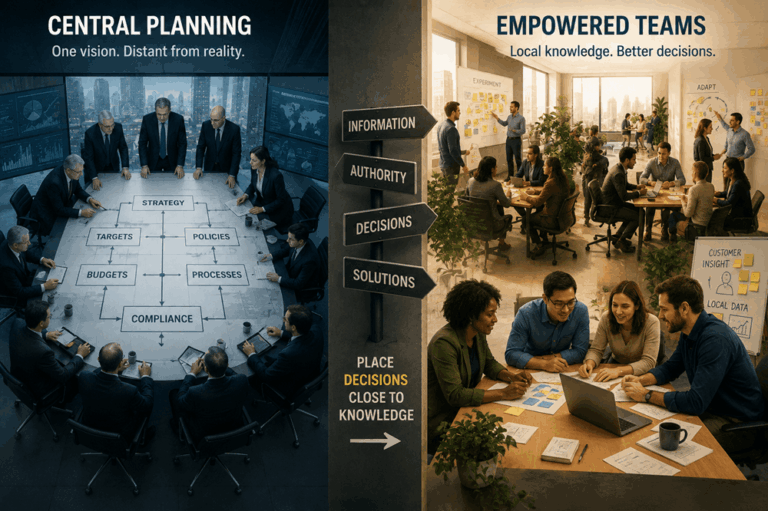
His approach was therefore neither complete centralization nor unrestricted local independence. Global leadership established the broad strategy and supplied resources that individual markets could not easily develop alone. Local operating teams and bottling partners determined how those capabilities should be applied in practice.
This balance is embedded in Coca-Cola’s franchise system. The company develops brands, concentrates and strategic capabilities, while bottling partners manufacture, distribute and sell products within local markets. Those partners bring detailed knowledge of retailers, routes, pricing and consumer behavior.
The leadership challenge is to keep this network aligned without assuming uniformity. Too much central control can make a global business slow and insensitive to local conditions. Too little coordination can fragment investment and weaken the advantages created by scale.
Quincey’s adaptive style sought a middle ground: common priorities combined with enough local authority to respond when market realities did not fit the global plan.
Encouraging Innovation Without Protecting Every Idea
Quincey supported experimentation, but he rejected the idea that innovation meant keeping every new product alive indefinitely.
He described himself as both a “chief agitator,” encouraging the organization to do something new, and a “chief zombie killer,” ending projects or brands that continued consuming resources without producing convincing results.
That distinction recognizes that innovation can serve several purposes. A new product may become a permanent brand, address an unmet consumer need or open a valuable category. A limited release may instead create attention, test an unusual concept or reconnect consumers with an established franchise. It does not have to remain on shelves forever to provide useful information.
The difficulty begins when a temporary experiment acquires internal defenders. Teams may become attached to their work, while managers ask for another campaign or budget cycle to turn around a product that has struggled for years. Without clear stopping rules, an organization can accumulate too many minor initiatives and spread its resources too thinly.
Coca-Cola’s portfolio restructuring illustrated Quincey’s willingness to make that choice. The company reduced its portfolio from about 400 master brands to about 200. According to a 2021 investor presentation, the eliminated or transitioned brands represented approximately 1% of revenue and 2% of volume based on 2019 data.
The purpose was not merely to make the portfolio smaller. It was to redirect marketing, investment and management attention toward opportunities with a stronger chance of growing across markets.
This part of Quincey’s leadership was more disciplined than permissive. People were encouraged to test ideas, but experimentation did not create an entitlement to permanent support.
Focusing on the Decisions That Matter Most
Quincey did not view the CEO’s job as making as many decisions as possible. He believed senior leaders should concentrate on the relatively small number of choices that genuinely require their authority or perspective.
In a 2026 discussion at London Business School, he explained that the decisions reaching a CEO are often the ones other people do not want to make. These include strategy, senior personnel questions and other difficult or “unpalatable” choices.
Some matters should still be pushed back to the appropriate level. When executives become the default answer to every uncertainty, managers below them learn to seek approval rather than exercise judgment. Decisions slow down, accountability becomes blurred and senior attention is consumed by issues that others are capable of resolving.
Quincey also emphasized leaving enough room to think. A calendar filled entirely with meetings may create the appearance of productivity while preventing a leader from noticing weak signals, connecting information or reconsidering the direction of the organization.
His approach linked delegation with decisiveness. Giving others authority did not reduce the CEO’s responsibility. It preserved executive attention for the decisions where top-level involvement could make the greatest difference.
Strengths and Limitations of Quincey’s Approach
Where the approach was strongest
The strength of Quincey’s leadership came from combining qualities that can easily pull an organization in opposite directions.
He promoted experimentation but also imposed limits. He valued Coca-Cola’s history while challenging routines created by that history. He supported global coordination without treating local markets as interchangeable. He communicated the need for change through visible actions and then reinforced the message through portfolio and organizational decisions.
This combination gave his transformation efforts greater credibility. Culture, strategy and resource allocation pointed in broadly the same direction. Employees were not merely told to adopt a growth mindset; the company also changed what it funded, how it organized work and which brands it continued to support.
Where the trade-offs became visible
Decisive transformation carries costs. Coca-Cola’s 2020 reorganization involved voluntary and involuntary workforce reductions. The company initially offered voluntary separation packages to approximately 4,000 eligible employees in the United States, Canada and Puerto Rico, and independent reporting later described thousands of layoffs.
Portfolio simplification also depends on imperfect judgments about the future. Concentrating investment can strengthen the most promising brands, but a company may discontinue an idea before its potential becomes clear. The same decisiveness that prevents waste can create blind spots when assumptions are wrong.
Nor did transformation remove Coca-Cola’s underlying challenges. At the end of Quincey’s CEO tenure, the company still faced changing consumer attitudes toward ingredients, pressure in some established markets and continuing debate over the health and environmental effects of its products. Independent coverage of the leadership transition noted both the expansion of the portfolio under Quincey and the difficult issues inherited by his successor.
These limitations do not invalidate his leadership model. They show why transformational leadership should be evaluated by both its strategic logic and its consequences.
Leadership Lessons From James Quincey
Make cultural change visible
Employees draw conclusions from behavior more readily than from slogans. Leaders should examine whether their decisions, routines and use of resources support the culture they say they want.
Begin with the customer’s need
Established organizations often view new opportunities through existing products and capabilities. Starting with the customer’s problem or preference can reveal possibilities that the current portfolio obscures.
Separate shared principles from local execution
A large organization needs a common direction, but it does not need identical methods everywhere. Leaders should clarify which principles are fixed and where local teams have room to adapt.
Define when an experiment should end
Before starting a pilot, teams should know what they are trying to learn, how success will be assessed and when further investment will be reconsidered. Ending an unsuccessful project can be responsible innovation rather than failure.
Protect attention for consequential choices
Senior leaders should resist becoming the approval point for every problem. Delegating routine or reversible decisions develops judgment throughout the organization and leaves more time for strategy, talent and high-consequence choices.
Conclusion
James Quincey’s leadership style combined transformational ambition with practical discipline. He encouraged Coca-Cola to think beyond its most famous product, respond more quickly to changing conditions and become more comfortable testing unfamiliar ideas. He was equally willing to narrow the portfolio and stop supporting initiatives that lacked a convincing future.
His tenure offers a useful lesson for leaders of successful organizations: respecting the source of past success does not require protecting every habit that developed around it. The harder task is deciding which strengths remain essential, which conventions have become constraints and when the organization must change before certainty is available.
Featured Image Source: fortune