What Is the Leadership Circle Profile and How Does It Work?
Leadership Circle usually refers to the Leadership Circle Profile, a 360-degree assessment that connects leadership behavior with the habits of thought that may influence it. By comparing a leader’s self-assessment with feedback from colleagues, the Profile can highlight recognized strengths, differences in perception, and patterns that may deserve further development.
What Is the Leadership Circle Profile?
The Leadership Circle Profile, commonly shortened to LCP, is a leadership-development assessment. It asks a participant to evaluate their own leadership and gathers observations from people who regularly work with them.
The assessment is designed to examine two connected parts of leadership. The first is the leader’s visible behavior, including how they build relationships, pursue results, make decisions, and respond to complexity. The second is the model’s interpretation of the assumptions that may be associated with those behavioral patterns.
This distinction requires some care. The Profile cannot directly observe a person’s private beliefs. Instead, it identifies behaviors that the Leadership Circle model links with particular habits of thought. The results are therefore best treated as prompts for reflection rather than a diagnosis of the leader’s personality or motives.
The Profile also captures a particular period in a person’s working life. It may reflect the demands of the current role, recent organizational changes, relationships with colleagues, and pressures the leader is facing. It should not be read as a fixed statement about how that person will always lead.
Creative Competencies and Reactive Tendencies
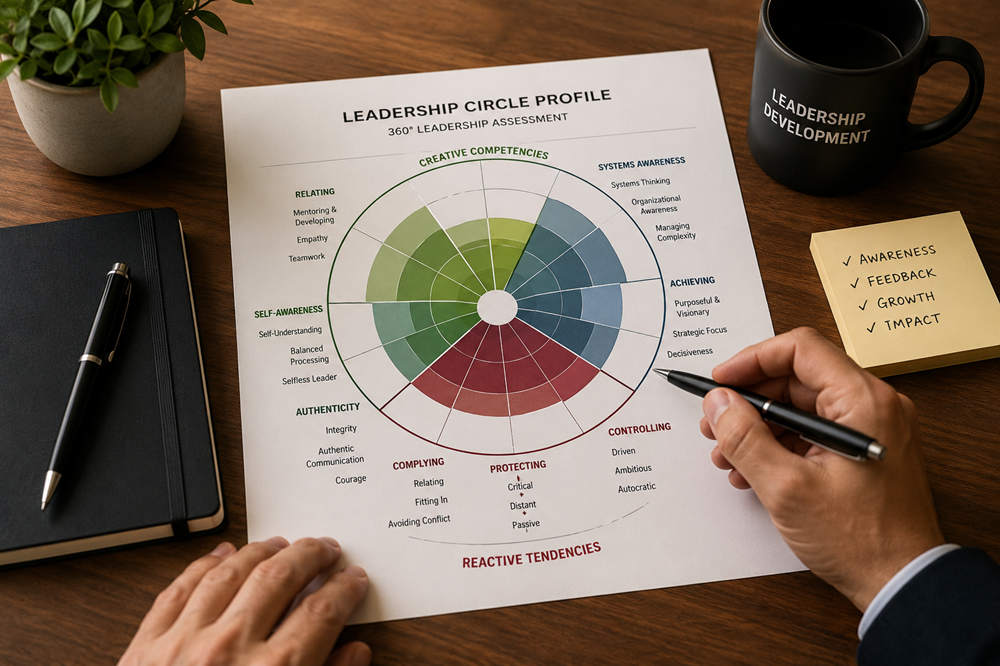
The Leadership Circle model contains 18 Creative Competencies and 11 Reactive Tendencies. These individual dimensions are organized into broader areas so that leaders can see connections across the Profile rather than interpreting every score separately.
Creative Competencies
Creative Competencies represent leadership patterns associated with purposeful action, constructive relationships, self-awareness, and sustainable performance. Here, “creative” does not mean artistic. It describes leadership that is guided primarily by values, purpose, and a considered response to circumstances.
The competencies are grouped into five main areas:
- Relating covers building trust, encouraging teamwork, developing others, and handling interpersonal differences constructively.
- Self-Awareness includes personal learning, emotional composure, self-understanding, and the ability to maintain a sustainable balance.
- Authenticity reflects integrity, honest communication, consistency between values and actions, and the courage to address difficult issues.
- Systems Awareness concerns understanding interdependence, recognizing long-term consequences, and seeing problems within a wider organizational context.
- Achieving includes creating a clear vision, setting direction, making decisions, pursuing meaningful goals, and maintaining effective standards.
The placement of these areas helps reveal whether a leader leans more heavily toward relationships or tasks. Strong performance usually requires both. A leader who concentrates almost entirely on results may weaken trust and engagement, while one who prioritizes harmony without establishing direction may struggle to move work forward.
Reactive Tendencies
Reactive Tendencies represent protective ways of responding that may become more visible during conflict, uncertainty, or pressure. They are grouped into three broad patterns:
- Complying involves seeking security through approval, fitting in, avoiding disagreement, or allowing other people’s expectations to shape important choices.
- Protecting involves creating distance through criticism, emotional withdrawal, cynicism, superiority, or excessive reliance on intellectual analysis.
- Controlling involves seeking security through achievement, perfection, authority, ambition, dominance, or close control over decisions and outcomes.
These tendencies should not be reduced to character flaws. They often develop alongside useful qualities. A leader with a strong Controlling pattern may also be disciplined and highly committed to results. Someone who scores strongly in Complying may be considerate and sensitive to other people’s needs.
The difficulty appears when the protective response becomes automatic. High standards can turn into perfectionism, consideration can become approval-seeking, and careful analysis can become emotional distance. Development involves retaining the useful quality while gaining more choice over when and how it is expressed.
How the Assessment and Report Work
The participant begins by completing a self-assessment. Evaluators then respond to similar questions based on their experience of the leader. Depending on the participant’s role, these evaluators may include a manager, peers, direct reports, clients, or other colleagues.
Using several evaluator groups can show whether a behavior is experienced consistently. A senior manager might view a participant as decisive, for example, while direct reports experience the same behavior as overly controlling. Peers may see something different because they work with the person without the same reporting relationship.
Those perspectives are combined in a report containing a circular graph, detailed scores, evaluator-group results, and written feedback. The graph displays the participant’s self-ratings alongside the combined ratings from other people.
How to Read the Circle Graph
The Profile presents results as percentile scores compared with the global LCP norm base. A score at the 70th percentile means that the result is higher than that of approximately 70 percent of participants in the comparison group. It does not mean that the leader answered 70 percent of the questions correctly.
Results extend outward from the center of the graph as percentile scores increase. The official guide to reading the Profile identifies scores from the 66th to the 100th percentile as high, scores between the 33rd and 66th percentiles as medium, and scores below the 33rd percentile as low.
Location matters as much as height. A high Creative score generally indicates a competency that is strongly present. A high Reactive score indicates that a protective pattern is strongly present. A large shape is therefore not automatically positive across every part of the circle.
Differences between the self-rating and evaluator rating can be particularly useful. A higher self-score may point to a blind spot, but it could also reflect behavior that colleagues have had little opportunity to observe. A higher evaluator score may reveal a strength that the leader underestimates. Written comments and differences among evaluator groups help explain what may be behind the gap.
The report also contains four summary measures:
- Reactive–Creative Scale summarizes the leader’s overall balance between Creative Competencies and Reactive Tendencies.
- Relationship–Task Balance indicates how evenly the Profile reflects relationship-oriented and task-oriented leadership.
- Leadership Potential Utilization combines the Reactive–Creative Scale and Relationship–Task Balance to indicate how fully the leader appears to be using their capabilities within the model.
- Leadership Effectiveness reflects how evaluators rate the participant’s overall effectiveness as a leader.
Leadership Potential Utilization is not a separate measurement of someone’s complete personal potential. As the summary-scale documentation explains, it is calculated from the Reactive–Creative and Relationship–Task measures and then expressed as a percentile.
No individual score tells the whole story. The graph is most useful when it is considered alongside evaluator comments, workplace events, the demands of the role, and examples of how the leader behaves in real situations.
Turning Leadership Circle Results Into Development
A detailed Profile can create pressure to address every low competency or high Reactive score. That approach usually produces an unfocused development plan. A more practical method is to identify one pattern that affects several parts of the leader’s work.
For example, a participant may receive strong Achieving scores while also showing a pronounced Controlling pattern. The goal is not to reduce commitment or ambition. It may be to involve colleagues earlier, delegate decisions with clearer boundaries, or respond to unexpected problems without immediately taking control.
The following steps can turn the report into a focused plan:
- Define the leadership challenge. Begin with a real demand, such as building a new team, improving collaboration, leading change, or moving into a more strategic role.
- Find a recurring pattern. Look for a theme supported by the graph, evaluator comments, and recent workplace experiences.
- Identify the trigger. Determine when the behavior is most likely to appear. Common triggers include disagreement, uncertainty, tight deadlines, mistakes, or scrutiny from senior leaders.
- Select a replacement behavior. Make the goal observable. “Be less controlling” is vague, while “ask the team to propose two approaches before giving my answer” can be practiced and reviewed.
- Request targeted feedback. Ask a small number of trusted colleagues to watch for the chosen behavior and explain what effect it has.
- Review the outcome. Consider whether the new response improves decisions, relationships, accountability, or results, and adjust it when necessary.
A structured debrief can help the participant understand how different parts of the Profile relate to one another. It can also prevent the conversation from becoming a mechanical review of every number. The aim should be to connect the report with current responsibilities and leave with a specific action that can be tested at work.
Progress is ultimately demonstrated through behavior rather than a better-looking graph. A later assessment may show whether ratings have changed, but everyday evidence matters more: how the leader handles disagreement, shares authority, communicates expectations, or responds when plans go wrong.
Benefits and Limitations of the Leadership Circle Profile
One strength of the Profile is its integrated structure. Instead of presenting leadership qualities as an unrelated list, it places competencies, protective responses, relationship behavior, and task behavior within one visual model. This can help a leader recognize that several workplace difficulties may be connected to the same underlying pattern.
The 360-degree format also provides perspectives that a self-assessment cannot supply. Leaders do not always see how their behavior affects colleagues, especially when organizational hierarchy discourages candid feedback. The report can give a development conversation a clearer starting point and a shared vocabulary.
However, the results depend on the quality of the input. Evaluators may have limited contact with the participant, interpret questions differently, or allow a recent event to influence their responses. Rater selection, workplace politics, organizational culture, and the leader’s current responsibilities can all shape the Profile.
The detail of the report can create another risk. Percentiles and visual patterns may appear more definitive than they are. Similar scores can have different meanings for different people, and an evaluator gap does not automatically prove that the participant lacks self-awareness. Interpretation requires context and, ideally, examples that support the feedback.
The available psychometric evidence should also be described carefully. A 2008 evaluation by the Institute for Psychological Research and Application at Bowling Green State University found the Profile sufficiently reliable and valid for developmental feedback. The researchers also identified limitations involving several scales and recommended further validation before broader conclusions were made.
The report stated that the assessment was intended for development, not for selection, promotion, termination, or other high-stakes employment decisions. That boundary remains important. A Leadership Circle Profile can support reflection and coaching, but it should not serve as a final judgment of a person’s ability, character, or suitability for a position.
Used thoughtfully, the Leadership Circle Profile can help leaders examine the relationship between what they intend, what they do, and how other people experience the result. The circle is not a verdict or a complete development plan. It is a map that becomes useful when its findings are tested through practical action, observation, and continuing feedback.