Motivation Assessment Scale Explained: Behavior Functions, Scoring, Examples, Uses, and Key Limitations
A motivation assessment scale can help you understand what may be driving a repeated behavior. Instead of treating the behavior as random, stubborn, or deliberately difficult, the scale encourages you to look at what the person may gain, avoid, or communicate through it.
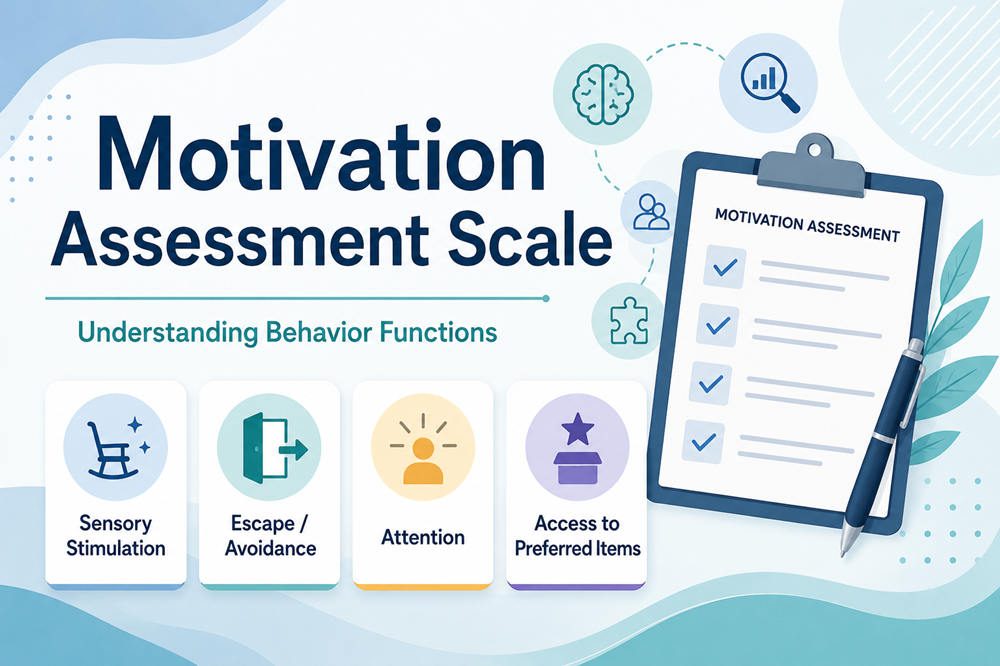
The formal Motivation Assessment Scale, commonly called the MAS, focuses on four possible behavior functions: sensory stimulation, escape, attention, and access to preferred items or activities.
What Is the Motivation Assessment Scale?
The Motivation Assessment Scale is a behavioral questionnaire developed by V. Mark Durand and Daniel B. Crimmins. It is commonly used to explore the possible purpose of a specific challenging behavior, particularly among children and adults with developmental disabilities.
The standard scale contains 16 questions. Each question describes a situation in which the behavior might occur, and an observer rates how often that situation applies.
The MAS is usually completed by someone who regularly sees the behavior, such as a parent, teacher, caregiver, therapist, or support professional.
It is important to assess only one clearly defined behavior at a time. Combining hitting, screaming, refusing work, and leaving a room into one assessment can produce confusing results because each behavior may serve a different purpose.
The MAS does not measure ambition, willpower, productivity, or general enthusiasm. It is designed to help you understand why a particular behavior may continue to happen.
The Four Functions Measured by the MAS
The scale groups behavior into four possible functions. A behavior may fit mainly into one category, or it may serve different functions in different situations.
Sensory Stimulation
A sensory behavior produces an internal feeling or physical experience that the person finds stimulating, calming, or satisfying.
Examples may include:
- Rocking back and forth
- Repeatedly tapping a surface
- Making the same sound
- Spinning an object
- Rubbing a particular material
- Repeating certain body movements
Sensory behaviors may happen even when no one else is nearby. They do not always depend on attention, demands, or access to an object.
However, you should not assume that every repetitive behavior is sensory. Frequent touching, scratching, hitting, or rubbing of one body area may also be related to pain, discomfort, or irritation. Sudden changes in behavior may require a medical evaluation.
Escape or Avoidance
An escape behavior helps a person delay, reduce, avoid, or leave an unwanted situation.
The person may be trying to escape:
- A difficult assignment
- A confusing instruction
- A loud environment
- An uncomfortable social situation
- A household responsibility
- A long activity
- A task that requires an undeveloped skill
For example, a student may push a worksheet onto the floor whenever challenging math problems are presented. If the worksheet is removed afterward, pushing it away may become an effective way to escape the task.
This does not necessarily mean the student planned the behavior. It means the result of the behavior may make it more likely to happen again.
Attention
An attention-related behavior produces a response from another person.
The response could include:
- Conversation
- Eye contact
- Comfort
- Physical contact
- Reassurance
- Correction
- Scolding
- Negotiation
Negative reactions can still provide attention. A child who shouts while two adults are speaking may continue shouting if both adults immediately stop and respond.
The goal is not to ignore every attention-related behavior. A better approach is often to provide positive attention regularly and teach the person a clearer way to request interaction.
Access to Preferred Items or Activities
A behavior may provide access to something the person wants.
This could include:
- Food or snacks
- Toys
- A phone or tablet
- Television
- A favorite activity
- A preferred location
- More free time
- Contact with a particular person
For example, a child may cry after being told that tablet time is over. If the tablet is returned, crying may become linked with regaining access to it.
This function is sometimes called the tangible function, but it is not limited to physical objects. Activities, privileges, locations, and social experiences may also be desired outcomes.
How the Motivation Assessment Scale Works
Completing the MAS involves more than answering 16 questions. You first need to define the behavior and identify the setting in which it occurs.
Choose One Target Behavior
Select the specific behavior you want to understand.
Avoid labels such as:
- Being difficult
- Acting badly
- Having an attitude
- Becoming aggressive
- Refusing to cooperate
These descriptions depend heavily on personal opinion. Instead, describe what another person can see or hear. The IRIS Center explains why a useful behavior definition should be both observable and measurable.
For example:
- Throws school materials onto the floor
- Hits another person with an open hand
- Leaves the classroom without permission
- Cries loudly for longer than 30 seconds
- Drops to the floor after receiving an instruction
- Pushes food away during meals
A clear definition makes it easier for different observers to recognize the same behavior.
Identify the Setting
Behavior can change depending on the environment. A person may act one way during schoolwork and another way during meals, transitions, shopping, or personal-care routines.
Record details such as:
- Where the behavior happens
- Who is present
- What activity is taking place
- What happens immediately before it
- What happens immediately afterward
These details may reveal patterns that a questionnaire score alone cannot show.
Ask a Familiar Observer to Complete the Scale
The person completing the MAS should have enough direct experience with the behavior to rate it accurately.
When possible, more than one observer can complete the scale. A parent and teacher may produce different results because the behavior serves different purposes at home and school.
Different scores do not automatically mean that one person is wrong. They may show that the setting matters.
Motivation Assessment Scale Scoring
Each MAS question is rated on a frequency scale from 0 to 6:
- 0: Never
- 1: Almost never
- 2: Seldom
- 3: About half the time
- 4: Usually
- 5: Almost always
- 6: Always
The 16 questions are divided among the four functions. Each category contains four questions.
To score the assessment:
- Add the four ratings within each category.
- Divide each total by four to calculate the mean.
- Compare the four mean scores.
- Rank the functions from highest to lowest.
The highest-scoring category suggests the most likely function of the behavior.
For example:
| Possible Function | Mean Score |
|---|---|
| Escape | 5.25 |
| Attention | 3.50 |
| Tangible | 2.25 |
| Sensory | 1.50 |
In this example, escape is the strongest possibility. The next step would be to observe whether the behavior usually starts after a task or demand and whether it results in a break, delay, or removal of the task.
The score is a useful clue, not a final answer. Direct observation is still needed to confirm the pattern.
Practical Motivation Assessment Scale Example
Imagine a student named Jordan who pushes written assignments away, cries, and leaves his seat.
His teacher notices that the behavior usually begins shortly after difficult writing tasks are presented. She completes the MAS based on several weeks of observation.
Escape receives the highest score. Attention receives a moderate score, while the sensory and tangible categories score much lower.
The teacher then reviews the usual pattern:
- A writing assignment is presented.
- Jordan looks away and pushes the paper.
- He cries and leaves his chair.
- An adult approaches him.
- The assignment is delayed or removed.
The pattern supports the idea that the behavior helps Jordan escape difficult written work. It may also produce attention, but avoiding the task appears to be the main outcome.
A helpful response might include:
- Checking whether the assignment matches Jordan’s skill level
- Dividing the work into smaller sections
- Giving simpler instructions
- Offering a choice between two tasks
- Teaching Jordan to request help
- Teaching him to ask for a short break
- Praising him for completing manageable parts of the assignment
Simply punishing Jordan for leaving his seat would not address the underlying difficulty. A better plan gives him an appropriate way to ask for help or relief while gradually building his ability to complete the work.
Benefits of the Motivation Assessment Scale
The MAS gives caregivers, teachers, and support teams a structured way to discuss behavior.
Its main benefits include:
- It is relatively quick to complete.
- It focuses on one specific behavior.
- It encourages people to look for patterns.
- It considers several possible behavior functions.
- It can guide further observation.
- It may help teams choose more suitable support strategies.
The scale also helps shift the conversation away from blame.
Instead of saying, “He is doing it for no reason,” you can ask what happens before the behavior, what changes afterward, and what the person may be trying to communicate.
Limitations of the Motivation Assessment Scale
The MAS depends on an observer’s memory and judgment. Two people may rate the same behavior differently because they see it in different settings or interpret situations differently.
Other limitations include:
- A behavior may serve more than one function.
- Its function may change across settings.
- The scale may not capture every relevant cause.
- Medical or communication difficulties may be overlooked.
- A high score does not prove why the behavior occurs.
- The results may become outdated if circumstances change.
For these reasons, the MAS should not be the only source of information used to make important decisions.
Serious behaviors involving self-injury, aggression, running away, major property damage, or sudden unexplained changes should be evaluated with help from qualified professionals.
MAS Versus a Functional Behavior Assessment
The Motivation Assessment Scale and a functional behavior assessment are related, but they are not the same.
The MAS is an indirect questionnaire. It records what an observer has noticed about the conditions surrounding a behavior.
A functional behavior assessment is a broader process that may include interviews, records, direct observation, behavior data, communication needs, environmental factors, and patterns before and after the behavior.
The MAS may contribute useful information to that process, but it does not replace direct observation or a complete assessment. A function-based approach should connect the likely purpose of the behavior with positive, practical support rather than relying only on consequences or punishment.
Using the Results Responsibly
Assessment results should guide supportive action rather than labels or punishment. The principles of function-based support focus on preventing difficult situations when possible and teaching more effective skills.
When escape appears to be the likely function, support may involve changing task difficulty, improving instructions, offering breaks, or teaching the person how to request help.
When attention scores highest, the person may benefit from regular positive interaction and a clear way to ask for attention.
When access to preferred items is the likely function, support may focus on waiting, accepting limits, following schedules, and making appropriate requests.
When sensory stimulation appears likely, the next step may involve offering safer sensory options, changing the environment, or checking for discomfort.
The response should always be based on the individual rather than the category alone. Two people with the same MAS result may still need very different forms of support.
Final Thoughts
The Motivation Assessment Scale can help you move beyond the surface of a challenging behavior. It organizes observations around four possible functions and gives you a clearer idea of what to investigate next.
Its greatest value is not producing a score. It is helping parents, educators, caregivers, and professionals ask a more useful question: What need or outcome might this behavior be communicating?