
Teamwork Makes the Dream Work: What Effective Teams Actually Need
A project brings together experienced people from several departments. Every necessary area of expertise appears to be represented.
Yet progress soon slows. Two people believe they own the same decision, while another important task has no clear owner. Problems circulate privately before reaching the wider team. Meetings produce updates but few decisions, and individual departments protect their own priorities.
The project has talented contributors and a shared assignment, but it does not yet have effective teamwork.
“Teamwork makes the dream work” contains a useful truth. Many worthwhile goals require people to combine their knowledge, judgment, and effort. But bringing people together does not automatically create a team. Effective teamwork depends on a shared purpose, connected contributions, honest communication, coordinated decisions, and mutual accountability.
What Does “Teamwork Makes the Dream Work” Mean?
The phrase means that people can often accomplish more by working together toward a shared goal than they could achieve separately.
The “dream” does not have to be a grand personal ambition. In a workplace, it could be a successful product launch, a safer service, a difficult organizational change, or a project completed under uncertain conditions.
Teamwork is the coordinated effort through which people pursue that result. It involves more than dividing a large assignment into separate tasks. Members need to understand how their contributions connect, exchange useful information, manage dependencies, and adjust when conditions change.
This is what distinguishes a team from a group.
A group may attend the same meetings, report to the same manager, or work in the same department. Its members may still complete largely independent tasks. A team shares an outcome that depends on members combining their work.
That distinction matters because individual talent does not guarantee collective performance. Leading Beat’s discussion of why real teams can outperform groups of star performers shows how competition, unclear authority, and weak coordination can prevent talented people from working effectively together.
Who Popularized “Teamwork Makes the Dream Work”?
The expression is closely associated with leadership author John C. Maxwell. His 2002 book Teamwork Makes the Dream Work: Together We Can Do the Impossible helped popularize the phrase in leadership and workplace writing.
However, closely related wording appeared earlier. The official song of the 1986 New York Mets included the idea of having the teamwork needed to make the dream work. The song was produced and co-written by Shelly Palmer, whose account of its creation confirms its connection to the championship team.
It is therefore safer to say that Maxwell popularized the familiar expression rather than definitively invented it.
The saying has endured because it is memorable. It is also incomplete. It tells people that teamwork matters without explaining why some teams succeed while others make decisions more slowly, obscure responsibility, and produce less than their members could have achieved alone.
Why Effective Teamwork Can Produce Better Results
Teamwork creates value when it allows people to combine resources that one person cannot easily provide alone. Four mechanisms are especially important.
Teams combine complementary expertise
Complicated goals often require several kinds of knowledge.
A product launch, for example, may depend on technical development, customer research, financial judgment, operations, legal advice, marketing, and support. One person is unlikely to understand every part well enough to make all the necessary decisions.
A well-designed team brings these perspectives together. Specialists can identify risks that others might miss, explain constraints, and offer different interpretations of the same problem.
Expertise only adds value when the team can use it. Including a specialist achieves little if that person receives essential information too late or is discouraged from challenging a preferred plan.
Teams can integrate information
Members frequently hold different pieces of the same problem. One person understands what the customer requested. Another knows why the request is technically difficult. Someone else recognizes a financial or regulatory consequence.
A meta-analysis of 72 independent studies found that information sharing was positively related to team performance, cohesion, decision satisfaction, and knowledge integration.
That does not mean every message or meeting improves performance. Teams benefit when relevant information reaches people who can interpret and act on it.
A lengthy meeting in which members repeat familiar updates may add little value. A brief discussion that reveals an overlooked risk could change the direction of the entire project.
Teams can coordinate connected work
Many projects contain dependencies. One person cannot complete their work until another produces an input, makes a decision, or resolves an uncertainty.
Effective teamwork helps members anticipate these connections. They can coordinate handoffs, identify delays early, and adjust priorities when one part of the project changes.
This coordination becomes especially important under uncertainty. A formal plan may allocate responsibilities, but it cannot predict every customer request, staffing change, technical problem, or external disruption.
Leading Beat’s article on teams as complex adaptive systems examines how feedback, relationships, and changing conditions influence performance beyond what a fixed plan can specify.
Teams can provide continuity and support
Members can challenge weak assumptions, help investigate problems, share demanding workloads, and preserve important knowledge when a colleague becomes unavailable.
This support should not turn into permanent dependence on the most reliable person. A healthy team spreads knowledge and responsibility rather than quietly expecting one member to rescue every difficult situation.
Why Teamwork Does Not Automatically Make the Dream Work
A substantial meta-analysis of teamwork processes found positive relationships with team performance and member satisfaction. Those relationships varied somewhat according to factors such as task interdependence and team size.
Teamwork therefore depends not merely on putting people together, but on how closely their work is connected and how they coordinate it.
Common causes of poor teamwork include:
- Unclear or conflicting goals
- Overlapping responsibilities
- Decisions without identifiable owners
- Unequal or invisible contributions
- Important information that is delayed or withheld
- Too many meetings and approval stages
- Fear of questioning influential members
- Individual incentives that conflict with the shared outcome
Working in a team does not always increase individual effort either. A meta-analysis of effort gains and losses in teams found that teamwork can either increase or reduce effort depending on the task, group, and way contributions are structured.
People may disengage when they cannot see how their work affects the result, believe that others will compensate for weak performance, or feel that their contribution cannot be recognized. Collective responsibility can then become responsibility that belongs to nobody in particular.
The answer is not to abandon teamwork. It is to use teams where genuine interdependence exists and to create conditions in which members can contribute effectively.
Six Conditions That Make Teamwork Work
1. A shared purpose and clear definition of success
A team needs more than a broad statement about excellence, growth, or innovation. Members should understand the outcome they jointly own and how success will be judged.
They need clear answers to questions such as:
- What are we trying to achieve?
- Who should benefit from the result?
- Which outcomes matter most?
- What constraints must we respect?
- What trade-offs are acceptable?
A shared purpose helps members make decisions without repeatedly asking for permission. It also gives them a basis for resolving competing priorities.
Agreement on the goal does not require agreement on every method. Productive teams can debate how to proceed while remaining aligned on what they are trying to accomplish.
2. Clear roles and decision rights
Members should know what they own, where they need input, and who has authority to make a final decision.
Role clarity does not require a rigid procedure for every possible situation. It means reducing avoidable confusion about:
- Who owns each important commitment
- Who makes a particular decision
- Whose expertise must inform it
- Who carries out the resulting work
- When an issue should be escalated
Without this clarity, teams may duplicate work, overlook tasks, or continue discussing an issue because nobody knows who can decide.
3. Complementary contributions and genuine interdependence
Each permanent member should make a continuing contribution that the shared work genuinely requires.
Adding people can increase expertise and capacity, but it also creates more relationships, discussions, and handoffs to manage. A larger team is not necessarily a more capable one.
Leading Beat’s guide to choosing an appropriate team size explains why additional members should contribute more value than the coordination demands they create.
Specialists needed only occasionally may be more useful as advisers than as permanent participants in every discussion.
4. Psychological safety and constructive disagreement
Team members need to be able to raise concerns, ask questions, admit uncertainty, and report mistakes without expecting humiliation or retaliation.
Amy Edmondson’s foundational research on psychological safety and team learning described psychological safety as a shared belief that a team is safe for interpersonal risk-taking.
Psychological safety does not mean constant agreement, low standards, or freedom from consequences. It means members can discuss the work honestly.
They can say:
- “I may have misunderstood this requirement.”
- “The current plan creates a risk we have not considered.”
- “I made an error and need help correcting it.”
- “I disagree with this decision for the following reasons.”
Constructive disagreement focuses on evidence, assumptions, and consequences rather than status or personality. Teams lose useful information when members learn that silence is safer than candor.
5. Relevant and timely information sharing
Communication quality should not be measured by the number of meetings, messages, or documents a team produces.
The more useful questions are:
- Did important information reach the right person?
- Did it arrive early enough to influence the work?
- Was its meaning understood?
- Was the resulting decision recorded?
- Do affected people know what changed?
Useful practices may include concise progress updates, visible decision records, shared access to essential documents, explicit handoffs, and early reporting of risks.
Communication also requires listening. A team may allow everyone to speak while repeatedly ignoring information from junior employees, less confident members, or specialists outside the dominant profession.
6. Mutual accountability and regular learning
Members should be accountable for their individual commitments and for helping the team achieve its shared result.
Individual accountability provides reliable ownership. Mutual accountability prevents members from ignoring a failing dependency simply because another person formally owns it.
Teams also need opportunities to examine their performance. A useful review can ask:
- What did we expect to happen?
- What actually happened?
- What explains the difference?
- Which behaviors helped or obstructed progress?
- What should we repeat, stop, or change?
Blame-focused reviews encourage self-protection. Reviews that ignore repeated poor performance are equally ineffective. A useful process distinguishes between honest mistakes, weak systems, changing conditions, and avoidable failures to meet commitments.
What Leaders Should Do Instead of Repeating the Slogan
A leader cannot create teamwork simply by telling people to collaborate. Leaders shape the conditions in which collaboration becomes possible.
They should:
- Define the shared outcome and important constraints.
- Clarify responsibilities, dependencies, and decision rights.
- Give the team the capabilities, information, time, and resources it needs.
- Invite concerns and respond constructively to unwelcome information.
- Address persistent nonperformance and uneven workloads.
- Reward behavior that supports the shared result.
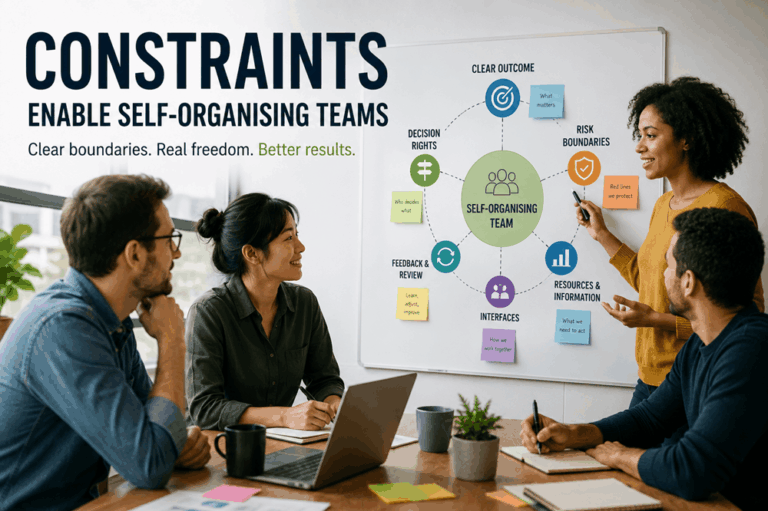
Leaders should provide enough structure to create direction without controlling every action. Leading Beat’s article on using constraints to enable self-organizing teams explains how clear goals, boundaries, and decision rights can support responsible autonomy.
Leadership behavior also teaches people what the organization genuinely values. A leader may ask employees to report risks early, but an angry response to unwelcome news teaches them to wait. A company may praise teamwork, but promotions based entirely on individual visibility teach people to compete for credit.
Teams learn more from consequences than from slogans.
When Working Alone Is the Better Choice
Not every assignment benefits from collaboration.
Individual work may be more suitable when:
- The task requires extended, uninterrupted concentration.
- One person already has the necessary expertise.
- The work has few meaningful dependencies.
- A preliminary analysis or first draft is needed.
- The information is private or highly confidential.
- Coordination would take longer than completing the task.
- Clear individual judgment or ownership is essential.
Even within a team project, people may need periods of independent work followed by deliberate coordination. A writer may prepare a draft alone, specialists may investigate separate questions, and analysts may examine data independently before the team compares findings.
The goal, then, is not to maximize collaboration. It is to use teamwork when combining people’s contributions improves understanding, judgment, capacity, or execution.
That is the useful truth behind “teamwork makes the dream work.” Important outcomes often depend on other people, but a shared ambition does not automatically create a functioning team. Talent does not guarantee coordination, communication does not guarantee understanding, and collective responsibility does not guarantee accountability.
The dream becomes more achievable when people share a clear purpose, understand how their work connects, exchange relevant information, disagree honestly, keep their commitments, and learn from what happens.