Vygotsky Theory of Cognitive Development Explains How Social Learning Shapes Children’s Thinking
A child may struggle with a new skill alone but succeed when a teacher, parent, or classmate offers the right hint. That simple situation captures much of Vygotsky’s theory of cognitive development.
Russian psychologist Lev Vygotsky argued that thinking develops through social interaction, language, and culture. Instead of viewing cognitive growth as something that happens only inside a child’s mind, his sociocultural theory shows how learning with other people can gradually lead to independent thinking.
What Is Vygotsky’s Theory of Cognitive Development?
Vygotsky’s theory is commonly known as sociocultural theory. Its central idea is that children develop important thinking skills while participating in the social and cultural world around them.
Parents, teachers, siblings, classmates, and other people introduce children to language, problem-solving methods, symbols, routines, and ways of understanding their environment. Children do not simply copy this information. They gradually learn to use these tools for themselves.
For example, a parent might initially help a child complete a puzzle by pointing out where to start. After enough practice, the child learns the strategy and can complete a similar puzzle without assistance.
For Vygotsky, that shift from supported activity to greater independence was an important part of development. Learning is not separate from social interaction; social interaction can help create new ways of thinking.
Unlike Jean Piaget, Vygotsky did not organize cognitive development into a fixed sequence of universal stages. His work focused more on how learning changes through social participation, language, and cultural experience.
Key Concepts in Vygotsky’s Theory
Several connected ideas make Vygotsky’s approach easier to understand.
Social Interaction
Social interaction plays a central role in cognitive development.
Children learn when they ask questions, watch others solve problems, participate in conversations, receive feedback, and work alongside people who have more experience with a task.
This does not mean that every interaction automatically produces learning. The important point is that interaction can expose children to strategies and ways of thinking that they are not yet using independently.
A child learning to count, for example, may first count objects with a parent. Later, the child can use the same process alone.
In Vygotsky’s view, skills that eventually become individual abilities often have an earlier social form.
Zone of Proximal Development
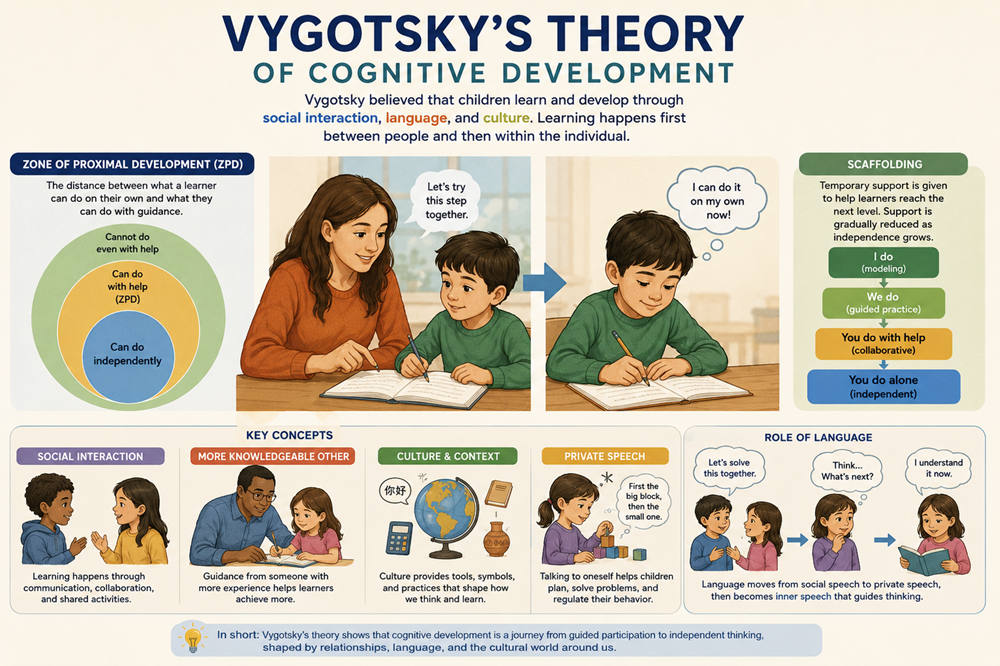
The Zone of Proximal Development, usually called the ZPD, is one of Vygotsky’s best-known concepts.
It refers to the area between what a learner can already accomplish independently and what the learner can accomplish with appropriate assistance.
Think of learning as having three general levels:
- Tasks a learner can already complete alone
- Tasks the learner can complete with some help
- Tasks that are currently too difficult even with help
The middle area is where the ZPD is most relevant.
Suppose a child can add simple numbers independently but gets stuck when a problem involves regrouping. A teacher demonstrates one step and asks a few guiding questions. With that support, the child finishes the problem.
The child has not fully mastered the skill yet, but the ability is developing.
The ZPD therefore shifts attention away from asking only, “What can this child do right now?” It also encourages us to ask, “What can this child learn to do with suitable guidance?”
Vygotsky’s original idea was more complex than simply matching students with slightly difficult work, but assisted versus independent performance remains central to understanding the concept.
More Knowledgeable Other
Modern explanations of Vygotsky often use the phrase more knowledgeable other, or MKO, for someone who can provide useful guidance during learning.
That person could be:
- a teacher
- a parent
- a tutor
- an older sibling
- a coach
- a classmate who understands the task better
Being the “more knowledgeable” person is not a permanent status.
A student who needs help with math could be the person helping another student learn how to use a computer program later that day. What matters is who has the knowledge or skill needed in that particular situation.
The phrase is widely used in modern explanations of sociocultural learning and describes the person who can provide the guidance a learner needs for a particular task.
Scaffolding
Scaffolding describes temporary support that helps a learner handle a task that would otherwise be difficult to complete independently.
A teacher might:
- demonstrate the first step
- provide a hint
- ask a guiding question
- break a large task into smaller parts
- remind the student of a useful strategy
The goal is not to keep providing the same level of assistance forever. Support should decrease as the learner becomes more capable.
For example, a teacher helping a student write an essay might initially provide an outline and help organize the first paragraph. On the next assignment, the student may only need a few prompts. Eventually, the student plans the essay independently.
Although scaffolding fits naturally with the ZPD, Vygotsky did not coin the term. It became associated with Vygotskian approaches to education through later work on guided learning.
That distinction matters because scaffolding is an application connected to Vygotsky’s ideas rather than one of his original named concepts.
Language, Private Speech, and Inner Speech
Language does more than allow children to communicate with other people. In Vygotsky’s theory, it can also become a tool for organizing thought and controlling behavior.
You can see this when children talk themselves through a challenging activity.
A child working on a puzzle might say:
“Corners first. This piece doesn’t fit. Try the blue one.”
The child is not necessarily trying to communicate with anyone nearby. The speech is helping guide the task.
This is known as private speech.
Rather than dismissing it as meaningless talking, Vygotsky saw self-directed speech as part of the development of self-regulation. Research on private and inner speech has continued to examine their connections with planning, attention, memory, and control of behavior.
As children develop, some of this spoken self-guidance becomes internal. Instead of saying each step aloud, they can think through it silently.
This is commonly described as inner speech.
Adults use versions of the same process when mentally rehearsing directions, working through a problem, or reminding themselves what to do next.
The Role of Culture in Cognitive Development
The word sociocultural is important because Vygotsky was interested in more than interactions between individual children and adults.
He also emphasized the cultural environment in which those interactions occur.
Every child grows up surrounded by tools that previous generations have developed. These include:
- language
- writing
- number systems
- symbols
- diagrams
- technologies
- social rules
- methods of organizing information
Learning to use these cultural tools changes what a person is able to do and, in many cases, how a person approaches a problem.
Consider mathematics. Children do not invent the number system from scratch. They learn symbols, counting methods, and mathematical procedures that already exist in their culture.
The same applies to reading and writing. A child learns an established system for recording and communicating ideas and eventually uses that system independently.
This cultural emphasis also helps explain why learning can look different across communities. Children may practice different skills depending on the activities, responsibilities, technologies, languages, and traditions that surround them.
Vygotsky’s theory therefore encourages us to look at development within its social and cultural setting rather than treating every child’s experience as identical.
How Vygotsky’s Theory Is Applied in the Classroom
Vygotsky’s ideas have clear implications for teaching.
Instead of giving students only work they have already mastered, teachers can introduce challenges that students are close to understanding and provide support where necessary.
Choose Tasks That Are Challenging but Reachable
A task should require some thought without being completely beyond the student’s current ability.
If work is far too easy, little new learning may occur. If it is far too difficult, additional explanation or prerequisite skills may be needed first.
The ZPD encourages teachers to look for the productive space between those extremes.
Use Guiding Questions
Teachers do not always need to give the answer immediately.
Questions such as:
“What do you already know about this problem?”
“What could you try first?”
“What happened when you used that method?”
can help students connect existing knowledge with a new problem.
Encourage Collaborative Learning
Students can learn from one another when collaboration is structured well.
One student may explain a concept in language another student understands easily, while group discussion can expose learners to different ways of approaching the same problem.
Peer learning fits Vygotsky’s broader emphasis on knowledge developing through participation with others.
Gradually Reduce Support
The purpose of guidance is greater independence.
As students understand a skill, teachers can provide fewer hints, fewer examples, and less direct involvement.
A student who once needed step-by-step help should eventually be able to choose a strategy and complete the task without assistance.
Vygotsky vs. Piaget
Vygotsky and Jean Piaget are often discussed together because both changed how psychologists understood children’s thinking.
However, they emphasized different parts of cognitive development.
Piaget is known for describing broad stages in which children’s reasoning changes as they develop. He also emphasized children’s active exploration and construction of knowledge.
Vygotsky placed greater emphasis on social interaction, language, culture, and guided learning. He did not propose a comparable set of universal cognitive stages.
The difference should not be exaggerated, though. Neither thinker viewed children as passive containers waiting for adults to fill them with information.
Both saw children as active participants in development. They mainly differed in how they explained the forces shaping that development.
Strengths and Limitations of Vygotsky’s Theory
One major strength of Vygotsky’s theory is its recognition that children learn within relationships.
A child’s ability cannot always be understood by looking only at what the child can perform alone. Sometimes the way a learner responds to a hint, demonstration, or question reveals an ability that is still developing.
The theory also gives culture a meaningful place in development. Language, symbols, educational practices, and everyday activities differ across communities, so children do not all encounter exactly the same learning environment.
Vygotsky’s treatment of language is another lasting contribution. His ideas about private and inner speech helped establish an important way of examining how communication with others can become part of self-guided thought.
There are limitations as well.
A child’s ZPD is not something a teacher can identify with a single simple measurement. The amount and type of help a learner needs can vary from task to task.
Vygotsky’s theory also does not offer the kind of clearly defined age-based sequence found in Piaget’s stage theory. That makes it less useful when someone wants a simple timetable showing exactly when a particular cognitive ability should appear.
His work also needs to be understood carefully rather than reduced to slogans such as “children learn from adults.” The larger theory involves relationships among social activity, language, culture, and the development of higher psychological processes.
Why Vygotsky’s Theory Still Matters
Vygotsky’s theory offers a practical way to understand why people can often do more with good guidance than they can manage alone.
A learner may first solve a problem during a conversation with someone else. With practice, the strategies used in that shared activity can become part of the learner’s own way of thinking.
That is the central value of the Vygotsky theory of cognitive development: learning is not simply an individual process. Our thinking develops within relationships, through language, and with cultural tools that help us gradually turn supported learning into independent ability.