
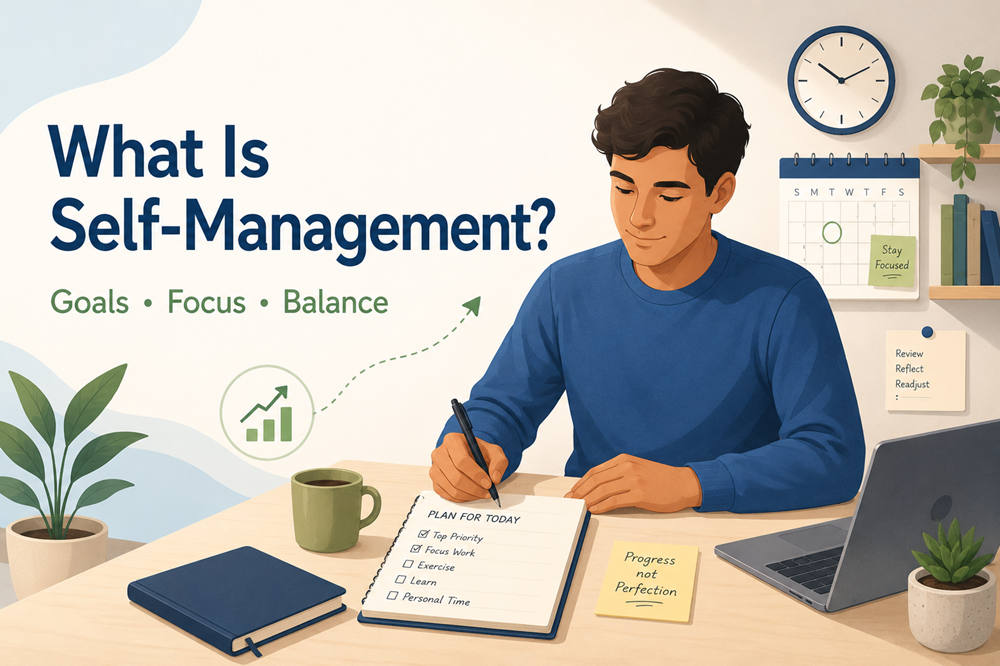
What Is Self-Management? Meaning, Skills, and Everyday Examples
Self-management is the ability to manage your thoughts, emotions, and behavior so you can handle responsibilities and work toward your goals. It helps you decide what needs to be done, control unhelpful reactions, stay focused, and adjust when things do not go as planned.
CASEL’s social and emotional learning framework connects self-management with managing emotions, handling stress, staying motivated, setting goals, planning, organizing, and taking initiative.
A student practices self-management by studying before an exam without being reminded. An employee uses it by organizing assignments, meeting deadlines, and communicating early when a problem appears. In everyday life, it may mean following a budget, keeping an appointment, or staying calm during a disagreement.
Self-management does not mean doing everything alone or never experiencing difficult emotions. It means taking responsibility for your choices while recognizing when you need information, support, or a different approach.
Why Is Self-Management Important?
Strong self-management skills can make you more dependable and independent. Instead of waiting for someone else to direct every action, you can identify priorities, create a plan, and follow through.
Self-management can help you:
- Complete responsibilities on time
- Stay focused on long-term goals
- Make thoughtful decisions
- Handle setbacks more calmly
- Reduce avoidable stress
- Build reliable habits
- Communicate problems before they grow
- Learn from mistakes
These abilities matter at school, at work, in relationships, and when managing personal responsibilities.
Key Self-Management Skills
Self-management is not one skill. It is a combination of abilities that help you guide your actions in different situations.
1. Emotional Regulation
Emotional regulation means recognizing your emotions and choosing how to respond to them. It does not mean pretending that you are not angry, nervous, disappointed, or frustrated.
For example, you may feel defensive after receiving criticism. Instead of immediately arguing, you can pause, listen, and decide whether the feedback could help you improve.
Useful ways to manage an emotional reaction include:
- Taking a few slow breaths
- Waiting before sending a message
- Stepping away briefly
- Writing down what you are thinking
- Considering the result you want
The goal is not to eliminate emotion. It is to prevent a temporary feeling from controlling an important decision.
2. Goal Setting and Planning
Goals give your efforts a clear direction. Planning turns those goals into actions.
A vague goal such as “I want to get healthier” can be difficult to follow. A clearer goal might be, “I will walk for 30 minutes four times this week.”
The APA’s explanation of goal setting notes that goals are more effective when people understand what they are trying to accomplish, accept the goal, and believe it is attainable. Goal setting can also improve focus, persistence, and the development of better strategies.
Large goals become easier to manage when you divide them into smaller steps. Instead of trying to complete an entire project at once, identify the first task, give it a deadline, and continue from there.
3. Time Management and Prioritization
Time management is deciding how to use your available time. Prioritization is deciding which tasks deserve attention first.
A full schedule is not always a productive one. Good self-management involves focusing on important work rather than trying to stay busy every minute.
Before starting your day, ask:
- What must be completed today?
- Which task has the greatest consequences?
- What can wait?
- What can be simplified or removed?
It also helps to leave some open space in your schedule. Unexpected delays happen, and a plan with no flexibility can quickly fall apart.
4. Self-Discipline and Motivation
Motivation is the desire to take action. Self-discipline helps you continue when that desire becomes weaker.
You use self-discipline when you study instead of checking social media, follow your budget when you want to make an unnecessary purchase, or finish an assignment before watching television. It often means giving up a small, immediate reward to support a more valuable long-term goal.
However, self-management should not depend entirely on willpower. Your surroundings can make good choices easier.
For example, you could:
- Turn off unnecessary notifications
- Prepare materials before starting
- Keep distractions outside your workspace
- Use a regular study or work routine
- Begin with a small, manageable task
These changes reduce the number of temptations and decisions you must handle.
5. Stress Management
Stress is a normal response to challenging situations, but long-term stress can affect your physical health, mental well-being, and ability to complete everyday activities.
The CDC’s guidance on managing stress explains that ongoing stress may contribute to sleep problems, low energy, difficulty concentrating, headaches, irritability, and trouble making decisions.
Healthy ways to manage everyday stress include:
- Taking regular breaks
- Getting enough sleep
- Being physically active
- Talking with someone you trust
- Practicing slow breathing or relaxation
- Breaking a large problem into smaller actions
Even a short pause, a walk, or a conversation with someone supportive can make a stressful situation feel more manageable. The CDC also recommends physical activity, connection with others, and taking a few minutes to care for yourself.
Stress management also involves recognizing when your workload is unrealistic. Sometimes the responsible choice is to change a deadline, set a boundary, or ask for assistance.
Persistent stress, anxiety, or emotional difficulties may require more than ordinary self-management strategies. Consider speaking with a qualified healthcare or mental health professional when a problem becomes overwhelming or interferes with daily life.
6. Adaptability and Accountability
Even a good plan may need to change. Adaptability helps you respond to new information or unexpected problems without abandoning the main goal.
Suppose you planned to study at the library, but it closes unexpectedly. You could study somewhere else, move the session to another time, or complete a different task first.
Accountability means being honest about your choices and results. If you miss a deadline, accountability is not simply admitting that you failed. It involves identifying what happened and deciding how to prevent the same problem next time.
You might say:
“I underestimated how long the assignment would take. Next time, I will begin earlier and provide an update if I fall behind.”
That response accepts responsibility while creating a practical plan for improvement.
Examples of Self-Management
Self-management appears in many ordinary situations.
At School
A student may:
- Keep track of assignments
- Begin studying before the night of an exam
- Put their phone away during class
- Ask questions when instructions are unclear
- Balance schoolwork with sleep and personal time
Students also use self-regulated learning when they monitor what they understand, test their knowledge, and spend more time on subjects they have not yet mastered.
At Work
An employee may:
- Prioritize important assignments
- Prepare for meetings
- Communicate delays early
- Respond professionally to feedback
- Stay calm when priorities change
Self-management at work does not mean accepting an unreasonable workload without speaking up. Workplace demands, available resources, communication, and management practices can all affect stress and well-being.
At Home
Self-management may involve:
- Paying bills on time
- Following a household routine
- Planning meals
- Limiting unnecessary spending
- Completing chores without repeated reminders
In Relationships
You practice self-management when you listen before responding, respect boundaries, keep promises, and discuss problems without turning every disagreement into a personal attack.
Self-Management, Time Management, and Self-Control
These terms are related, but they do not mean exactly the same thing.
Time management focuses on how you organize and use your time. It is one part of self-management.
Self-control usually involves resisting an immediate impulse or temptation. The APA defines self-control as managing your behavior and choosing a more valuable long-term outcome instead of a smaller immediate reward.
Self-management is broader. It includes self-control and time management, along with emotional regulation, planning, motivation, stress management, and the ability to adjust your behavior over time.
For example, resisting an unnecessary purchase is self-control. Creating a budget, tracking your spending, and changing your financial habits are forms of self-management.
How to Improve Your Self-Management Skills
You do not need to change your entire life at once. Improving one repeated behavior can make a noticeable difference.
Choose One Specific Area
Start with a problem you regularly experience, such as arriving late, missing deadlines, becoming distracted, or reacting emotionally.
Turn it into a clear goal. Instead of “I need to become more organized,” try “I will write tomorrow’s task list before going to bed.”
Create a Simple Routine
Routines make helpful behavior easier to repeat. You might plan your week every Sunday, study at the same time each evening, or prepare your work materials the night before.
Keep the routine simple enough to maintain. A basic system you actually use is more helpful than a complicated one you abandon after three days.
Track What Happens
Use a calendar, notebook, spreadsheet, or habit tracker to record your progress. This type of self-monitoring can help you notice patterns in your behavior, evaluate your progress, and decide what needs to change.
Tracking is not about proving that you are perfect. It helps you understand which actions support your goals and which habits repeatedly get in the way.
Review and Adjust
At the end of each week, consider:
- What did I complete?
- What distracted me?
- Which task took longer than expected?
- What should I change next week?
Reviewing your progress matters because setting a goal alone is not always enough. Research summarized by the APA suggests that monitoring progress helps turn goals into action.
Self-management is not about following one perfect plan forever. It is about paying attention, learning from experience, and making better adjustments over time.
Final Thoughts
Self-management is the ability to guide your thoughts, emotions, time, and behavior toward meaningful goals. It includes planning, emotional regulation, self-discipline, motivation, stress management, adaptability, and accountability.
You will not manage every situation perfectly. What matters is recognizing your choices, taking responsibility for them, and building routines that make helpful actions easier to repeat.