
What Is the Purpose of Brainstorming During the Development of an Action Plan?
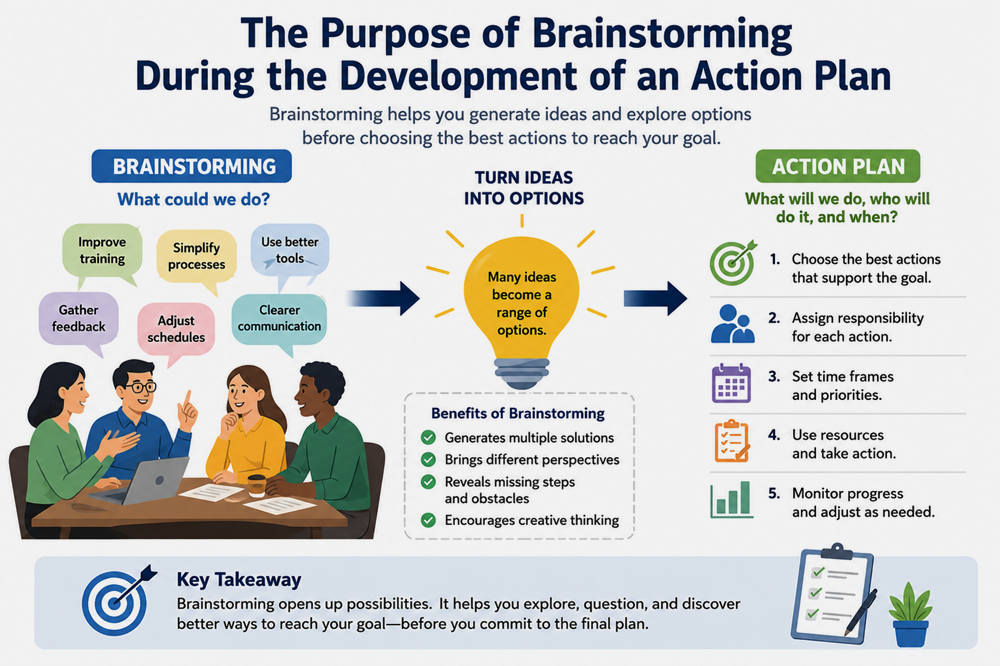
The purpose of brainstorming during the development of an action plan is to generate possible ideas, solutions, and actions before deciding which ones should become part of the plan. It gives you time to explore different ways to reach a goal instead of immediately choosing the first solution that comes to mind.
In simple terms, brainstorming answers “What could we do?” Once you have enough ideas, you can decide what you actually will do, who will do it, and when it needs to happen. Brainstorming creates a broad list of ideas before those ideas are reviewed and turned into next steps.
What Brainstorming Means in Action Plan Development
An action plan turns a goal into specific tasks. It normally identifies the work that needs to be completed, establishes priorities, assigns responsibility, and sets time frames.
Brainstorming usually comes before those details are finalized.
For example, imagine a team wants to reduce missed project deadlines. Instead of immediately deciding that employees need more meetings, the team could brainstorm several possibilities:
- Set more realistic deadlines.
- Divide large projects into smaller milestones.
- Clarify who owns each task.
- Review employee workloads.
- Use better project-tracking tools.
- Hold short progress check-ins.
- Create an early-warning system for delays.
At this point, the team does not need to decide which idea is best. The purpose is to create enough useful options to make a better decision afterward.
Why Brainstorming Is Important When Creating an Action Plan
Brainstorming improves the planning process because it gives you choices. It can also bring out ideas, obstacles, and viewpoints that might otherwise be missed.
It Generates Different Ways to Reach the Goal
A goal rarely has only one possible solution.
Suppose a business wants to improve customer satisfaction. Possible actions could include better employee training, faster complaint handling, clearer return policies, improved products, or better customer feedback systems.
If the team settles on the first suggestion immediately, it may overlook a simpler or more effective approach.
Good brainstorming guidelines encourage people to create a broad list first and evaluate it afterward. Separating idea generation from immediate criticism gives you several alternatives to compare instead of building the whole action plan around one assumption.
It Brings Different Perspectives Into the Discussion
When several people are involved in a goal, each person may see a different part of the problem.
A manager might be concerned about cost. An employee doing the work may notice an inefficient process. Someone dealing directly with customers may understand complaints that other team members rarely hear.
Brainstorming creates space for those perspectives before decisions are made.
This is especially useful for workplace, school, organizational, and community plans where several people will eventually be responsible for carrying out the actions.
It Helps Identify Missing Steps and Obstacles
Brainstorming can also reveal practical details that were easy to overlook.
Imagine you are planning a community event. Your first list may include finding a location, inviting guests, and arranging food. Further brainstorming might reveal the need for parking, permits, volunteers, accessibility, equipment, cleanup, security, or a backup plan for bad weather.
You can also brainstorm potential barriers.
If a company wants to introduce a new employee training program, possible obstacles might include scheduling conflicts, limited training time, budget restrictions, remote employees, or a shortage of instructors.
Thinking about these issues early makes it easier to create an action plan that can actually be carried out.
How Brainstorming Turns a Goal Into Action Steps
The process becomes easier to understand when you separate it into stages.
Start with a clear goal.
For example:
Goal: Reduce customer response times.
Next, brainstorm possible actions:
- Create standard email templates.
- Add another customer-service employee.
- Improve the ticket-priority system.
- Expand the website’s FAQ section.
- Provide additional staff training.
- Track response times every week.
- Assign urgent requests to designated employees.
Now evaluate the ideas.
Ask which options are realistic, which ones directly support the goal, what resources they require, and which are likely to have the greatest effect.
You can also use principles from the SMART framework to make sure goals and action plans are specific, measurable, achievable, relevant, time-bound, and realistic given the resources available.
After that review, the selected ideas can become specific action steps. A practical action plan should move beyond broad ideas by identifying necessary tasks, deciding priorities, assigning responsibility, and setting time frames.
The final plan might include:
- Create standard response templates for the five most common customer questions.
- Introduce a priority system for urgent support requests.
- Measure average customer response time each week.
The brainstorm produced possibilities. The action plan turned the strongest possibilities into commitments.
Not Every Brainstormed Idea Belongs in the Action Plan
A productive brainstorming session may generate many ideas, but that does not mean every suggestion should be used.
Some ideas may cost too much. Others may require resources you do not have. Two suggestions may solve the same problem, while another may not contribute enough to the main goal.
After brainstorming, review each option by asking:
- Does this idea directly support the goal?
- Is it realistic?
- Do we have the people, money, or tools to carry it out?
- How much time will it require?
- Who could be responsible for it?
- How will we know whether it worked?
The Community Tool Box guidance on identifying action steps follows a similar process: brainstorm different ways to implement a proposed change and then develop a final list of action steps from the ideas generated.
This is why brainstorming should not be confused with making the final decision. Brainstorming creates choices; evaluation determines which choices belong in the plan.
Simple Example of Brainstorming an Action Plan
Imagine a manager wants to reduce missed deadlines.
The team begins with one question:
What could we change to help projects finish on time?
They brainstorm several ideas:
- Hold weekly progress meetings.
- Set more realistic deadlines.
- Assign one person to every major task.
- Divide projects into smaller milestones.
- Review workloads before assigning new work.
- Require employees to report likely delays earlier.
After discussing the ideas, the team discovers that two problems cause many of its delays: unclear task ownership and managers finding out about problems too late.
Instead of putting every brainstormed idea into the action plan, the team chooses three:
- Assign a clear owner to every major project task.
- Divide long projects into smaller milestones with individual deadlines.
- Hold a short weekly check-in to identify delays early.
Those steps are much more useful than a vague goal such as “finish projects faster.” They give the team specific actions it can carry out.
A complete plan can then add responsibility, deadlines, available resources, and ways to monitor progress. Guidance on developing an action plan also emphasizes defining the changes or action steps needed to move toward a goal.
Key Takeaway
The purpose of brainstorming during the development of an action plan is to explore a range of possible solutions and actions before choosing the ones that will be included in the final plan.
It helps you avoid jumping to the first solution, brings different perspectives into the process, and can uncover important steps or obstacles you had not considered.
The distinction is simple:
Brainstorming asks, “What could we do?”
The action plan answers, “What will we do, who will do it, and when?”
That is what makes brainstorming a useful early step in creating a practical action plan.