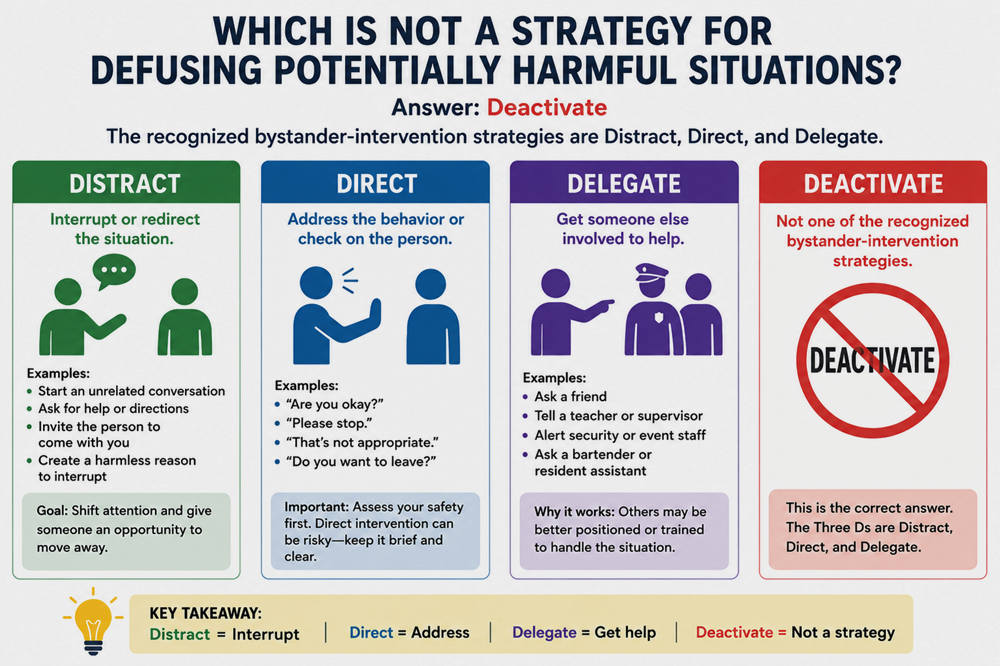
Which Is Not a Strategy for Defusing Potentially Harmful Situations? Explained Clearly
If the choices are Distract, Direct, Deactivate, and Delegate, the answer is Deactivate. This question relates to bystander intervention, where Distract, Direct, and Delegate are recognized ways to respond when you notice a situation that could become harmful.
The easiest way to remember the answer is simple: Distract interrupts the situation, Direct addresses it, and Delegate gets someone else involved. Deactivate is not part of this group of strategies.
Which Is Not a Strategy for Defusing Potentially Harmful Situations?
Correct answer: Deactivate.
The three relevant strategies are:
- Distract — create an interruption that changes what is happening.
- Direct — address the concerning behavior when it is safe to do so.
- Delegate — ask another person for help.
- Deactivate — not one of the recognized strategies in this question.
These approaches are commonly called the Three Ds of bystander intervention: Distract, Delegate, and Direct. Right To Be explains that the Three Ds were later expanded into its current 5Ds model by adding Delay and Document.
So, even though “Deactivate” may sound like something you could do to calm a situation, it is not the term used in this framework.
Why Deactivate Is the Correct Answer
The word deactivate can make the question tricky because it sounds similar to de-escalate.
De-escalation is a real safety concept. It refers to reducing or stabilizing the intensity of a tense or potentially dangerous situation through communication and other techniques. Deactivate, however, is not one of the named bystander-intervention strategies being tested here.
For this question, focus on remembering the three recognized choices:
Distract. Direct. Delegate.
Each gives a bystander a different way to respond without assuming that direct confrontation is always necessary.
Distract
The Distract strategy involves interrupting what is happening without directly confronting the person causing concern.
The goal is to shift attention, break the momentum of the interaction, or give someone an opportunity to move away.
For example, you could:
- Start an unrelated conversation.
- Ask someone for directions or help.
- Invite the person to join you somewhere else.
- Create a harmless reason to interrupt.
- Drop something or cause a small distraction.
Imagine you are at a party and notice that someone looks uncomfortable while another person keeps pressuring them. You might walk over and say, “Hey, can you come help me with something?”
You have not started an argument or accused anyone of anything. You have simply created an opening for the person to leave the situation.
Right To Be describes distraction as a subtle way to interrupt harassment and recommends focusing on the person experiencing the unwanted behavior rather than engaging the person causing it.
RAINN’s bystander-intervention guidance similarly includes creating a distraction as one way to interrupt potentially harmful behavior.
Direct
The Direct strategy means openly responding to what you see happening.
That could mean checking on the person who appears uncomfortable or clearly telling someone that their behavior needs to stop.
Examples include:
- “Are you okay?”
- “Do you want to leave?”
- “Please stop.”
- “They already said no.”
- “That’s not appropriate.”
Being direct does not mean you need to shout, threaten someone, or start a confrontation. A short, clear statement may be enough.
However, Direct is not always the safest choice. If the person involved is aggressive, hostile, or likely to escalate, confronting them could increase the risk. Right To Be recommends considering your safety before using Direct and notes that it carries more risk because it involves confronting the person responsible for the behavior.
If direct involvement does not feel safe, Distract or Delegate may be a better option.
Delegate
The Delegate strategy means asking someone else to help with the situation.
You might turn to:
- A friend
- A teacher
- A supervisor
- A resident assistant
- A bartender
- Event staff
- Security personnel
- Another nearby bystander
For example, suppose you see an argument becoming increasingly aggressive at a concert. Instead of stepping between the people yourself, you could tell security what is happening.
That is still intervention. You are recognizing a possible problem and getting help from someone who may be better positioned to respond.
Right To Be includes Delegate as one of its established bystander-intervention methods, while RAINN uses a similar approach called Rally Others, which involves bringing other people into the response when help is needed.
Direct, Distract, and Delegate at a Glance
| Strategy | What You Do | Simple Example |
|---|---|---|
| Distract | Interrupt or redirect the interaction | Start an unrelated conversation |
| Direct | Address what is happening | “Are you okay?” or “Please stop.” |
| Delegate | Get another person involved | Ask security or a supervisor for help |
| Deactivate | Not part of the Three Ds | Correct answer to the question |
The strategies give you different options because no single response works in every situation.
Sometimes a distraction is enough. Sometimes speaking directly makes sense. In other cases, getting someone else involved is safer.
The CDC’s sexual violence prevention guidance includes bystander approaches among its prevention methods and identifies Green Dot as an example of a bystander-based prevention program.
The Key Difference to Remember
You do not need to overthink this question.
Use this simple memory aid:
Distract = interrupt.
Direct = address.
Delegate = get help.
Deactivate = not one of the strategies.
So, when asked “Which is not a strategy for defusing potentially harmful situations?”, choose Deactivate if the other options are Distract, Direct, and Delegate.
The main idea behind the question is that bystanders have several ways to respond to concerning behavior. You can interrupt what is happening, address it directly when safe, or bring in someone else who can help.