Teams as Complex Adaptive Systems
A leader assembles capable people, assigns clear roles, creates a timeline, and establishes measures for tracking progress.
On paper, the project looks controllable.
Then a minor misunderstanding changes how two members coordinate. One missed deadline causes another department to protect itself by withholding commitments. A respected employee questions an assumption, making others more willing to speak honestly. A customer complaint exposes a problem nobody anticipated.
No single event explains what happens next. The team’s behaviour changes through the interaction of all of them.
This is why teams cannot always be managed like machines. Their performance does not come only from individual skills, personalities, and effort. It also emerges from relationships, feedback loops, shared history, informal rules, dependencies, and changing external conditions.
A systematic review of 92 studies published over 17 years found growing research support for examining teams through a complex-adaptive-systems lens. A broader review of team effectiveness research similarly describes organisational teams as dynamic systems that develop in response to their environments.
This perspective does not make planning, roles, or accountability irrelevant. It asks leaders to pay attention to the interactions and patterns through which those formal structures become real team behaviour.
What Is a Complex Adaptive System?
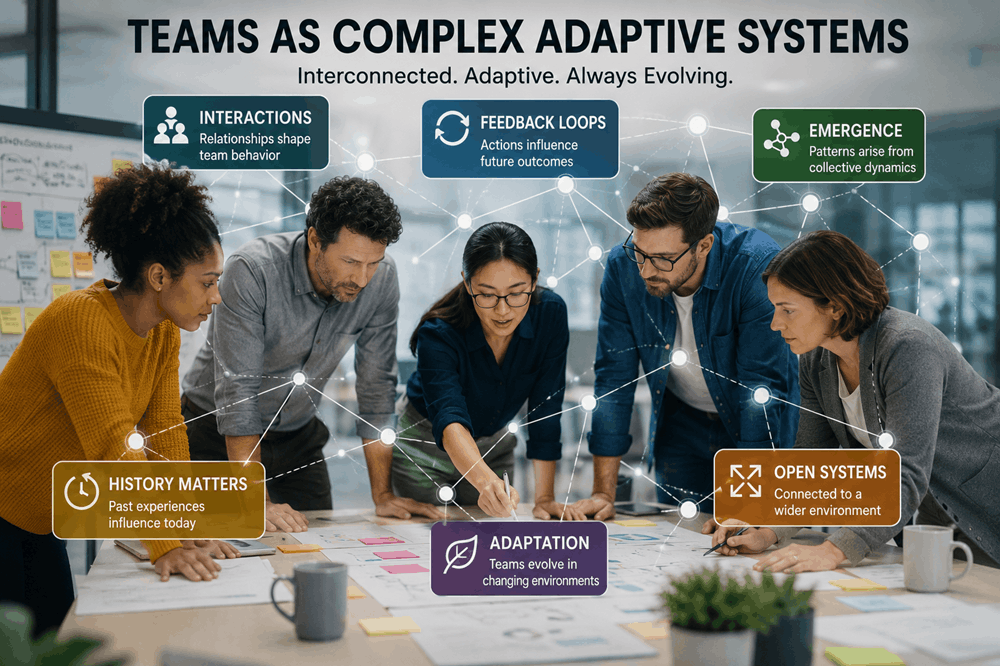
A complex adaptive system is a network of interacting participants whose local actions contribute to evolving patterns across the wider system.
Within a team:
- Members are the interacting participants.
- Conversations, decisions, habits, and dependencies form the connections.
- Feedback changes future behaviour.
- Informal norms emerge through repetition.
- External events continually affect the team.
- Overall behaviour cannot always be predicted by examining each member separately.
A study of interdisciplinary healthcare teams as complex adaptive systems identified features including local autonomy, team history, interaction with the external environment, nonlinear relationships, and emergent behaviour.
That research concerned a particular healthcare setting, so it does not prove that every team behaves identically. It does show how the framework can reveal patterns that conventional descriptions of roles and individual performance may miss.
A practical definition is:
A team behaves as a complex adaptive system when its overall patterns develop through continuing interactions among members and between the team and its environment.
Complex Is Not the Same as Complicated
The words complex and complicated are often treated as synonyms, but they call for different responses.
A complicated problem may involve many parts and require substantial expertise. Cause and effect can still be investigated and understood.
Examples might include:
- Repairing specialised machinery
- Calculating a difficult tax obligation
- Designing a component under stable requirements
- Following a detailed regulatory procedure
A complex situation involves interacting people or conditions whose responses alter the situation itself.
Examples include:
- Rebuilding trust after conflict
- Responding to changing customer behaviour
- Coordinating several teams during an uncertain launch
- Changing an established workplace culture
- Encouraging employees to report emerging risks
Complexity is not a permanent label attached to a type of work. Designing a technical component may be complicated under stable conditions but become complex when requirements, technologies, stakeholder expectations, and regulations are all changing.
The Cynefin framework distinguishes ordered contexts, where cause and effect are sufficiently predictable, from complex contexts characterised by entanglement and enabling constraints.
One team may simultaneously face routine, complicated, complex, and urgent problems. The leadership challenge is to recognise the current context rather than apply the same management approach everywhere.
A Team Is More Than the Sum of Its Members
Traditional team analysis often begins with individual characteristics:
- Skills
- Experience
- Motivation
- Personality
- Job responsibilities
Those factors matter, but they do not fully explain performance.
Two groups containing similarly capable people may produce very different results because their interaction patterns differ.
One team shares incomplete information early, investigates disagreement, and asks for help before problems become serious. Another delays bad news, protects departmental interests, and waits for authority to resolve every uncertainty.
The difference is not simply talent. It is how that talent is connected.
A study of 96 real-world teams involving 1,395 members found that participative interaction patterns were associated with better perceived information sharing and effectiveness. Repetitive patterns were associated with poorer results, particularly during nonroutine work.
Team performance therefore depends partly on questions such as:
- Who speaks to whom?
- Whose information receives attention?
- How does the group respond to disagreement?
- Where do decisions stall?
- Who connects otherwise separated areas of expertise?
A team is not merely the sum of its talent. It is also the pattern through which that talent interacts.
Team Behaviour Is Often Nonlinear
In a linear system, a small input produces a proportionately small result.
Teams do not always behave that way.
A short comment from a trusted employee may change an entire discussion. One act of public blame may make people cautious for months. A small improvement in information sharing may remove several recurring delays.
The same intervention can also have different effects in different teams.
A daily meeting might improve coordination in one group. In another, it may become a ritual in which members perform progress, hide uncertainty, and wait for the manager to solve their problems.
This does not mean outcomes are random. Their effects depend on context, including:
- Existing relationships
- Previous events
- Informal authority
- Incentives
- Timing
- External pressure
Small events can sometimes produce disproportionate effects when they interact with conditions already present in the team.
This is one reason leaders should be cautious about copying practices simply because they worked elsewhere. The visible practice may not be the underlying cause of the result.
Team Qualities Emerge Through Interaction
Many qualities associated with effective teams cannot be established by declaration alone.
These include:
- Trust
- Psychological safety
- Shared understanding
- Collective confidence
- Informal leadership
- Coordination habits
- Conflict patterns
They develop through repeated experience.
Members observe whether colleagues keep commitments, admit mistakes, share useful information, and respond constructively to problems. They also watch what happens to the first person who challenges a popular decision or delivers unwelcome news.
Leaders can deliberately support these qualities through consistent behaviour, clear processes, coaching, and fair responses. They cannot create them merely by including the right words in a values statement.
Team qualities also influence later interactions. A history of constructive disagreement makes future disagreement easier. Repeated blame makes people increasingly defensive.
The team’s behaviour shapes what the team becomes, and what the team has become shapes how members behave next.
Feedback Loops Reinforce Patterns
Teams continually learn from the consequences of their own behaviour.
Consider a destructive loop:
- A leader reacts badly to unexpected news.
- Employees become more cautious about reporting problems.
- The leader receives incomplete information.
- Decisions become less realistic.
- More problems arrive as surprises.
- The leader responds with greater control.
The leader’s original reaction has helped create the conditions that appear to justify further control.
A healthier loop might begin when someone raises a concern early. The team investigates without immediately assigning blame, prevents a larger problem, and makes speaking up more credible. More weak signals then become visible.
The formal policy may say, “Report risks immediately.” The real feedback loop may teach employees that reporting risk damages their reputation.
Leaders should therefore examine what the team’s reactions actually reinforce:
- What happens after someone admits a mistake?
- Who benefits from withholding information?
- Which behaviours receive attention and recognition?
- What becomes less likely after a negative reaction?
- Which patterns repeat despite official instructions?
Teams learn from consequences more powerfully than they learn from slogans.
History Remains Active
Teams carry earlier experiences into new work.
Members remember:
- Broken promises
- Previous failures
- Unfair decisions
- Successful improvisations
- Earlier conflicts
- Which risks were punished
- Who received credit
A new manager may introduce an open-door policy, but employees who were previously punished for honesty may remain silent. A team that survived a crisis by bypassing formal procedures may continue using the same workarounds after the emergency ends.
The behaviour can appear irrational when its history is ignored. To team members, it may represent a sensible response to what they have already experienced.
Leaders inherit patterns before they begin changing them.
Before introducing a new process, it helps to ask:
- What happened here before?
- Which commitments were not honoured?
- What has the team learned to avoid?
- Which unofficial practices currently protect performance?
- Why might the new proposal be difficult to trust?
Understanding history does not mean preserving every old habit. It makes attempts to change those habits more realistic.
Teams Are Open Systems
A team does not operate independently from the organisation around it.
Its behaviour may be affected by customers, senior leaders, neighbouring teams, staffing levels, technology, incentives, regulation, and competing priorities.
A team may appear dysfunctional because several executives continually give it conflicting instructions. Another may appear highly efficient only because surrounding teams absorb its delays and unfinished work.
A systematic review of teams implementing new practices found that adaptive functioning, shared cognitive states, communication, trust, and coordination supported implementation. Staffing shortages, turnover, competing goals, and dysfunctional processes created barriers. The findings came from healthcare and human-services settings, but they illustrate how team adaptation depends on both internal behaviour and surrounding conditions.
Before treating a problem as an individual or internal team failure, ask:
- Which conflicting demands are entering the team?
- What resources or information are missing?
- Which dependencies prevent local improvement?
- What external incentives reinforce the current behaviour?
- Is apparent team success creating hidden costs elsewhere?
Improving the team may require changing part of the system around it.
Adaptation Matters More Than Perfect Optimisation
Traditional management often tries to identify the best process and standardise it.
That works well when conditions are stable and the work is repeatable. In an uncertain environment, a process perfectly optimised for today may become fragile tomorrow.
An adaptive team can:
- Detect meaningful change
- Share information quickly
- Reallocate attention
- Revise assumptions
- Learn from unexpected results
- Adjust its coordination
Adaptation does not mean constantly changing direction. Teams need enough continuity to retain knowledge and enough flexibility to respond when circumstances genuinely change.
The goal is not permanent movement. It is responsiveness based on evidence.
How Leaders Can Support Adaptive Teams
Viewing a team as a complex adaptive system shifts leadership from controlling every interaction to shaping conditions.
Establish direction and boundaries
The team needs a meaningful outcome, clear decision rights, essential risk limits, and an understanding of its major dependencies.
Within those boundaries, members need room to alter their methods as new information appears.
Too little structure creates confusion. Too much instruction prevents local adaptation.
Improve information flow and shared understanding
A team cannot adapt to signals it never receives or cannot interpret.
Leaders should make it easier for:
- Frontline observations to reach decision-makers
- Specialists to challenge assumptions
- Members to disclose mistakes
- Customers to influence priorities
- Connected teams to coordinate dependencies
A meta-analysis of 72 studies found positive relationships between information sharing and team performance, cohesion, decision satisfaction, and knowledge integration.
More communication is not automatically better. Teams need relevant information to reach people who can understand and act on it.
Members also need enough shared understanding to know what the team is trying to accomplish, how their work connects, who possesses particular expertise, and which signals require escalation.
Shared understanding does not require identical opinions. Different interpretations can help the team detect change and challenge weak assumptions.
Run a portfolio of small probes
When cause and effect cannot be predicted confidently, placing all confidence in one large experimental solution creates unnecessary risk.
The Cynefin approach recommends using safe-to-fail probes: several small, coherent experiments designed to reveal possible paths forward.
A useful portfolio should:
- Test different explanations
- Operate within clear boundaries
- Produce observable feedback
- Contain the consequences of failure
- Allow promising patterns to be amplified
- Allow harmful patterns to be stopped early
“Safe to fail” does not mean careless. Legal, ethical, safety, and financial boundaries still apply.
Create short learning loops
Teams need structured opportunities to examine what happened, what they expected, and what should change.
A review can ask:
- What were we trying to achieve?
- What actually happened?
- What contributed to the difference?
- What should we repeat, change, or test next?
A review of team-development interventions notes meta-analytic evidence that properly conducted debriefs can improve team effectiveness substantially, even when the sessions are relatively brief.
The purpose is not to identify one person to blame. It is to update the team’s shared understanding and future behaviour.
Watch patterns as well as individual performance
Individual accountability remains necessary, but leaders should also notice:
- Repeated handoff failures
- Information that consistently arrives late
- People who become central during disruption
- Recurring informal workarounds
- Behaviour that spreads after mistakes
- Hidden costs imposed on other teams
A recurring problem may not be explained by one person’s motivation or ability. It may be continually recreated by the system.
Allow useful leadership to emerge
During uncertain work, leadership may temporarily come from the person holding the most relevant knowledge rather than the highest title.
A technical specialist may guide the response to a system failure. A frontline employee may recognise a changing customer pattern. A coordinator may connect people holding different parts of the problem.
A theoretical review of leadership for organisational adaptability proposes that leaders can help connect emerging ideas with operational systems so useful innovations can be developed and adopted.
Formal authority still matters. Effective formal leaders recognise and support valuable influence emerging elsewhere rather than treating it as a threat.
A Product Launch Under Pressure
Consider a cross-functional team preparing to launch a new product.
Its plan assigns responsibilities, deadlines, and expected outputs. Shortly before release:
- A technical issue delays an important feature.
- Sales has promised that feature to a major customer.
- Marketing materials are built around it.
- Support notices that early users misunderstand another part of the product.
- Departments begin protecting their own commitments.
A mechanical response would demand that everyone return to the original timeline.
An adaptive response would:
- Build a shared picture of the changed situation.
- Reconfirm the non-negotiable customer, safety, legal, and financial constraints.
- Develop and test several viable responses.
- Review the effects quickly and adapt as new information appears.
Possible responses might include delaying the release, launching without the feature, limiting the first release, changing the marketing message, or temporarily providing part of the service manually.
The original plan has not become useless. It remains one input into a system whose conditions have changed.
What This Perspective Does Not Mean
Teams are not impossible to manage
Leaders can influence purpose, incentives, resources, constraints, information flow, and reactions to events.
They simply cannot guarantee every result through instructions.
Prediction and standardisation still matter
Many activities remain stable and repeatable. Forecasts, technical expertise, checklists, and standard processes are valuable in those contexts.
The challenge is recognising when the situation has become too interdependent or changeable for a fixed answer.
Systems thinking does not erase responsibility
Patterns matter, but individuals remain accountable for misconduct, negligence, dishonesty, and harmful choices.
A systems perspective expands the investigation. It should not become an excuse.
Complexity is not permission for disorder
Complex systems still require effective boundaries. Removing all constraints produces confusion or chaos rather than useful self-organisation.
The framework is a lens, not a universal law
Management writing sometimes borrows language from the natural sciences too confidently.
A critical review of complexity leadership theory found that parts of the literature relied heavily on broad scientific analogies and offered limited empirical evidence for some practical prescriptions.
Viewing teams as complex adaptive systems is useful because it highlights interactions, emergence, feedback, history, and context. It does not prove that every complexity-inspired practice will work in every organisation.
Guide the Conditions, Not Every Interaction
A leader can assemble capable people, define roles, and create a sensible plan.
What the plan cannot fully specify is how members will respond to uncertainty, how information will travel, which informal patterns will emerge, or how one disruption will affect the rest of the team.
That uncertainty does not make leadership unnecessary. It changes what good leadership requires.
Teams become more adaptable when people can detect change, share useful information, learn from outcomes, and reorganise their work within responsible boundaries.
A team is not a machine to be programmed.
It is an evolving pattern of relationships that must be guided, observed, and continually renewed.