
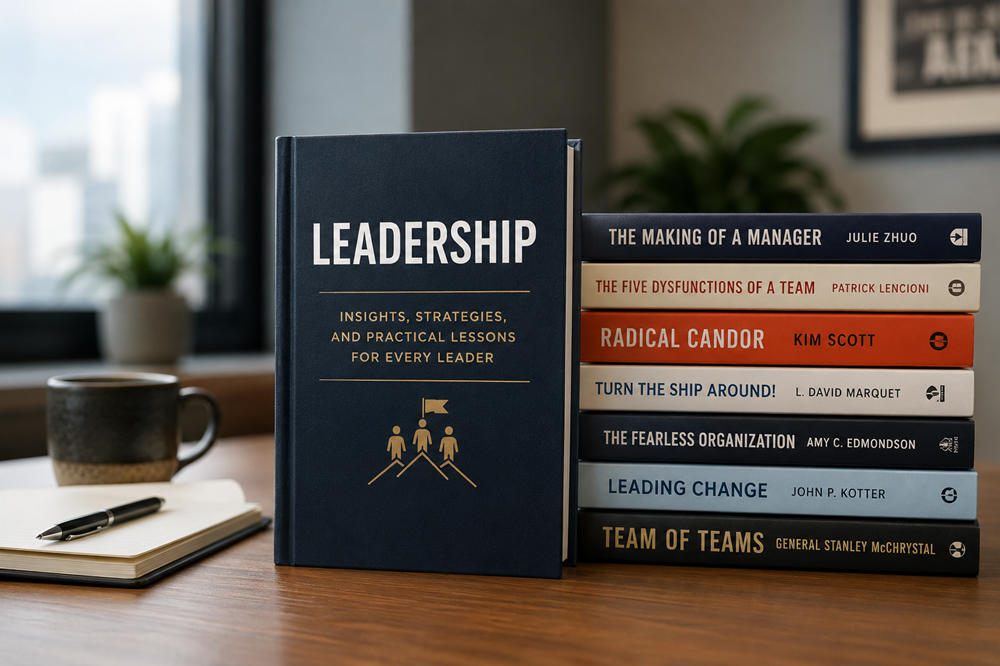
18 Best Leadership Books for Managers, Team Leaders, and Executives
A good leadership book should do more than offer an inspiring idea. It should help you understand a real problem: giving useful feedback, delegating decisions, developing employees, building trust, or guiding an organization through change.
This is an evergreen collection rather than a ranking from best to worst. It combines practical management guides with enduring books on emotional intelligence, team culture, strategy, and organizational leadership. The right place to begin depends on the responsibility or difficulty you are facing now.
Best Leadership Books at a Glance
| Book | Author | Best for |
|---|---|---|
| The Making of a Manager | Julie Zhuo | First-time managers |
| The First 90 Days | Michael D. Watkins | Leaders entering a new role |
| Act Like a Leader, Think Like a Leader | Herminia Ibarra | Professionals taking on broader responsibilities |
| Primal Leadership | Daniel Goleman, Richard Boyatzis, and Annie McKee | Emotional intelligence |
| Dare to Lead | Brené Brown | Courage and difficult conversations |
| Leadership and Self-Deception | The Arbinger Institute | Self-awareness and workplace relationships |
| High Output Management | Andrew S. Grove | Operational management |
| Multipliers | Liz Wiseman | Developing capable employees |
| Turn the Ship Around! | L. David Marquet | Delegation and distributed authority |
| The Coaching Habit | Michael Bungay Stanier | Better management conversations |
| Radical Candor | Kim Scott | Honest and respectful feedback |
| The Culture Code | Daniel Coyle | Building cohesive groups |
| The Fearless Organization | Amy C. Edmondson | Psychological safety |
| The Five Dysfunctions of a Team | Patrick Lencioni | Team trust and accountability |
| Leading Change | John P. Kotter | Organizational transformation |
| Team of Teams | General Stanley McChrystal, Tantum Collins, David Silverman, and Chris Fussell | Complex and fast-changing organizations |
| The Hard Thing About Hard Things | Ben Horowitz | Founders and senior executives |
| Leadership on the Line | Ronald Heifetz and Marty Linsky | Leading difficult, contested change |
Best Leadership Books for New Managers
Moving into management changes how success is measured. The work is no longer only about personal performance. New managers must learn to set expectations, develop people, make decisions through others, and build relationships without trying to control every detail.
1. The Making of a Manager by Julie Zhuo
Julie Zhuo offers a practical introduction to the situations that make early management difficult. She covers one-on-one meetings, hiring, feedback, team relationships, confidence, and the challenge of being responsible for work you no longer complete personally.
The book’s greatest strength is its reassuring but realistic view of management as a set of learnable skills. It is most useful for new managers who need clear guidance on everyday responsibilities rather than a broad theory of executive leadership.
2. The First 90 Days by Michael D. Watkins
A new role creates a difficult gap between responsibility and knowledge. Expectations may be high, but the leader has not yet learned the organization’s history, relationships, political dynamics, or operational weaknesses.
Michael Watkins provides a structured approach to learning quickly, establishing priorities, building support, and gaining early momentum. The framework can feel formal in a very small workplace, but its central lesson is widely relevant: leadership transitions need to be managed deliberately rather than treated as ordinary work from the first day.
3. Act Like a Leader, Think Like a Leader by Herminia Ibarra
Herminia Ibarra challenges the belief that people must first feel like leaders before they can act like them. Leadership identity often develops through what she calls outsight: the external perspective gained by taking on unfamiliar work, expanding professional relationships, and experimenting with new behavior.
This makes the book particularly useful for experienced specialists moving into more strategic positions. Instead of waiting for confidence or perfect clarity, readers are encouraged to learn through action and let their understanding of leadership evolve with experience.
Best Leadership Books for Self-Awareness and Emotional Intelligence
Leadership behavior shapes the emotional environment around a team. The following books examine how moods, assumptions, fears, and defensive habits affect judgment and relationships.
4. Primal Leadership by Daniel Goleman, Richard Boyatzis, and Annie McKee
Primal Leadership connects emotional intelligence with the practical work of influencing a group. The authors argue that a leader’s emotional behavior affects motivation, trust, cooperation, and the way employees respond to pressure.
Rather than promoting one ideal personality, the book considers several leadership styles and the conditions in which each may be effective. It is a valuable counterweight to models that treat leadership as a purely analytical activity, although readers seeking step-by-step management routines may find it more conceptual than practical.
5. Dare to Lead by Brené Brown
Brené Brown explores courage, vulnerability, trust, empathy, values, and accountability. She presents courageous leadership as a collection of behaviors that can be practiced rather than a quality reserved for unusually confident people.
Vulnerability in this context does not mean sharing everything or abandoning professional boundaries. It means being willing to admit uncertainty, receive uncomfortable information, acknowledge mistakes, and address difficult issues without hiding behind authority. The book is reflective rather than operational, making it most helpful when paired with concrete management practices.
6. Leadership and Self-Deception by the Arbinger Institute
This book examines how people justify their behavior by creating distorted stories about others. A manager who labels an employee as careless or resistant may begin interpreting every interaction as proof, while overlooking how the manager’s own behavior contributes to the conflict.
Its fable-based format makes the central idea accessible: leaders make better decisions when they see colleagues as people with legitimate needs and pressures rather than as obstacles or resources. Readers who prefer research-heavy analysis may find the presentation simple, but the questions it raises about responsibility and perception are valuable.
Best Leadership Books for Leading and Developing Teams
Managers can easily become the point through which every question, approval, and decision must pass. These books explore how leaders can improve performance while helping other people develop judgment and independence.
7. High Output Management by Andrew S. Grove
Andrew Grove defines managerial effectiveness through the results produced by the people and systems a manager influences. The book covers meetings, training, motivation, performance, and managerial leverage: the places where focused effort can create a much larger improvement in output.
Some examples reflect the industrial and technological environment in which the book was written, and its language can sound more mechanical than modern leadership writing. Its disciplined attention to priorities remains useful, especially for managers whose schedules are full but whose teams are not making enough progress.
8. Multipliers by Liz Wiseman
Liz Wiseman contrasts leaders who expand the intelligence of the people around them with those who unintentionally suppress it. A leader can be talented and supportive while still dominating discussions, supplying every answer, or taking difficult work away from employees.
The framework helps managers recognize when helpful involvement has become control. Its categories are intentionally sharp, while real leaders usually display both multiplying and diminishing habits. Used as a diagnostic rather than a label, the book offers a strong guide to developing more capable and independent teams.
9. Turn the Ship Around! by L. David Marquet
L. David Marquet describes replacing a traditional leader-follower structure aboard a U.S. Navy submarine with a system that gave crew members greater control. Instead of waiting for commands, people were expected to understand the situation and state what they intended to do.
Although the military setting is far removed from most workplaces, the principle transfers well: authority should often sit closer to the people with the most relevant information. Successful delegation still requires clear purpose, technical competence, and boundaries. It is not simply the removal of supervision.
10. The Coaching Habit by Michael Bungay Stanier
Managers often respond to a problem by immediately giving advice. That can appear efficient, yet it may solve the wrong issue or encourage employees to return whenever another decision is needed.
Michael Bungay Stanier introduces a concise set of questions that can clarify what matters, uncover the real challenge, and help employees think before the manager proposes a solution. The method does not replace direct instruction or formal performance management. It improves the everyday conversations in which advice is often offered too quickly.
Best Leadership Books for Communication, Trust, and Culture
Culture develops through repeated signals about what people may question, discuss, admit, and challenge. These books examine the conditions that support honest communication and coordinated work.
11. Radical Candor by Kim Scott
Kim Scott’s framework asks managers to combine personal care with direct challenge. Feedback becomes ineffective when leaders avoid honesty to protect short-term comfort, but directness can also become destructive when it is separated from respect.
The book is especially helpful for managers who postpone difficult conversations until frustration has grown. Scott advocates frequent and specific feedback, including praise that explains what worked rather than offering a vague compliment. Radical candor should not be confused with bluntness; timing, context, and the relationship still matter.
12. The Culture Code by Daniel Coyle
Daniel Coyle studies how successful groups create belonging, cooperation, and shared purpose. He focuses less on formal values statements and more on the small, repeated signals that tell people whether they are respected, connected, and contributing to something meaningful.
The examples highlight attentive listening, acknowledged fallibility, visible priorities, and rituals that reinforce group identity. Readers should resist copying isolated practices without considering context, but the broader message is highly transferable: culture is built through behavior, not declared through slogans.
13. The Fearless Organization by Amy C. Edmondson
Amy Edmondson explains psychological safety as an environment in which people can ask questions, raise concerns, admit mistakes, and offer incomplete ideas without unnecessary interpersonal risk. It is particularly important in work that depends on learning, judgment, and specialized knowledge.
Psychological safety is not constant agreement or protection from accountability. Teams still need high standards and honest evaluation. The purpose is to make important information discussable, because a leader cannot respond to a concern that employees are afraid to express.
14. The Five Dysfunctions of a Team by Patrick Lencioni
Patrick Lencioni presents a five-part model in which team problems build on one another. An absence of trust discourages productive conflict. Without open disagreement, commitment weakens, accountability becomes difficult, and individual priorities may displace collective results.
The fictional narrative makes the framework memorable and gives teams a shared language for discussing behavior that may otherwise remain vague. It is better used as a conversation starter than as a complete explanation of team performance, especially when organizational incentives or structural problems are also involved.
Best Leadership Books for Strategy, Change, and Difficult Decisions
Senior leaders often face problems that cannot be solved through better personal productivity. They must coordinate complex systems, build support for change, and make consequential decisions without complete information.
15. Leading Change by John P. Kotter
John Kotter presents organizational transformation as a connected process involving urgency, a credible coalition, a clear vision, sustained communication, the removal of obstacles, visible progress, and the eventual reinforcement of new practices.
The framework explains why a sensible strategy can still fail. Leaders may announce a direction without building support, underestimate resistance, communicate too little, or declare success before the change has become stable. Real transformations rarely follow a perfectly ordered sequence, so the model works best as a set of diagnostic questions rather than a rigid checklist.
16. Team of Teams by General Stanley McChrystal, Tantum Collins, David Silverman, and Chris Fussell
Team of Teams considers how a large and efficient hierarchy can struggle against a smaller but more adaptable opponent. When information moves slowly and senior approval is required for too many decisions, local teams may be unable to respond to rapidly changing conditions.
The authors propose combining shared awareness with decentralized execution. People closer to events receive broader context and greater authority to act. This approach is valuable for organizations whose specialized units perform well independently but coordinate poorly, though decentralization without trust and disciplined communication can create confusion rather than agility.
17. The Hard Thing About Hard Things by Ben Horowitz
Ben Horowitz concentrates on leadership situations in which every available option carries a serious cost. Drawing on his experience building technology companies, he discusses layoffs, executive performance, organizational politics, rapid growth, and the isolation that can accompany high-stakes decisions.
The venture-backed startup setting will not resemble every workplace, but the book’s honesty is widely relevant. Some problems do not have a polished framework or a painless answer. Leaders still have to make a decision, communicate it, and accept responsibility for the consequences.
18. Leadership on the Line by Ronald Heifetz and Marty Linsky
Ronald Heifetz and Marty Linsky focus on adaptive challenges: problems that cannot be resolved through technical expertise alone because meaningful progress requires people to change established habits, loyalties, expectations, or beliefs.
Leaders who surface those issues may become targets for the anxiety and resistance they create. The book explores how to regulate conflict, observe the wider system, maintain relationships, and protect the personal capacity needed to continue the work. It is demanding reading, but especially valuable for people leading change in politically sensitive organizations or institutions.
How to Apply What You Read
Reading several leadership books at once can feel productive without changing how anyone is led. Begin instead with one observable problem, such as delayed feedback, weak delegation, excessive approvals, or silence during meetings.
Choose the book that most directly addresses that problem and test one practice from it. Apply the idea consistently, observe how the team responds, and ask other people what has changed. Keep or adapt the practice when it improves the work, and discard it when the evidence does not support it.
Leadership books simplify reality so that a pattern becomes easier to see. Their ideas are starting points for judgment, not universal instructions.
Conclusion
The most useful leadership book is not necessarily the most popular or the newest. It is the one that helps you see a current responsibility more clearly and gives you an idea worth testing.
Choose one title connected to a real leadership challenge, apply one meaningful lesson, and pay attention to what happens next.