The 5 Levels of Leadership Explained: From Position to Lasting Influence
A leadership title gives someone authority, but it does not automatically create trust, commitment, or influence. Those qualities develop through the way a leader treats people, produces results, and helps others grow.
John C. Maxwell’s 5 Levels of Leadership framework offers a practical way to understand that development. It begins with formal authority and progresses toward an influence that can continue beyond a leader’s immediate role.
What Are the 5 Levels of Leadership?
John C. Maxwell first introduced the framework in Developing the Leader Within You and later expanded it in The 5 Levels of Leadership.
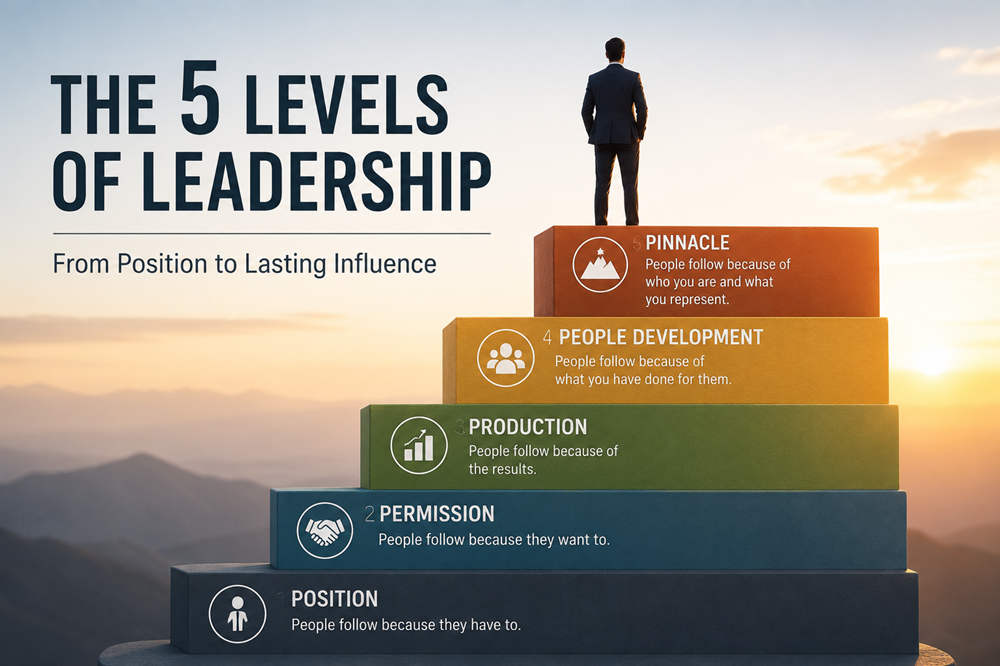
The model focuses on why people follow a leader:
| Level | Name | Why People Follow |
|---|---|---|
| 1 | Position | Because they have to |
| 2 | Permission | Because they want to |
| 3 | Production | Because of the results the leader has produced |
| 4 | People Development | Because the leader has helped them grow |
| 5 | Pinnacle | Because of who the leader is and what the leader represents |
The levels are cumulative. Moving higher does not make the earlier levels irrelevant. A productive leader still needs strong relationships, while a leader who develops others must continue delivering worthwhile results.
Level 1: Position — People Follow Because They Have To
Position is the starting point of formal leadership. A person becomes a supervisor, team lead, manager, director, or executive and receives authority over certain responsibilities and decisions.
This authority serves an important purpose. Teams need someone who can clarify expectations, assign work, enforce policies, resolve disagreements, and take responsibility for final decisions.
However, positional authority generally produces compliance rather than commitment. Employees may complete their assigned work because the organizational structure requires it, not because they trust the person giving the instructions.
Leaders who depend too heavily on Position often use hierarchy as their main source of influence. They may control information, emphasize rank, avoid admitting mistakes, or assume that a promotion automatically earns respect.
The result is often a cautious team. People follow instructions but contribute fewer ideas, avoid unnecessary risks, and hesitate to share bad news. They do what is required without investing much additional energy in the work.
Position is not inherently negative. Every formally appointed leader starts with some degree of positional authority. The question is whether the leader uses that authority as a foundation or treats it as the full extent of leadership.
Level 2: Permission — People Follow Because They Want To
At the Permission level, leadership begins to rest on trust rather than hierarchy alone. People cooperate because they respect the leader and believe the relationship is worth maintaining.
Permission develops through everyday interactions. Leaders listen carefully, communicate honestly, keep reasonable promises, give credit fairly, and show genuine interest in the people doing the work.
Trust improves the quality of information available to a leader. Employees are more likely to discuss mistakes, raise concerns early, suggest alternatives, and disagree constructively when they expect a fair response.
This level is not about seeking popularity or avoiding conflict. A leader can be warm and respectful while still addressing missed deadlines, poor conduct, or weak performance. In fact, trust often grows when difficult conversations are handled directly and fairly.
Permission creates voluntary cooperation. People are no longer responding only to the authority of the role. They are also responding to the character and behavior of the person holding it.
Level 3: Production — People Follow Because of Results
Relationships make cooperation possible, but teams must also accomplish meaningful work. At the Production level, a leader earns credibility by helping people turn effort into results.
Productive leaders establish priorities, define what success looks like, coordinate responsibilities, and remove obstacles that slow the team down. They help people understand how individual tasks contribute to a larger objective.
Results at this level are not limited to the leader’s personal output. A manager may be highly productive while the rest of the team remains confused or dependent. Leadership production appears in collective performance: projects move forward, quality improves, commitments are met, and recurring problems are addressed.
Leaders at Level 3 also model the standards they expect. Their own reliability makes expectations more credible. When challenges arise, they take responsibility for finding a path forward rather than blaming the team or waiting for conditions to improve.
Consistent results create momentum. People become more confident in the team’s direction because they have seen plans become outcomes. The leader gains greater influence when employees can connect that leadership with genuine progress.
The main danger at this level is allowing achievement to overshadow people. Short-term targets can sometimes be met through constant urgency or excessive pressure, but that approach is difficult to sustain. Effective production balances performance with the team’s long-term capacity.
Level 4: People Development — People Follow Because You Help Them Grow
At Level 4, the leader’s contribution extends beyond managing current performance. The leader begins increasing the ability of other people to take responsibility, make decisions, and influence the team.
People Development includes coaching, mentoring, useful feedback, and thoughtful delegation. It requires identifying potential and providing opportunities for that potential to become visible.
A developing leader might be asked to manage a project, lead a meeting, coach a new employee, present a recommendation, or solve a problem that previously would have gone directly to the manager. These assignments create experience that classroom instruction alone cannot provide.
Meaningful delegation is central to this level. It does not mean passing along undesirable tasks or abandoning someone with an unfamiliar responsibility. A developmental assignment should stretch a person’s judgment while still providing enough guidance and support.
People Development differs from Permission. A leader may have excellent relationships with employees without helping them become more capable. Level 4 requires evidence that people have gained skills, confidence, judgment, or leadership responsibility.
This level also demands humility. As employees become stronger, they need less direct intervention and may receive more recognition. Leaders who develop people successfully become less central to routine decisions, not more.
The wider benefit is increased organizational capacity. Instead of relying on one person to direct every important activity, the team gains several people who can take ownership and guide others.
Level 5: Pinnacle — People Follow Because of Who You Are and What You Represent
Pinnacle leadership develops through sustained results, sound character, and a long record of developing other leaders. It cannot be obtained through a promotion or claimed after one successful project.
At this level, a leader’s influence may extend beyond a direct reporting relationship. People recognize what that person represents, such as integrity, service, courage, strong judgment, or commitment to developing others.
Pinnacle leadership should not be confused with fame or personal visibility. A well-known executive is not automatically a Level 5 leader. The more meaningful test is whether the person has produced capable leaders and established values that can continue without constant personal involvement.
These leaders prepare successors, protect the organization’s long-term interests, and create opportunities for others to lead. Their influence is visible in the quality of the people and culture that remain after they step away.
Level 5 is therefore less about becoming indispensable and more about building leadership that can endure. Its clearest legacy is an organization or community that remains capable because leadership has been multiplied rather than concentrated in one individual.
How the Five Levels Build on One Another
The five levels describe an expanding basis of influence:
- Position gives a leader formal responsibility.
- Permission creates trust and voluntary cooperation.
- Production establishes credibility through results.
- People Development increases the abilities of others.
- Pinnacle creates influence that can outlast the leader’s direct involvement.
Each level supports the ones above it. Results achieved without trust may be difficult to sustain. Strong relationships without clear performance can produce a pleasant but ineffective team. A leader who builds trust and produces results but never develops others may eventually become a bottleneck.
Leadership level can also differ from one relationship to another. Maxwell Leadership’s training materials encourage leaders to assess their influence separately with their boss, peers, and direct reports. A manager might have strong trust with longtime employees while still operating mostly from Position with a newly formed team.
For that reason, the framework is better used as a relationship-based reflection tool than as a permanent label attached to a person.
How to Identify Your Current Leadership Level
A job title does not reveal a leader’s actual level of influence. A more useful assessment considers how people respond, what the team achieves, and how much leadership exists beyond the manager.
Why do people follow you?
Consider whether people would still seek your guidance if you could no longer assign their work or evaluate their performance. If authority is the main reason they respond, the relationship is likely centered on Position.
How honest is communication?
Do employees raise concerns early, admit mistakes, and express disagreement? Open communication usually indicates trust. Consistent silence or excessive agreement may suggest that people do not yet feel safe enough to be candid.
Can the team produce results consistently?
Look beyond one successful project. Does the team repeatedly meet meaningful goals without depending on last-minute pressure or constant intervention from the leader?
Who has become more capable?
Identify people who have gained judgment, confidence, or responsibility under your leadership. Growth may appear through a promotion, but it can also be seen when someone independently manages a complex project or begins coaching colleagues.
What happens when you are absent?
A team that loses direction whenever the manager steps away may be overly dependent on one person. Stronger leadership is visible when people can maintain standards, make sound decisions, and support one another without continuous supervision.
These questions should be considered separately for different groups and relationships. Feedback from colleagues and team members can also reveal gaps between how a leader intends to act and how that leadership is experienced.
How to Move to the Next Leadership Level
Progress occurs when consistent behavior gives people another reason to follow. The most important development priority depends on the leader’s current source of influence.
| Current Level | Main Development Priority | Practical Action |
|---|---|---|
| Position | Become credible in the role | Set clear expectations and apply standards consistently. |
| Permission | Turn trust into coordinated action | Give the team a clear shared priority and define ownership. |
| Production | Develop capability beyond yourself | Delegate an important outcome, not just a routine task. |
| People Development | Make leadership development repeatable | Help emerging leaders begin coaching and developing others. |
| Pinnacle | Protect leadership continuity | Prepare successors and strengthen systems that do not depend on your presence. |
Leadership growth is rarely permanent or perfectly linear. A promotion, reorganization, new team, or major change may require a leader to rebuild trust and credibility with a different group of people.
Returning to foundational work does not erase previous experience. It reflects the reality that influence must be established within each new relationship and context.
Conclusion
The 5 Levels of Leadership framework shows how influence can expand over time. Position provides authority. Permission creates trust. Production builds credibility. People Development multiplies capability. Pinnacle leadership creates an impact that can continue beyond the leader’s immediate role.
The goal is not simply to claim the highest possible level. The more useful question is: What reason are you currently giving people to follow you, and what must you build next?