Leadership Roles: 8 Essential Responsibilities of Effective Leaders
Leadership is not one responsibility performed from one position. A leader may set direction in the morning, make a difficult decision after lunch, and coach an employee before the day ends.
Understanding these different leadership roles helps people respond deliberately instead of using the same approach in every situation. It also shows that leadership depends less on a title than on how someone helps a group work toward a shared result.
What Are Leadership Roles?
Leadership roles are the functions a person performs to guide people, support cooperation, and advance shared goals. They describe what a leader contributes at a particular moment rather than where that person appears on an organizational chart.
A job title identifies a formal position, such as supervisor, manager, director, or chief executive. A leadership style describes how someone tends to lead, such as through a democratic, coaching, or directive approach. A leadership role describes what the person is responsible for accomplishing.
For example, a department manager may act as a decision-maker while approving a budget, a coach while developing an employee, and a change leader while introducing a new process. The title remains the same, but the role changes with the situation.
Leadership can also be formal or informal. A person does not always need managerial authority to organize an effort, influence a decision, support a colleague, or help a group find a productive direction.
This broader view treats leadership as a shared process that creates direction, alignment, and commitment among people with common work.
8 Essential Leadership Roles
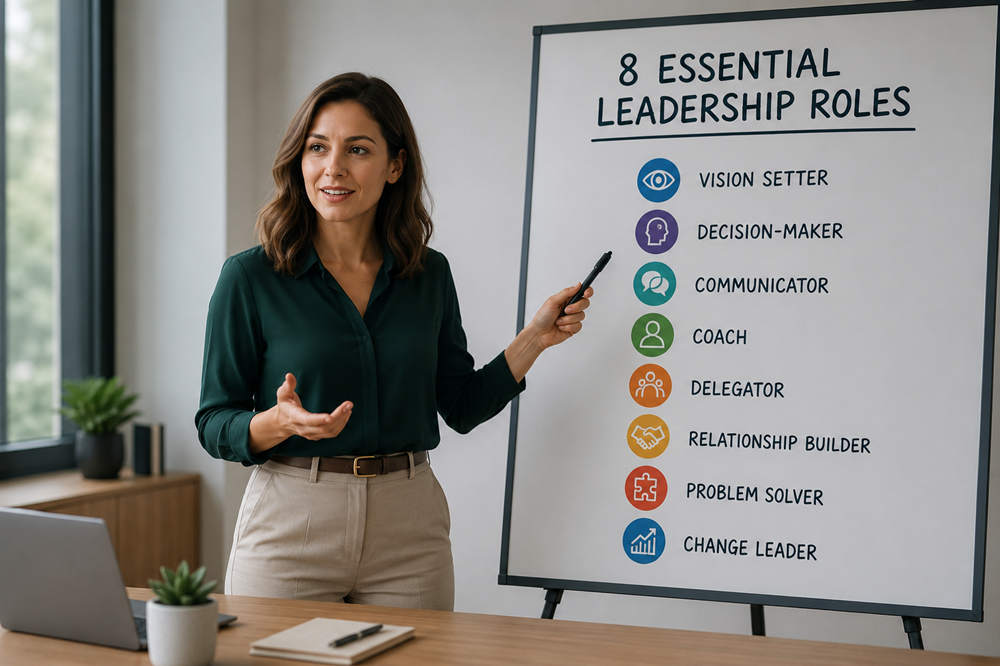
There is no single universal list of leadership roles. The following eight roles provide a practical way to understand the responsibilities effective leaders commonly carry. Their importance will vary according to the work, the people involved, and the conditions surrounding the team.
1. The Vision Setter
The vision setter defines where a team or organization is trying to go. This role gives people a meaningful destination instead of leaving them with a collection of disconnected assignments.
A useful vision does not have to be grand or dramatic. It may describe how a department will improve customer service, how a project will solve a specific problem, or what a team should be capable of within the next year.
The leader then connects that direction to everyday priorities. Plans, resource decisions, performance standards, and meeting agendas should reinforce what the group is trying to achieve. When employees can see how their work contributes to the larger purpose, the vision becomes a practical guide rather than a slogan.
2. The Decision-Maker
Leaders frequently make choices with incomplete information, limited time, and competing interests. The decision-maker examines the available evidence, considers the likely consequences, and selects a reasonable course of action.
This does not mean making every decision alone. Some choices benefit from employee input, technical expertise, or discussion among affected groups. The leader must determine who should contribute, who owns the final decision, and when additional consultation would improve the outcome.
After deciding, the leader should explain what was chosen, why it was necessary, and what happens next. Effective decision-makers also review the result, accept responsibility for mistakes, and change course when new evidence makes an adjustment necessary.
3. The Communicator
The communicator creates shared understanding. Leaders must make goals, responsibilities, expectations, constraints, and changes clear enough for people to act confidently.
Communication also involves listening. Employees may hold information that does not appear in formal reports, including customer concerns, process weaknesses, emerging risks, and misunderstandings affecting the work. Leaders need reliable ways for that information to move upward.
The message may need to be adapted for different audiences without changing its central meaning. A senior executive may need a concise account of a project risk, while the project team needs specific instructions about how that risk affects its work. Communication succeeds when each group understands what matters and what it needs to do.
4. The Coach
The coach helps people strengthen their ability, confidence, and judgment. Rather than solving every problem personally, the leader helps employees learn how to handle increasingly difficult work themselves.
Coaching may involve asking thoughtful questions, observing performance, offering specific feedback, or helping someone compare possible approaches. The objective is not only to correct the present task but also to develop capability that can be used in future situations.
This role requires an appropriate balance of assessment, challenge, and support. Too little challenge can restrict growth, while too little support can leave someone unprepared. Unlike a formal performance evaluation, coaching is an ongoing developmental conversation.
5. The Delegator
The delegator transfers meaningful ownership so that work does not depend on one person. Effective delegation identifies the expected result, selects an appropriate owner, provides necessary resources, and defines the boundaries of the person’s authority.
Assigning a task without giving the employee room to make relevant decisions is not complete delegation. People need to know which choices they may make independently, when they should consult the leader, and which constraints cannot be changed.
Delegation also requires suitable checkpoints. Leaders remain accountable for the overall outcome, but constant intervention weakens ownership and can turn oversight into micromanagement. The goal is to provide enough support to protect the work without taking responsibility back from the person who received it.
6. The Relationship Builder
The relationship builder develops the trust and professional connections that allow people to cooperate. Within a team, trust grows when leaders act fairly, keep commitments, treat people with respect, and address concerns consistently.
Leadership relationships also extend beyond direct reports. Leaders may need cooperation from other departments, specialists, clients, senior executives, suppliers, or community partners. These connections provide access to information, expertise, and support that formal authority alone may not secure.
Understanding informal organizational networks is especially valuable because influence and information do not always follow reporting lines. Building relationships is not about pleasing everyone; it is about creating enough credibility and mutual respect to work through disagreements honestly.
7. The Problem and Conflict Resolver
The problem resolver looks beyond immediate symptoms. A missed deadline may reveal an unrealistic workload, an unclear handoff, or a decision that was never assigned to a specific person. Addressing only the late task would leave the underlying weakness in place.
Conflict requires similar attention. Leaders should clarify what happened, listen to the relevant perspectives, separate personal assumptions from observable facts, and identify what each person needs to move forward.
Not every disagreement requires compromise. Some situations call for a firm decision, enforcement of a policy, or correction of unacceptable conduct. In other cases, the leader can help people find a solution that protects both the work and the professional relationship. The objective is not to eliminate disagreement but to keep it constructive and connected to the team’s goals.
8. The Change Leader
The change leader helps people move from an established way of working to a different one. The change may involve new technology, revised priorities, organizational restructuring, regulatory requirements, or a new approach to serving customers.
People are more likely to resist when they do not understand why the change is necessary, what it will require, or how it will affect them. Leaders therefore need to explain the reason for the change, define the desired outcome, and distinguish confirmed information from issues that remain uncertain.
Successful implementation also draws on the knowledge of people close to the work. Their involvement can expose practical obstacles, improve the plan, and create stronger ownership. Leaders must then provide training, remove conflicting procedures, monitor unintended consequences, and reinforce the new practices until they become part of normal operations.
How Leadership Roles Change at Different Levels
The same roles appear throughout an organization, but their scale and emphasis change. Management research provides another useful way to understand this shift. Mintzberg’s framework groups managerial work into interpersonal, informational, and decisional roles, with the balance influenced by a person’s position in the organization.
Team and Project Leaders
Team and project leaders work close to day-to-day execution. They clarify immediate priorities, assign work, provide feedback, address obstacles, and maintain working relationships among the people delivering the result.
Because they are close to operations, they can often identify unclear plans, skill gaps, and process problems quickly. Communication, coaching, delegation, and practical problem-solving therefore occupy much of their attention.
Middle Managers
Middle managers connect organizational strategy with operational activity. They translate broad goals into departmental plans, allocate limited resources, and coordinate work that crosses team or functional boundaries.
They also carry information in two directions. Senior leaders need an accurate view of operational conditions, while employees need strategic decisions converted into clear priorities. Middle managers must therefore balance communication, decision-making, relationship building, and change leadership.
Senior and Executive Leaders
Senior leaders focus more heavily on long-term direction, organizational culture, major investments, external conditions, and alignment among large functions or business units.
Their decisions affect more people and may produce consequences that take months or years to become visible. Vision setting, organizational change, resource allocation, and the development of other leaders become increasingly important.
Executives still communicate, coach, and resolve conflict, but they perform those roles on a broader scale. They increasingly achieve results through other leaders rather than through direct involvement in everyday work.
Formal and Informal Examples of Leadership Roles
Leadership may come from an established position or emerge temporarily because someone has the knowledge, credibility, or willingness to help others move forward.
Formal Leadership Positions
- Team supervisor: Guides daily work, supports employees, and addresses performance concerns.
- Department manager: Converts organizational goals into plans for a particular function.
- Project lead: Takes responsibility for delivering a defined project outcome.
- Committee chair: Organizes collective work and keeps members focused on the committee’s purpose.
Informal or Situational Leadership Roles
- Mentor: Shares experience and supports another person’s professional development.
- Meeting facilitator: Structures a discussion so participants can contribute and reach a useful conclusion.
- Change advocate: Helps colleagues understand and adopt a new process or direction.
- Volunteer coordinator: Brings people together around a shared cause without relying on workplace authority.
Formal positions usually include recognized decision-making authority. Informal leaders rely more heavily on expertise, reliability, judgment, and influence. Both can make important contributions, particularly when the work crosses reporting lines or requires cooperation among people from different groups.
How to Become More Effective in a Leadership Role
Leadership improves through deliberate practice rather than title changes alone. The following actions help turn broad leadership principles into observable behavior.
Clarify Your Responsibility and Authority
Understand the results you own, the decisions you may make, the limits of your authority, and the people who depend on your work. Unclear responsibility makes it difficult to lead consistently or assess performance fairly.
Identify the Roles You Overuse or Avoid
Most leaders have natural preferences. Someone who enjoys setting direction may overlook coaching, while a highly collaborative leader may delay decisions that require a firm answer. Recognizing these patterns makes development more focused.
Ask for Behavioral Feedback
General questions such as “How am I doing?” often produce vague answers. Ask employees, peers, or supervisors about specific behaviors: whether expectations are clear, whether decisions arrive in time, or whether people have enough freedom to handle their responsibilities.
Practice During Real Work
Choose one behavior and apply it to a current responsibility. Transfer ownership of a recurring task, ask coaching questions before offering advice, or explain the reasoning behind an important decision. Real work provides more useful practice than studying leadership ideas without applying them.
Adapt Without Becoming Inconsistent
An experienced team may need considerable independence, while new employees may require clearer instructions and more frequent support. Effective leaders adjust to people and circumstances while maintaining consistent principles such as fairness, accountability, honesty, and respect.
Leadership effectiveness is ultimately visible in the group’s capability. A strong leader helps people understand their goals, make sound decisions, solve problems, and continue performing without constant intervention.
Conclusion
Effective leadership requires more than holding authority or performing one responsibility well. Leaders must move among different roles as circumstances change—setting direction, supporting people, distributing ownership, and addressing problems when necessary. Their success is reflected in the team’s ability to understand its goals, work together, and produce sustainable results.