Matrix of Leadership: How Four Communication Styles Shape the Way Leaders Lead
Leaders influence a team not only through the decisions they make but also through the way they communicate. Some ask questions that encourage employees to investigate a problem. Others provide clear answers and direction. Some remain largely silent, while others move continually between inquiry and explanation.
The matrix of leadership places these communication patterns into four types: silent, questioning, answering, and conversational leadership. Each type has useful qualities, but each can also create problems when it does not fit the needs of the situation.
What Is the Matrix of Leadership?
The matrix of leadership is a practical communication framework developed by Carsten Lund Pedersen and Thomas Ritter from their work and interactions with executives. Published by California Management Review, it gives managers a simple way to reflect on how their communication affects the people they lead.
The framework does not attempt to measure every aspect of leadership. It focuses specifically on two visible behaviors: asking employees questions and providing employees with answers. These behaviors influence whether a team feels invited to think, equipped to act, or uncertain about what its leader expects.
This model should not be confused with the Blake–Mouton Leadership Grid, which examines concern for people and concern for production. It is also different from matrix management, an organizational structure in which employees may report to more than one manager. Here, the word “matrix” refers only to the four combinations created by questions and answers.
How the Leadership Matrix Works
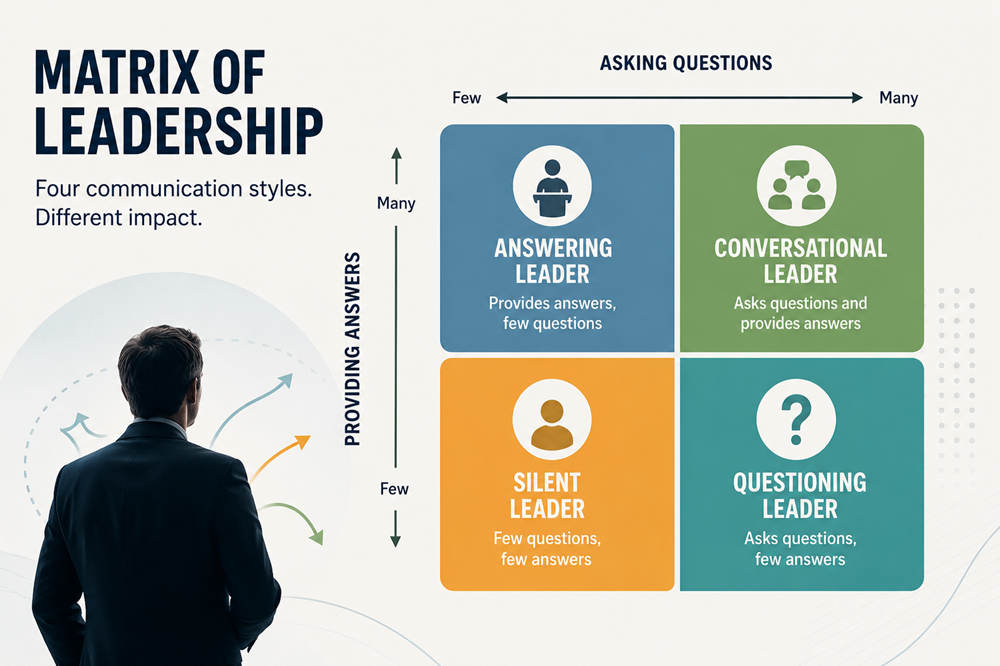
The matrix is built around two basic questions:
- Does the leader predominantly manage by asking employees questions?
- Does the leader predominantly manage by providing employees with answers?
Questions represent inquiry. Leaders use them to gather information, challenge assumptions, identify risks, and invite employees to contribute their knowledge. A useful question does more than request an update. It helps the team examine an issue more carefully.
Answers represent direction. They may take the form of decisions, priorities, explanations, expectations, or a vision for what the organization should accomplish. Answers turn an open discussion into a clearer course of action.
Leaders may rely heavily or lightly on each behavior. Combining the two dimensions produces four positions:
- Few questions and few answers: the silent leader
- Many questions and few answers: the questioning leader
- Few questions and many answers: the answering leader
- Many questions and many answers: the conversational leader
The matrix is not a fixed personality test. A leader may have a familiar communication pattern while still moving between quadrants as circumstances change.
The Four Types in the Matrix of Leadership
Silent Leader
A silent leader asks relatively few questions and provides relatively few answers. This person may prefer to observe, think privately, and work behind the scenes rather than become the center of every discussion.
Silence can create valuable space. Employees are less likely to feel micromanaged, and experienced team members may have greater freedom to exercise judgment. A restrained leader may also avoid issuing premature instructions before fully understanding a complicated situation.
The weakness of this style is that employees cannot always distinguish thoughtful restraint from disengagement. Pedersen and Ritter describe its negative extreme as the “absent” leader. When guidance is limited, people may become unsure about priorities, decisions, or whether their concerns have been heard.
Silent leadership is most useful when employees already understand the desired outcome and the limits of their authority. Without that foundation, giving people space can feel more like leaving them without support.
Questioning Leader
A questioning leader asks many questions but provides relatively few answers. This approach is driven by curiosity and by the recognition that important knowledge often sits with employees who are closest to the work.
Good questions can reveal assumptions that have gone unchallenged, expose missing evidence, and bring different perspectives into the discussion. They can also help employees strengthen their judgment instead of becoming dependent on a manager for every solution.
The risk appears when inquiry continues without sufficient guidance. The authors call the negative version the “clueless” leader. Employees may wonder whether the questions reflect genuine curiosity or an inability to understand the issue and make a decision.
A questioning leader therefore needs to know when exploration has achieved its purpose. Once the relevant information is available, the team may need a conclusion, a priority, or a decision rather than another round of questions.
Answering Leader
An answering leader offers frequent direction while asking relatively few questions. This person tends to communicate through decisions, explanations, instructions, and confident statements about what should happen next.
The style can establish focus. Employees know what the leader expects, which goals matter most, and how their efforts fit into the broader direction of the organization. Clear answers can be particularly valuable when hesitation is preventing coordinated action.
However, direction becomes weaker when it is separated from inquiry. A leader who does not listen before deciding may miss operational knowledge, customer concerns, technical limits, or alternative ideas. At its negative extreme, this style becomes the “know-it-all” leader, someone who appears to value conformity more than employee expertise.
Answering leadership is more effective when decisions include enough context for people to understand the reasoning behind them. Direction should help employees act intelligently, not simply require them to obey.
Conversational Leader
A conversational leader asks meaningful questions and provides relevant answers. Communication becomes an exchange in which the leader gathers information, listens to different views, applies judgment, and offers direction.
This style can combine participation with accountability. Employees contribute knowledge from their areas of expertise, while the leader remains responsible for turning that knowledge into a coordinated decision.
Conversation can be especially useful when a problem crosses departments or involves competing priorities. Discussion allows technical, financial, operational, and customer perspectives to be considered before the organization commits to a course of action.
The danger is allowing interaction to become an end in itself. Pedersen and Ritter describe the negative version as the “all-talk” leader. Meetings may multiply, decisions may be postponed, and employees may be repeatedly consulted without seeing their input lead to action.
Conversational leaders must make the purpose of discussion clear. People should understand what is being decided, who holds final responsibility, and when the conversation will give way to action.
Choosing an Approach Based on Task, Team, and Timing
The purpose of the matrix is not to identify one quadrant as the ideal style. Its practical value comes from considering whether a communication pattern fits the task, the team, and the timing.
Leaders can begin by reflecting on the position they use most often and then comparing that view with how employees experience them. A manager may believe they are giving people independence while employees experience the same behavior as absence. Another may believe they are creating clarity while the team feels that its knowledge is being ignored.
Feedback helps reveal these differences, but choosing an appropriate approach requires a closer look at the situation.
Consider the Task
The nature of the work affects how much inquiry or direction is needed. A complex problem with incomplete information usually benefits from more questions. The leader needs to understand assumptions, possible consequences, and knowledge held by specialists before reaching a conclusion.
A familiar or highly structured task may require less discussion. Employees may already know the process and need only a clear goal, deadline, or decision. Additional questioning could slow work without improving the outcome.
Risk also matters. When a choice has serious financial, operational, or safety consequences, leaders should avoid both careless certainty and endless debate. They need enough inquiry to understand the risk and enough direction to ensure that responsibility is clear.
Consider the Team
A team’s knowledge and experience should influence how the leader communicates. Skilled employees may contribute insights that a senior manager does not possess. Asking questions allows that expertise to shape the decision rather than treating leadership rank as proof of superior knowledge.
Teams that are still developing may need more explanation. Employees can struggle when they are asked to solve problems without understanding the organization’s priorities, standards, or decision-making boundaries. In this setting, answers provide a foundation on which independent judgment can grow.
Autonomy should therefore be matched with readiness. Giving capable employees room to work can demonstrate trust. Withdrawing too early from a team that still needs support can create avoidable confusion.
Consider the Timing
Different stages of work call for different communication patterns. During early exploration, leaders may ask broad questions to uncover possibilities and identify risks. As a deadline approaches, the emphasis usually needs to shift toward choices, responsibilities, and execution.
During implementation, a leader may step back once responsibilities are understood. If new evidence appears or progress begins to fail, renewed questioning may be necessary. A serious disruption may require a faster exchange in which information is gathered quickly and translated into immediate direction.
Timing also affects how employees interpret silence. Remaining quiet while a team works confidently can protect its autonomy. Remaining quiet during uncertainty, restructuring, or conflict may appear evasive. The same behavior can therefore produce very different results depending on when it occurs.
Conclusion
The matrix of leadership shows how asking questions and providing answers shape the way a leader is experienced. Silent leaders create space, questioning leaders encourage inquiry, answering leaders establish direction, and conversational leaders connect discussion with action.
The value of the framework does not lie in selecting a permanent quadrant. It lies in recognizing a default communication pattern, understanding how that pattern may be perceived, and judging whether it fits the task, team, and timing. Effective leaders know when to ask, when to answer, when to listen, and when to step back.