
Contingency Theory of Leadership: How the Right Leader Fits the Situation
A leader who succeeds with one team may struggle in another. The difference ve when a person’s natural approach does not fit the work, relationships, or authority surrounding the role.
The contingency theory of leadership examines that fit. Rather than presenting one ideal way to lead, it considers the conditions under which different leaders are likely to perform well.
What Is the Contingency Theory of Leadership?
Contingency approaches are based on the idea that leadership effectiveness depends partly on context. Several leadership theories use this principle, but the framework most closely associated with the term is Fred Fiedler’s Contingency Model.
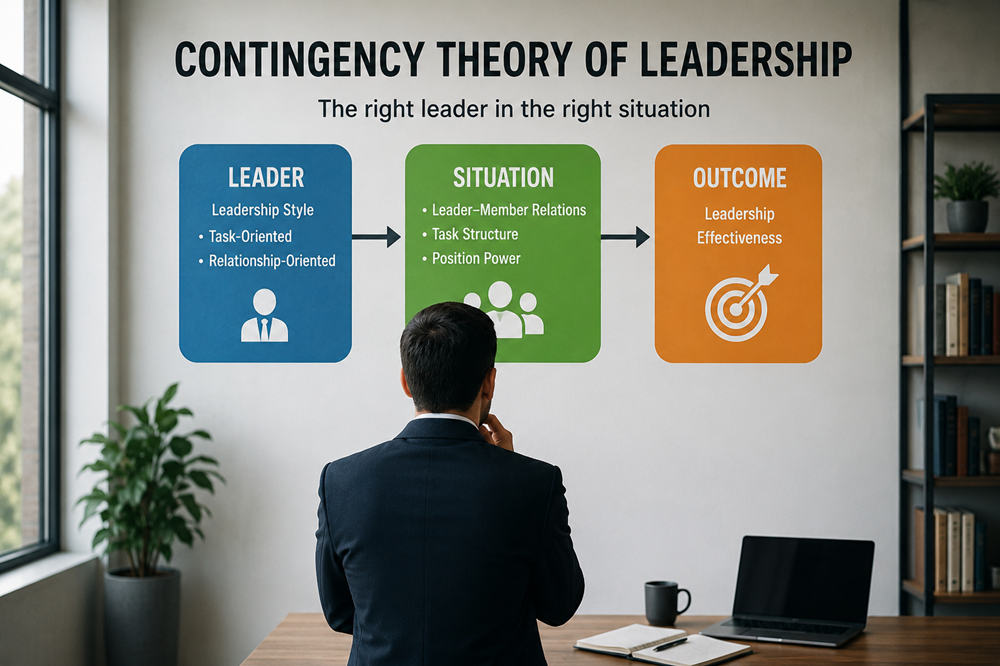
Developed during the 1960s, Fiedler’s model argues that group performance depends on the match between two elements:
- The leader’s underlying task or relationship orientation
- The degree of control the situation gives that leader
A leadership orientation that works well in one setting may be poorly suited to another. The model therefore avoids labeling one type of leader as universally superior. Task-oriented and relationship-oriented leaders can both succeed when placed in conditions that make their strengths useful.
Fiedler also viewed a leader’s basic orientation as relatively stable. Although people can adjust particular behaviors, the model does not assume that they can easily change their deepest leadership motivations whenever circumstances shift.
How Fiedler’s Contingency Model Works
The model begins by identifying whether a leader is primarily motivated by completing the task or maintaining productive relationships. It then evaluates the situation according to leader–member relations, task structure, and position power.
Those situational factors indicate how much control the leader can exercise. The model uses the resulting combination to predict whether the leader’s orientation is likely to fit the environment.
Task-Oriented and Relationship-Oriented Leaders
Task-oriented leaders focus first on accomplishing the group’s objective. They tend to emphasize responsibilities, schedules, procedures, standards, and measurable results. When work lacks direction, they are often inclined to define priorities and establish a clearer structure.
This orientation does not necessarily mean that the leader is cold or indifferent toward employees. It means that successful task completion is the leader’s primary motivation when balancing performance and interpersonal concerns.
Relationship-oriented leaders place greater emphasis on trust, communication, cooperation, and cohesion. They tend to see strong working relationships as essential to sustained group performance. Their attention may be directed toward resolving tension, encouraging participation, or helping team members work through disagreement.
Relationship orientation should not be confused with avoiding difficult decisions. A relationship-focused leader can still enforce standards, but is more likely to consider the quality of the group’s interactions when deciding how to proceed.
The Least Preferred Coworker Scale
Fiedler developed the Least Preferred Coworker scale, commonly called the LPC scale, to identify a leader’s orientation.
The leader thinks about the person with whom they have found it most difficult to work and rates that individual using pairs of contrasting qualities, such as friendly or unfriendly, cooperative or uncooperative, and supportive or hostile.
A relatively low LPC score means the difficult coworker is described in strongly unfavorable terms. Fiedler associated this scoring pattern with task motivation. A relatively high score means the coworker is described more favorably, which he associated with relationship motivation.
The scale is not designed to determine whether the coworker was capable, pleasant, or responsible for the difficult relationship. It is intended to reveal something about the leader’s priorities. However, researchers have long debated exactly what the LPC score measures, making it one of the model’s most disputed features.
The model is clearest for leaders with distinctly high or low scores. Its predictions are less precise for those who fall near the middle of the scale. Some later interpretations suggest that middle-LPC leaders may function effectively across a wider range of conditions, but they do not fit neatly into the model’s two main orientations.
The Three Factors That Shape the Leadership Situation
Fiedler first described the surrounding conditions in terms of situational favorableness and later used the term situational control. This means the extent to which a leader can influence the group’s activities and outcomes.
Three factors determine that control. Leader–member relations carry the most weight in the model, followed by task structure and position power.
Leader–Member Relations
Leader–member relations describe the level of trust, respect, and confidence between the leader and the group.
Relations are considered good when employees generally accept the leader, trust their judgment, and cooperate with their direction. These conditions allow the leader to devote more attention to the work because the relationship itself is not a continuing source of resistance.
Poor relations may involve resentment, skepticism, personal conflict, or low confidence in the leader. Even when instructions are clear, employees may question the leader’s intentions or resist their decisions.
This is the most influential factor in Fiedler’s model because formal authority cannot fully replace credibility. A person may have the organizational right to issue instructions without having the trust needed to secure genuine commitment.
Task Structure
Task structure refers to how clearly the work can be defined, completed, and evaluated.
A highly structured task has recognizable steps, established procedures, specific standards, and measurable results. Routine production, payroll processing, safety inspections, and other standardized operations may have high task structure.
A task has low structure when the problem, method, or desired outcome remains open to interpretation. Research, strategic planning, design, and other creative work may allow several reasonable approaches without one clearly correct solution.
Greater structure increases situational control because expectations and results are easier to communicate and assess. Low structure creates more uncertainty about what should be done, who should decide, and whether the final outcome is successful.
Position Power
Position power is the formal authority attached to the leadership role.
A leader with strong position power may be able to assign work, evaluate performance, approve resources, distribute rewards, impose consequences, or influence promotion and staffing decisions.
Position power is weak when someone is responsible for coordinating results but has limited authority over the people completing the work. Committee chairs, project coordinators, and temporary team leads often depend more heavily on persuasion and professional credibility.
Strong power does not automatically produce good leadership. It simply gives the leader more direct control over decisions and consequences. When position power is limited, cooperation must be earned through other forms of influence.
Matching Leadership Style to Situational Favorableness
The three situational factors create eight possible combinations, arranged from high to low control.
A highly favorable situation has good leader–member relations, a structured task, and strong position power. The group accepts the leader, the work is clear, and the role carries enough authority to address problems directly.
At the other extreme, the least favorable situation combines poor relations, an unstructured task, and weak position power. The leader faces uncertainty about the work, resistance from the group, and little formal ability to enforce decisions.
Fiedler’s classical model predicts that task-oriented leaders tend to perform best when control is either very high or very low. Relationship-oriented leaders generally perform better in the moderately controlled conditions between those extremes.
| Situation | Leader–Member Relations | Task Structure | Position Power | Situational Control | Classical Model Prediction |
|---|---|---|---|---|---|
| 1 | Good | High | Strong | High | Task-oriented |
| 2 | Good | High | Weak | High | Task-oriented |
| 3 | Good | Low | Strong | High | Task-oriented |
| 4 | Good | Low | Weak | Moderate | Relationship-oriented |
| 5 | Poor | High | Strong | Moderate | Relationship-oriented |
| 6 | Poor | High | Weak | Moderate | Relationship-oriented |
| 7 | Poor | Low | Strong | Moderate | Relationship-oriented, although findings are less consistent |
| 8 | Poor | Low | Weak | Low | Task-oriented |
In highly favorable conditions, task-oriented leaders can direct their attention toward performance because relationships, procedures, and authority already support execution.
In the least favorable conditions, the same emphasis on tasks may help a group establish immediate priorities amid confusion and weak influence. A relationship-oriented leader may find it difficult to build cooperation quickly enough to address urgent operational problems.
Moderately favorable conditions provide the leader with control in some areas but not others. Improving communication or cohesion may allow a relationship-oriented leader to make better use of the structure or authority that is already present.
These are theoretical predictions rather than guaranteed outcomes. The evidence supporting the broad pattern has been substantial but mixed, and the result for Situation 7 has been less consistent than the findings for the other combinations.
Examples of Contingency Theory in the Workplace
Workplace situations rarely fit a model perfectly, but the three situational factors provide a useful way to examine why different environments may favor different leadership orientations.
Leading a Crisis or Turnaround
Imagine a business unit facing missed deadlines, confused responsibilities, declining service, and low confidence in management. Leader–member relations are poor, the work has become unstructured, and the new leader has limited practical influence despite holding a formal title.
This environment resembles a low-control situation. A task-oriented leader may help by identifying the most urgent problems, assigning clear responsibilities, and establishing a short sequence of actions. The immediate need is not to create an ideal culture but to restore enough order for the group to function.
Managing a Creative or Research Team
A team of experienced designers or researchers may respect its leader while working on problems with several possible solutions. Leader–member relations are good, task structure is low, and the leader’s formal power may be limited because members possess specialized expertise.
This moderately controlled setting can suit a relationship-oriented leader. Maintaining open discussion, encouraging constructive disagreement, and connecting independent contributions may be more valuable than prescribing every step of the work.
Supervising a Highly Structured Operation
Consider an established operation with documented procedures, objective performance measures, positive team relationships, and a supervisor who has clear authority. All three situational factors provide the leader with strong control.
A task-oriented leader can use that control to coordinate schedules, maintain standards, and address deviations quickly. Because trust and procedures are already established, the role demands consistent execution more than relationship repair or extensive debate over methods.
Taking Over a Team With Low Trust
A department may understand its responsibilities and give its manager strong formal authority while remaining distrustful because of earlier reorganizations or broken promises. The task is structured and position power is strong, but leader–member relations are poor.
The model classifies this as a moderately controlled situation. A relationship-oriented leader may be effective because the main obstacle is not technical uncertainty. Credibility can improve through careful listening, consistent explanations, and visible follow-through on commitments.
Strengths and Limitations of Contingency Theory
Fiedler’s model made an important contribution by treating leadership as an interaction between a person and an environment. It also relies on assumptions and measurements that have generated considerable debate.
What the Theory Explains Well
It recognizes that effectiveness is contextual. A leadership approach cannot be evaluated separately from the conditions in which it is used.
It explains why success may not transfer between roles. A leader who excels in an orderly operation may perform differently when placed in a politically tense or ambiguous environment.
It gives value to more than one orientation. Task motivation and relationship motivation are both treated as potentially effective rather than as good and bad alternatives.
It directs attention toward situational obstacles. When performance declines, the model encourages organizations to examine team relations, the nature of the work, and the authority attached to the position.
It offers a usable diagnostic vocabulary. The three situational factors make it easier to discuss where a leader has influence and where that influence is restricted.
Where the Model Falls Short
The meaning of LPC scores remains disputed. Researchers have not reached complete agreement about the psychological qualities measured when leaders describe their least preferred coworkers.
The relationship between orientation and behavior is unclear. Knowing that a person has a high or low LPC score does not always reveal exactly how that leader will behave during a specific decision or conflict.
The treatment of leadership style can be too rigid. Experience, coaching, and deliberate practice can help leaders expand their behavioral range, even when their underlying preferences remain relatively stable.
Middle-range scores are difficult to place. The model’s strongest predictions concern distinctly task-motivated and relationship-motivated leaders, leaving less certainty about people who combine both orientations.
Situational control is simplified. Combining complex relationships, work characteristics, and authority into eight categories cannot capture every influence operating within a real organization.
Research results have not been uniform. Reviews of the model have found support for its central pattern while also identifying weaknesses in its measurements, explanations, and some of its individual predictions.
What Contingency Theory Still Teaches Leaders
Contingency theory is most useful as a diagnostic lens rather than a complete formula for assigning leaders.
When a team is struggling, the model encourages leaders and organizations to ask:
- Does the group trust and accept the leader?
- Is the work clearly structured or open to interpretation?
- Does the role provide enough formal authority?
- Does the leader naturally prioritize execution or relationships?
The answers can reveal a mismatch that is easy to overlook when success or failure is attributed entirely to personality. A capable leader may be working without sufficient authority, applying close direction to work that requires experimentation, or concentrating on relationships when immediate structure is essential.
Fiedler’s model cannot account for every part of modern leadership, and its measurements should not be treated as definitive. Its central insight nevertheless remains valuable: leadership performance depends not only on who the leader is, but also on the situation in which that person is expected to lead.