Vendor Management: A Practical Guide to Better Performance and Lower Risk
Organizations rely on outside vendors for technology, materiservices. These relationships can expand what a business is able to do, but they also create costs, dependencies, and risks that require active oversight.
Vendor management provides a consistent way to choose suitable providers, establish clear expectations, evaluate results, and decide how each relationship should develop. Done well, it protects the organization while helping capable vendors deliver greater value.
What Is Vendor Management?
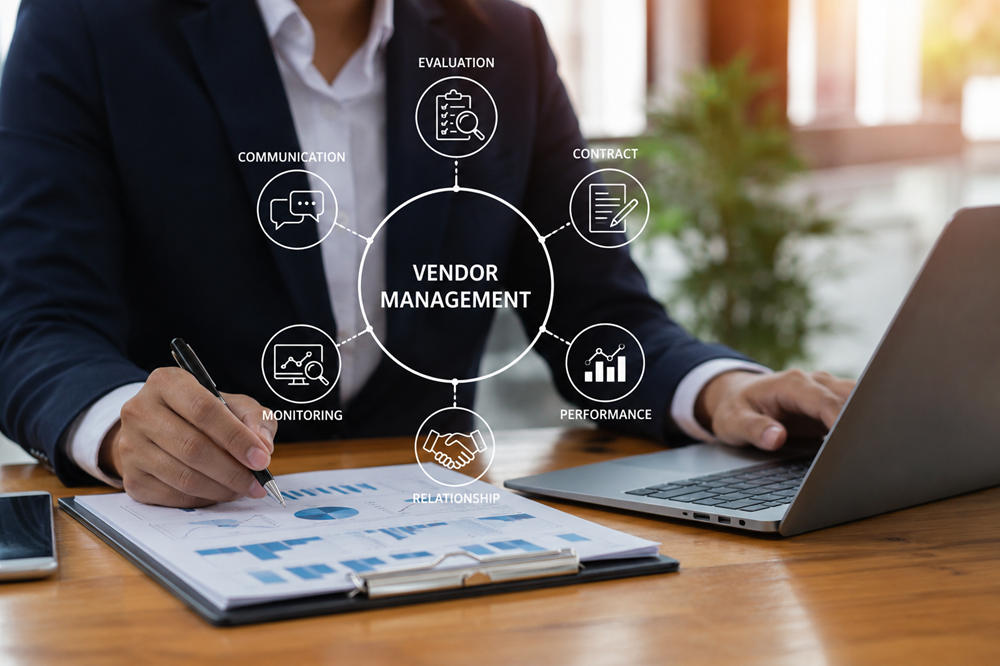
Vendor management is the coordinated oversight of the external companies and individuals that provide products or services to an organization. It brings together commercial decisions, operational responsibilities, risk controls, and relationship management.
The work may involve procurement, finance, legal, information security, operations, and the employees who use the vendor’s product or service. Although these teams contribute different expertise, their activities should support one shared understanding of what the vendor is expected to deliver.
Vendor management is broader than purchasing. Purchasing focuses on obtaining a product or service, while vendor management continues after the transaction. It considers whether the provider is meeting its obligations, whether the relationship still supports the business, and whether changing conditions require a different approach.
The terms vendor and supplier are often used interchangeably. Some organizations use “supplier” primarily for providers of physical materials and “vendor” for a wider range of contractors, consultants, service providers, and technology companies. The same core management principles generally apply to both.
Why Vendor Management Matters
A vendor operates outside the organization, but its work may directly affect employees, customers, finances, operations, and reputation. A structured approach helps the organization receive the intended value without losing visibility or control.
Better Quality and Service
Clear standards make it easier to judge whether a vendor is delivering acceptable work. Quality is no longer based on vague expectations or individual opinions; it can be assessed against agreed requirements.
This creates more consistent products, services, and customer experiences. It also reduces the time employees spend correcting errors, clarifying responsibilities, or compensating for unreliable delivery.
Greater Cost Control
The quoted price represents only part of a vendor’s financial impact. Implementation work, additional fees, internal administration, delays, rework, and service failures can all increase the total cost of the relationship.
Vendor management gives organizations better visibility into those costs. It also encourages teams to review usage, contract terms, price changes, and renewal decisions instead of allowing spending to continue automatically.
Lower Business Risk
Vendors may access sensitive information, enter company facilities, interact with customers, connect to internal systems, or provide services that cannot be interrupted without serious consequences.
The risks may be operational, financial, legal, regulatory, reputational, or related to cybersecurity. The necessary controls depend on the vendor’s role, the information or resources it can access, and how difficult it would be to replace.
NIST’s cybersecurity supply-chain guidance emphasizes identifying, assessing, and addressing supplier-related risks throughout the lifecycle of products and services. Although the publication focuses on cybersecurity, the broader principle is useful across vendor management: risk should be reviewed continuously rather than only when a provider is first approved.
Stronger Accountability
Vendor relationships often cross departmental boundaries. One team may select the vendor, another may approve invoices, and another may depend on the service every day.
A defined management structure makes it clear who has authority to approve changes, evaluate performance, raise concerns, and make renewal decisions. This reduces gaps in oversight and prevents important issues from being passed between departments without resolution.
The Vendor Management Process
Vendor management is most effective when it is treated as a connected lifecycle. Each stage prepares the organization for the decisions and responsibilities that follow.
1. Define the Business Need
The process begins by identifying the result the organization needs to achieve. Stakeholders should describe the required outcome, scope, budget, timeframe, users, and operational constraints before comparing providers.
This step should separate essential requirements from desirable features. It should also consider how the product or service will fit existing processes, which teams will depend on it, and what the consequences would be if it became unavailable.
A well-defined need gives vendors a clearer basis for their proposals and gives the organization a fair method for evaluating them.
2. Evaluate and Select Vendors
Vendor evaluation should consider the provider’s ability to deliver the required outcome consistently. Relevant factors may include experience, staffing, technical capability, capacity, references, financial stability, support arrangements, geographical coverage, and price.
The criteria should reflect the nature of the purchase. A routine office supplier does not require the same evaluation as a payroll provider holding employee data or a manufacturer supplying a component that is essential to production.
Price should be considered in relation to reliability, implementation effort, contractual limitations, and long-term value. A low-cost proposal may be unsuitable if it depends on unrealistic assumptions or excludes services the organization will later need.
3. Conduct Due Diligence
Due diligence verifies whether the vendor presents an acceptable level of risk before the organization becomes dependent on it. Reviews may cover business registration, financial condition, insurance, licenses, references, legal disputes, security practices, continuity arrangements, and the use of subcontractors.
The level of investigation should be proportionate. Vendors that process sensitive information, support critical operations, or have extensive access to systems and facilities require a more detailed assessment than easily replaceable, low-risk providers.
NIST’s final supplier due-diligence guide describes due diligence as gathering and examining relevant information so that informed decisions can be made about suppliers and products. The guide specifically addresses information and communications technology supply chains, but its risk-based approach can also inform wider vendor reviews.
4. Negotiate the Contract and Expectations
The contract should convert the business need into clear obligations. It should define what the vendor will provide, when the work will be completed, how charges will be calculated, and what each party must contribute.
Depending on the relationship, the agreement may address service levels, acceptance criteria, confidentiality, data handling, reporting, insurance, compliance, intellectual property, subcontractors, dispute resolution, and liability.
Renewal and termination provisions are especially important. The organization should understand notice periods, automatic-renewal terms, permitted price changes, data-return requirements, and any support the vendor must provide during a transition.
5. Onboard the Vendor
Onboarding prepares the vendor to begin work within the organization’s processes and controls. It may involve system access, security training, site procedures, payment instructions, brand standards, technical documentation, or reporting templates.
The vendor should know how routine communication will work, which decisions require approval, and where urgent issues should be escalated. Internal employees should also understand how to request work, report concerns, and interact with the provider.
A formal handoff from the selection team to the operational owner helps preserve the commitments and assumptions established during evaluation and negotiation.
6. Monitor Performance and Manage the Relationship
Once work begins, actual results should be compared with contractual requirements and operational expectations. Monitoring may involve service reports, delivery records, customer feedback, issue logs, audits, or scheduled meetings.
In U.S. federal contracting, the General Services Administration’s contract-administration guidance similarly describes day-to-day oversight as a way to confirm that vendors meet their commitments for timeliness and quality.
When results fall below expectations, the organization should document the issue, its business impact, the likely cause, and the required corrective action. Serious or recurring failures may justify a formal improvement plan with specific owners and deadlines.
Important vendors should also be required to disclose material changes that may alter the organization’s risk. Examples include a change of ownership, financial difficulty, a security incident, the loss of an important certification, a new subcontractor, or a major reduction in staffing or capacity.
7. Renew, Renegotiate, or Offboard
A renewal should be treated as a fresh business decision. Before extending the agreement, the organization should review performance, current requirements, pricing, risks, service usage, and available alternatives.
Renegotiation may be appropriate when the vendor remains suitable but the original terms no longer reflect the relationship. Changes may be needed to volumes, service levels, reporting, pricing, security obligations, or responsibilities.
When the relationship ends, offboarding should protect operations and information. Access must be removed, company property returned, final obligations resolved, and data transferred, retained, or destroyed according to the agreement. Knowledge and responsibilities may also need to move to an internal team or replacement provider.
How to Measure Vendor Performance
Performance measures should reflect the outcome the vendor was hired to produce. A logistics company, software platform, consultant, and equipment manufacturer will require different indicators.
A manageable performance framework may include:
- Quality: Defects, errors, rejected deliverables, complaints, or rework.
- Delivery and service levels: Whether orders, milestones, availability, or processing targets are achieved as agreed.
- Response and resolution: How quickly the vendor acknowledges and resolves incidents or requests.
- Cost and billing accuracy: Total spending, unexpected charges, price variance, and invoice errors.
- Security and compliance: Control failures, policy exceptions, audit findings, or reportable incidents.
- User satisfaction: Feedback from employees or customers who receive the vendor’s work.
- Corrective-action completion: Whether promised improvements are delivered by their deadlines and solve the identified problem.
- Continuous improvement: Practical contributions that improve quality, efficiency, resilience, or cost over time.
APQC defines supplier on-time delivery by comparing actual delivery with the agreed schedule. This illustrates why every performance measure needs a precise definition. Both parties should understand what is being counted, which period is being measured, and how exceptions will be handled.
Using a Vendor Scorecard
A vendor scorecard brings selected measures into a consistent review. It may show the target, actual result, recent trend, explanation, and required action for each indicator.
The scorecard should include only information that supports a decision or follow-up. Too many metrics can hide the results that matter and create reporting work without improving performance.
For significant vendors, scorecard meetings should end with documented actions, owners, and completion dates. This turns the scorecard into a management tool rather than a record of past results.
Vendor Management Best Practices
The vendor lifecycle describes what happens within an individual relationship. The following practices help an organization manage its full vendor portfolio consistently.
Segment Vendors by Importance and Risk
Organizations should not devote the same level of oversight to every provider. Vendors can be grouped according to business impact, spending, access to sensitive information, customer exposure, operational dependency, and replacement difficulty.
For example, an organization might classify vendors as:
- Strategic: Providers that contribute directly to long-term priorities or competitive capability.
- Critical: Providers whose failure would cause serious operational, financial, or customer disruption.
- Managed: Important vendors that need regular oversight but are reasonably replaceable.
- Routine: Low-risk providers of standard products or services.
Segmentation helps determine how much due diligence, monitoring, executive attention, and contingency planning each relationship requires.
Assign One Internal Relationship Owner
Each significant vendor should have a named internal owner who understands why the relationship exists and coordinates the organization’s involvement.
The owner gathers feedback, organizes reviews, tracks commitments, and makes sure concerns reach the right people. Procurement, legal, finance, security, and operational specialists may still contribute, but the owner keeps their efforts connected.
Keep Vendor Information in One Place
Contracts, contacts, risk assessments, performance reports, issue histories, and renewal dates should be stored in an accessible shared system.
The technology can match the size of the organization. A controlled spreadsheet and document repository may be sufficient for a small vendor portfolio, while a larger organization may require a dedicated vendor management platform.
The objective is to ensure that authorized employees can find current information without relying on one person’s inbox or memory.
Set a Review Cadence Based on Criticality
The frequency of formal reviews should reflect the importance of the vendor. A critical provider may require monthly operational meetings and quarterly business reviews, while an established routine vendor may need only an annual assessment.
The schedule should be agreed in advance so that both sides know when results, risks, planned changes, and unresolved issues will be discussed.
Discuss Performance Issues Early and Specifically
General dissatisfaction gives a vendor little guidance. An effective discussion identifies the unmet expectation, presents evidence, explains the business impact, and establishes what must change.
Raising concerns early provides time to correct the problem before it becomes a major disruption. It also allows the organization to increase oversight or prepare alternatives when improvement is uncertain.
Balance Control With Constructive Communication
Contracts and performance measures create necessary boundaries, but day-to-day cooperation still depends on timely and direct communication.
The organization should provide the information vendors need to perform their responsibilities, while vendors should raise questions, delays, and emerging risks before they affect delivery. Constructive communication supports compliance with the agreement; it does not replace it.
Maintain an Exit Plan
An exit plan explains how the organization would continue operating if the vendor relationship ended. It may cover replacement options, notice periods, data exports, access removal, knowledge transfer, transition support, and temporary workarounds.
The plan should be developed while the relationship is stable. Waiting until a serious failure occurs leaves less time to protect operations and reduces the organization’s negotiating position.
Building Vendor Relationships That Create Long-Term Value
Routine vendors are generally expected to provide a defined product or service reliably. Strategic vendors may offer opportunities that extend beyond routine contract performance, including process improvements, technical expertise, innovation, and better preparation for future needs.
These relationships benefit from selective information sharing. When appropriate, the organization can explain future demand, operational priorities, or customer needs. In return, the vendor can provide early warning about capacity constraints, market changes, emerging technology, or risks within its own supply chain.
Joint improvement efforts should address clear business opportunities. The parties might simplify an ordering process, redesign a service workflow, reduce avoidable costs, improve resilience, or develop a more effective solution for users.
ISO 44001 provides a framework for identifying, developing, and managing collaborative business relationships. Its principles are most relevant when both parties have a reason to invest in shared planning and improvement rather than limiting the relationship to individual transactions.
Deeper collaboration is not necessary for every vendor. It should be reserved for relationships in which stronger cooperation can create measurable value for both organizations.
Conclusion
Vendor management connects business needs, provider selection, contracts, performance, risk, and relationship decisions in one continuous process. It begins before a vendor is chosen and continues until the relationship has been renewed, changed, or safely concluded.
The right level of oversight depends on the vendor. Routine providers may need straightforward controls, while critical or strategic vendors require closer monitoring, stronger continuity planning, and more deliberate relationship management.
With clear ownership, proportionate controls, relevant performance measures, and organized information, organizations can reduce preventable risk while building more reliable and valuable vendor relationships.