Project Management Plan: Key Components and How to Create One
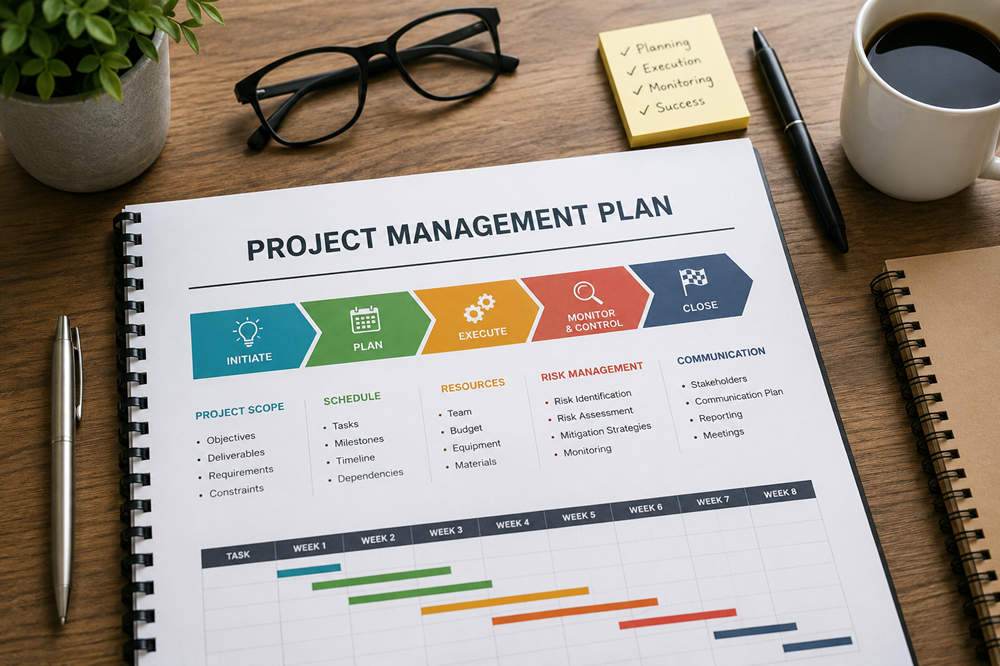
A project management plan explains how a project will be delivered, monitored, controlled, and completed. It brings the project’s objectives, scope, schedule, resources, costs, risks, quality standards, responsibilities, and change procedures into one coordinated framework.
A good plan does more than document early decisions. It gives team members a shared basis for organizing their work and helps project leaders respond consistently when priorities, risks, or delivery conditions change.
What Is a Project Management Plan?
A project management plan is the central document that describes how the project team will turn an approved idea into a completed result. It establishes the approach to delivery, decision-making, performance measurement, stakeholder involvement, and control.
Integrated project planning connects benefits, success criteria, scope, quality, time, resources, costs, risks, and communication. These areas cannot be planned effectively in isolation because a decision in one area often affects several others.
For example, bringing a deadline forward may require more staff, additional funding, a smaller scope, or a different technical approach. The project management plan gives decision-makers a way to assess those consequences together.
The level of detail should reflect the project’s size, complexity, and risk. A small internal improvement may need a short document, while a large construction, technology, or organizational-change project may require several supporting plans.
The plan can also be adapted to the delivery method. ISO 21502 recognizes predictive, incremental, iterative, adaptive, and hybrid approaches. An agile team may refine detailed work through backlogs and short planning cycles, but it still needs clear objectives, responsibilities, financial limits, governance, and risk controls.
How It Differs From a Charter and Schedule
A project charter authorizes the project and records its high-level purpose, sponsor, authority, objectives, and initial constraints. The project management plan builds on that foundation by explaining how the approved project will be delivered.
A project schedule focuses on activities, dependencies, milestones, and dates. It is an important part of the management plan, but it does not normally cover the full approach to scope, quality, cost, governance, risk, communication, and change.
What Should a Project Management Plan Include?
The exact contents will vary, but most effective plans address the following areas.
Purpose, Objectives, Benefits, and Success Criteria
The plan should begin by explaining the problem, need, or opportunity behind the project. This connects the work with the organization’s wider goals and gives the team a clear reason for undertaking it.
Objectives describe the results the project is expected to achieve. They should be specific enough for progress and final performance to be evaluated.
The plan should also identify the benefits the project is intended to enable. A benefit may be increased capacity, lower operating costs, improved customer service, reduced risk, stronger compliance, or another measurable improvement.
Benefits management continues beyond producing the deliverables. Some benefits may appear only after the completed product, service, or process has been transferred to operational teams. The plan should therefore indicate who will own each major benefit and how it will be measured.
Success criteria define how stakeholders will judge the project. Depending on the intended outcome, they may include:
- Completion within an agreed time or budget range
- Achievement of defined performance levels
- Compliance with legal or technical requirements
- Successful adoption by customers or employees
- Delivery of measurable operational improvements
- Acceptance by the designated decision-maker
Scope, Deliverables, Assumptions, and Constraints
The scope defines the work the project is responsible for completing. It should identify the main deliverables, project boundaries, and anything specifically excluded.
Clearly stated exclusions help prevent related requests from entering the project without proper assessment. They also give the project manager a reliable reference when stakeholders have different expectations about what is included.
Each major deliverable should have a clear description, relevant requirements, an owner, and defined acceptance conditions.
The plan should also record important assumptions and constraints. An assumption is a condition currently treated as true for planning purposes, such as the expected availability of a specialist. A constraint is a limit within which the project must operate, such as a fixed deadline, funding ceiling, policy requirement, or technology restriction.
Both should be reviewed during delivery. An invalid assumption or changed constraint may affect the feasibility of the approved approach.
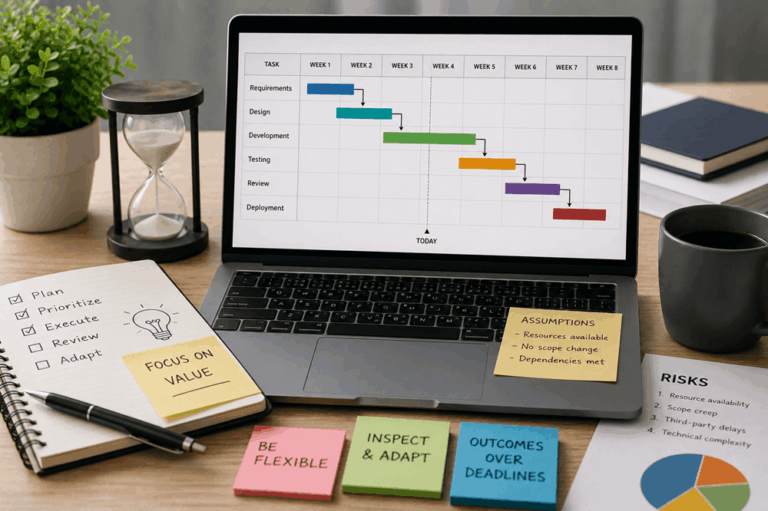
Work Breakdown, Schedule, and Milestones
The project’s deliverables should be divided into manageable work packages or activities. Each piece of work should be small enough to estimate, assign, monitor, and review.
The schedule places the work in a logical sequence. It should account for:
- Dependencies between activities
- Estimated durations
- Resource availability
- Supplier lead times
- Reviews and approvals
- Testing and correction periods
- Target completion dates
Milestones identify important events rather than periods of activity. Examples include approval of requirements, completion of a prototype, the end of testing, operational launch, and formal handover.
These points allow sponsors and other stakeholders to understand the project’s position without reviewing every individual task.
Budget, Resources, and Suppliers
The budget section should identify expected costs and explain how expenditure will be monitored. Depending on the project, estimates may include labor, equipment, software, materials, travel, training, professional services, contingency, and ongoing transition costs.
Resource planning should consider the skills and availability required at each stage rather than only the number of people assigned. A specialist with limited availability can create a significant dependency even when the wider team has sufficient capacity.
When external suppliers are involved, the plan should address the procurement route, contract responsibilities, lead times, expected deliverables, reporting arrangements, and supplier dependencies. The project team should also understand which commercial or contractual decisions require approval outside the project.
Roles, Responsibilities, and Governance
The plan should identify the sponsor, project manager, workstream leaders, team members, specialists, reviewers, suppliers, and operational representatives involved in delivery.
A responsibility matrix can clarify who performs the work, who approves it, who provides advice, and who needs to be informed. This reduces both unassigned tasks and duplicated effort.
Governance defines how the project will be directed and controlled. It should establish:
- Who approves major decisions
- Which decisions the project manager can make
- When a matter must be escalated
- How often governance reviews will occur
- What information decision-makers will receive
- Who can authorize changes to key commitments
The governance structure should be proportionate. Too little oversight can leave major risks unmanaged, while excessive approval layers can slow routine decisions.
Risk and Issue Management
A risk is an uncertain event or condition that could affect the project in the future. An issue is a situation that has already occurred and requires action.
The plan should explain how risks and issues will be identified, recorded, assessed, assigned, reviewed, and escalated. It should also define the criteria used to judge likelihood, impact, urgency, and severity.
Every significant risk should have an owner. That person is responsible for monitoring the situation and ensuring that the agreed response is implemented.
Possible risk responses include avoiding the cause, reducing the likelihood, limiting the impact, transferring some exposure, or consciously accepting it. Issues require corrective action, a decision, or escalation rather than a possible future response.
Quality and Acceptance Requirements
Quality planning defines the standards that deliverables must meet and the evidence needed to demonstrate compliance.
The approach may include design reviews, testing, peer checks, inspections, audits, prototypes, or formal approval gates. These activities should be built into the schedule and resource estimates rather than treated as additional work at the end.
Acceptance criteria should be agreed before the deliverable is submitted. The plan should identify who has authority to approve it, what evidence must be provided, and how rejected work will be corrected and resubmitted.
Stakeholder Engagement and Communication
The plan should identify the people and groups who can influence the project, are affected by it, or need information from it. Their level of interest, influence, and involvement will determine the most suitable engagement approach.
Different audiences need different information. A sponsor may need a concise view of progress, cost, risk, and decisions, while a delivery team may need frequent updates on tasks, dependencies, and technical problems.
The communication arrangements should specify:
- The intended audience
- The information they require
- The format or communication channel
- The frequency or timing
- The person responsible
- The method for collecting feedback
Possible channels include status reports, dashboards, team meetings, demonstrations, decision logs, governance reviews, workshops, and operational briefings.
Change Control
Projects rarely proceed exactly as first expected. Requirements may evolve, risks may materialize, and new information may reveal a better delivery option. The purpose of change control is not to prevent change but to ensure that it is understood and authorized.
The plan should explain how a proposed change will be documented, assessed, approved, communicated, and implemented. The assessment should consider its effect on objectives, benefits, scope, schedule, costs, resources, quality, risks, contracts, and stakeholders.
A seemingly small request may create consequences elsewhere. Adding a feature could require additional design, testing, documentation, training, security review, and operational support.
The current PMBOK Guide and Standard for Project Management emphasize adaptable project practices rather than a single rigid process. The project’s change-control approach should therefore provide enough oversight for the level of risk without making minor adjustments unnecessarily difficult.
How to Create a Project Management Plan
Creating the plan is a collaborative process. The project manager coordinates it, but reliable estimates and decisions require input from sponsors, team members, specialists, suppliers, operational representatives, and affected stakeholders.
1. Confirm the Project Foundation
Review the business case, charter, contract, funding approval, project brief, and any commitments already made.
Confirm the project’s purpose, sponsor, expected benefits, authority, deadlines, financial limits, and relationship with other initiatives. Resolve major contradictions before detailed planning begins.
2. Define the Required Results
Turn the initial idea into clear objectives, deliverables, success measures, and acceptance conditions.
Ask what must be different when the project is complete, what evidence will demonstrate that difference, and who will decide whether the result is acceptable.
3. Break Down and Sequence the Work
Divide the deliverables into work packages that can be estimated and assigned. Identify dependencies, required approvals, external lead times, and the order in which activities can realistically occur.
Include time for reviews, corrections, testing, and handovers. Plans often become unrealistic when they account for production work but overlook the time needed to examine and approve it.
4. Estimate Resources, Time, and Cost
Develop estimates with the people who understand the work. Record the assumptions behind those estimates and confirm that the required skills, equipment, funding, and supplier capacity will be available when needed.
Where uncertainty remains high, ranges or phased estimates are often more useful than unsupported precision.
5. Agree on Responsibilities and Controls
Assign owners to deliverables, risks, decisions, approvals, communications, and major work packages.
Establish the governance, quality, reporting, escalation, and change procedures needed to keep the project within agreed boundaries.
6. Test the Draft Plan
Ask the people responsible for delivery to challenge the proposed approach. They should examine whether the estimates are realistic, responsibilities are clear, dependencies are complete, and risks have workable responses.
The purpose of the review is not simply to gain agreement. It is to uncover weak assumptions and missing work before they create delays or additional costs.
7. Approve the Delivery Basis
Obtain the required authorization once the plan is considered achievable.
In a predictive project, the approved scope, schedule, and budget will often become formal performance baselines. Changes are then measured against those commitments.
In an iterative or adaptive project, approval may establish higher-level boundaries for outcomes, funding, release timing, quality, and governance. Detailed priorities can then be refined through backlogs, iterations, or rolling planning cycles without losing overall control.
How to Use the Plan During the Project
Coordinate Delivery
The plan gives team members a common view of priorities, responsibilities, dependencies, and upcoming decisions. Project managers can use it to coordinate internal teams, suppliers, reviewers, and operational staff.
Measure Performance
Actual progress, expenditure, completed scope, resource use, risks, and quality results should be compared with the approved delivery basis.
A variance does not automatically mean the project has failed. The project manager should determine why it occurred, whether it threatens an objective, and what response is appropriate.
Support Decisions
Reports and governance discussions should focus on meaningful developments. Decision-makers need to understand what has changed, why it matters, what action is already underway, and what choice or approval is required.
The plan provides the reference points needed to assess options consistently.
Keep the Plan Current
Approved decisions may alter deliverables, milestone dates, estimates, risks, responsibilities, or communication arrangements. The affected sections should be updated promptly.
Each revision should record what changed, why it changed, who approved it, and when the new version took effect. Obsolete versions should be clearly separated so the team does not work from conflicting instructions.
Simple Project Management Plan Template
The following structure can be adapted to different project sizes and delivery methods:
- Project overview and authorization
- Purpose, objectives, benefits, and success criteria
- Scope, exclusions, assumptions, and constraints
- Deliverables and acceptance criteria
- Work breakdown, schedule, and milestones
- Budget, resources, procurement, and suppliers
- Roles, responsibilities, and decision authority
- Governance and escalation arrangements
- Risk and issue management
- Quality management
- Stakeholder engagement and communication
- Change-control process
- Performance monitoring and reporting
- Handover and closure arrangements
- Approval and revision history
Final Thoughts
A useful project management plan gives the team a shared basis for delivering the work, measuring progress, making decisions, and controlling change. It should provide enough detail to guide the project without creating unnecessary administration.
When the plan remains connected to real work and is updated through authorized decisions, it becomes more than an initial planning document. It serves as the project’s practical guide from approval through delivery and handover.