EWMagWork Management Guide: How to Organize Teams, Tasks, and Workflows
Effective management gives people a clear result to pursue, a workable way to coordinate their efforts, and enough authority to make progress. It does not require constant supervision or an elaborate collection of tools.
The term EWMagWork management does not appear to refer to a clearly documented, standardized management methodology. In this guide, it is used as a practical label for organizing priorities, responsibilities, workflows, communication, and team performance.
What Does “EWMagWork Management Guide” Mean?
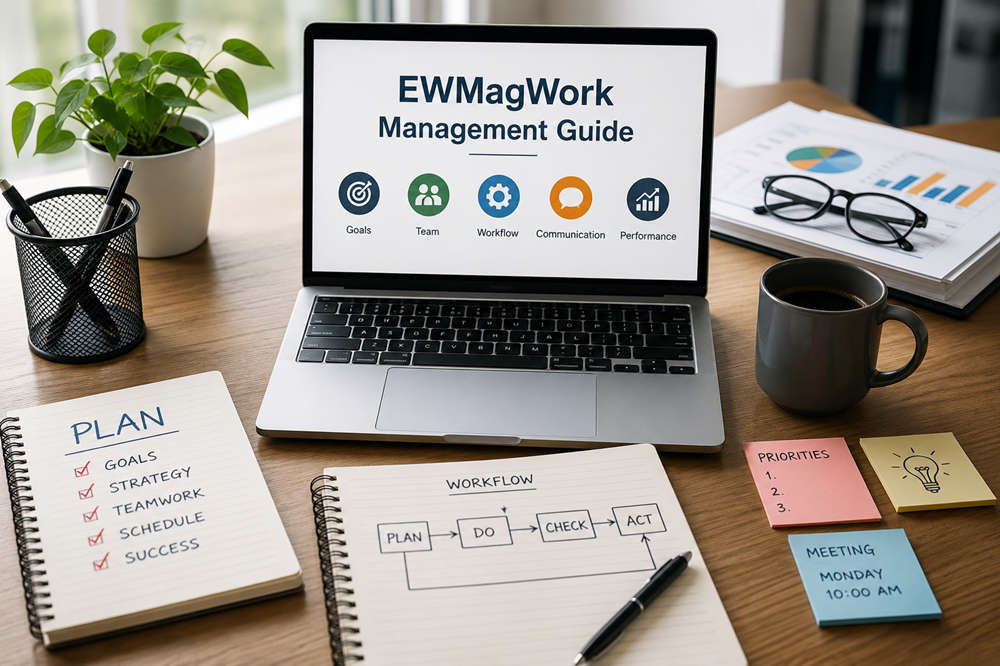
An EWMagWork management guide can be understood as a structured approach to running day-to-day work. It connects five parts of management that are often handled separately:
- Setting clear outcomes and priorities
- Defining responsibility and decision authority
- Organizing how work moves through the team
- Creating reliable communication habits
- Reviewing results and improving the system
The purpose is to make work easier to understand and coordinate. Employees should know what matters, what they own, where information belongs, and how decisions will be made.
This approach can be applied through a spreadsheet, project board, shared document, or existing management platform. The value comes from the structure behind the tool, not from the tool itself.
Set Clear Goals, Priorities, and Responsibilities
Management begins with a specific outcome. Broad instructions such as “improve performance” or “finish the project soon” leave employees to interpret what success means.
A useful goal should identify:
- The result that must be delivered
- The person or group it is intended to serve
- The quality or acceptance standard
- The deadline or review date
- The evidence that will show completion
Managers must then decide which goals deserve attention first. When every request is described as urgent, employees cannot make sensible tradeoffs. A short list of active priorities provides more direction than a long list of competing demands.
Lower-value work may need to be delayed, reduced, delegated, or removed. Adding new priorities without changing existing commitments usually creates hidden overload rather than greater productivity.
Each important deliverable should have one accountable owner, even when several people are responsible for completing parts of the work. A responsibility assignment matrix can distinguish four roles:
- Responsible: completes the work
- Accountable: owns the result and ensures completion
- Consulted: provides information or expertise
- Informed: receives relevant updates
Accountability should be matched with appropriate authority. A person cannot reasonably own an outcome while waiting for approval on every routine decision. Managers should define which choices the owner can make independently and which ones require escalation.
Design Workflows That People Can Actually Follow
Once responsibilities are clear, the team needs a visible path from request to completion. A workflow shows the stages a task passes through, who handles each stage, and where decisions or approvals occur.
Start by mapping one recurring process from beginning to end. An effective process flowchart may include:
- The event or request that starts the work
- The main actions performed
- The people involved at each stage
- The information passed between them
- The decisions and approvals required
- The condition that marks the work as complete
Mapping the process often reveals duplicated steps, unclear handoffs, long waiting periods, or approvals that no longer serve a useful purpose.
Simplify the workflow before automating it. Software can speed up notifications and assignments, but it cannot make an unnecessary step valuable. Removing friction first prevents the team from preserving a poor process in digital form.
Documentation should be proportionate to the work. Repeated, regulated, costly, or error-prone processes need clear instructions. Creative and highly variable work may need only a few principles, decision boundaries, and review points.
Keep the current workflow in one accessible location. Employees should not have to search through old messages and disconnected files to determine which process applies.
Create a Sustainable Communication Rhythm
Communication becomes difficult when the team has no shared rules for where information belongs. Requests are missed, decisions disappear in chat threads, and meetings become substitutes for organized documentation.
A simple communication structure can assign a clear purpose to each channel:
- Urgent issues: a designated channel for matters requiring prompt action
- Routine coordination: the project or task system where progress and handoffs are recorded
- Decisions: a durable record of what was decided, why, and by whom
- Reference information: a shared location for policies, procedures, and recurring guidance
Meetings should be reserved for work that benefits from live interaction, such as resolving disagreements, making complex decisions, coordinating dependencies, or developing ideas together.
Routine status information is usually better handled through written updates. Participants can review it before a meeting, allowing the conversation to focus on issues that require judgment or discussion.
Teams should also agree on reasonable response expectations. An urgent operational problem may require immediate attention, while a routine message may not need a reply until later in the day. Clear expectations reduce unnecessary interruptions.
After an important conversation, record the decision, owner, and next action. A short written summary prevents different interpretations from spreading across the team.
Manage Performance Without Micromanaging
Performance management should clarify expectations and help employees improve. It should not measure productivity through online presence, message volume, or constant activity.
Managers should choose measures that reflect the role. Relevant indicators may include quality, reliability, timeliness, sound judgment, customer impact, or contribution to shared work.
The measures should focus on valuable results. A high number of completed tasks means little when the tasks create rework, fail to meet standards, or do not support the team’s priorities.
Regular coaching conversations allow problems to be addressed before they become formal performance issues. Gallup’s work on workplace accountability emphasizes clear expectations, frequent coaching, and consistent follow-through.
A focused coaching discussion can cover:
- The outcome the employee is working toward
- The progress made since the previous discussion
- The obstacle or decision slowing the work
- The feedback that can improve the result
- The support or skill development needed next
Feedback should describe a specific action and its effect. Telling someone to “communicate better” gives little direction. Explaining that a late update prevented another team from adjusting its schedule makes the required change clear.
Managers should also examine the conditions surrounding poor results. Conflicting priorities, unclear authority, missing resources, or an unrealistic workload can produce weak performance even when the employee is capable and committed.
Accountability works best when employees are responsible for their commitments and managers are responsible for creating reasonable conditions for success.
Address Blockers and Workplace Conflict Early
A stalled task may be caused by an operational blocker rather than a performance problem. Common blockers include a missing decision, delayed approval, unavailable resource, unresolved dependency, or contradictory instruction.
The manager should identify the obstacle and decide who can remove it. When the same blocker appears repeatedly, the underlying process needs to be changed rather than managed as a series of emergencies.
Interpersonal conflict requires a different response. Disagreement may arise from competing priorities, different working methods, unclear roles, or behavior that affects trust and cooperation.
Managers can use a straightforward sequence:
- Determine whether the issue is operational or interpersonal.
- Describe the observable behavior and its effect on the work.
- Listen separately or jointly to the perspectives involved.
- Clarify expectations and agree on the required change.
- Decide whether informal resolution is appropriate.
- Document and escalate serious concerns through formal procedures.
The discussion should focus on actions rather than assumptions about intent. “The required information arrived after the agreed deadline” creates a clearer basis for resolution than “You do not respect the team.”
CIPD’s guidance for people managers emphasizes addressing conflict early while recognizing that managers may sometimes contribute to the problem themselves.
Informal resolution is not suitable for every situation. Allegations involving harassment, discrimination, retaliation, threats, serious misconduct, or safety concerns should follow the organization’s formal procedures.
Measure Whether the Management System Is Working
A management system should be judged by both results and working conditions. Review several measures together rather than optimizing one number in isolation. Faster delivery is not an improvement when quality declines, workloads become unsustainable, or unfinished work is transferred elsewhere.
Delivery
Delivery measures show whether the team is producing the intended work. Depending on the role, these may include:
- Completion rate
- Cycle time
- Missed deadlines
- Error or defect rate
- Amount of rework
Workflow Health
Workflow measures show where progress slows between the beginning and end of a process. Review waiting time, repeated approval delays, failed handoffs, reopened tasks, and work that remains stalled.
Team Health
Team-health indicators reveal whether employees have the conditions needed to perform sustainably. Useful signals include role clarity, workload balance, access to resources, unresolved tension, and recurring employee concerns.
Management Quality
Managers should also examine their own contribution. Consider whether decisions are made on time, priorities remain reasonably stable, blockers are removed, feedback is useful, and commitments are followed through.
A healthy team should also be able to continue routine work when the manager is unavailable. If every decision depends on one person, the management system has created a bottleneck.
A Practical Weekly Management Routine
A short weekly routine can keep the system active without adding unnecessary administration.
Beginning of the Week
- Confirm the most important outcomes.
- Check ownership, deadlines, capacity, and dependencies.
- Resolve competing assignments before work begins.
During the Week
- Review work that has stopped progressing.
- Remove obstacles requiring managerial authority.
- Record any priority change and identify what it replaces.
End of the Week
- Compare completed outcomes with the original plan.
- Recognize specific actions that helped the team.
- Select one practical process improvement for the following week.
Final Takeaway
An EWMagWork management approach does not depend on a particular platform or complicated framework. It depends on creating clarity around outcomes, ownership, workflows, communication, and performance.
The most effective system is not the one with the most meetings, rules, or dashboards. It is the one that helps people understand the work, make appropriate decisions, resolve obstacles, and improve how results are delivered.