What Is a Talent Management System? Features, Benefits, and Selection Tips
Recruiting, performance reviews, employee development, and succession planning are often managed through separate tools. As an organization grows, this can leave managers with incomplete information and employees with little visibility into their development opportunities.
A talent management system brings these activities into a coordinated platform. It helps an organization manage how people are hired, evaluated, developed, and prepared for future responsibilities.
What Is a Talent Management System?
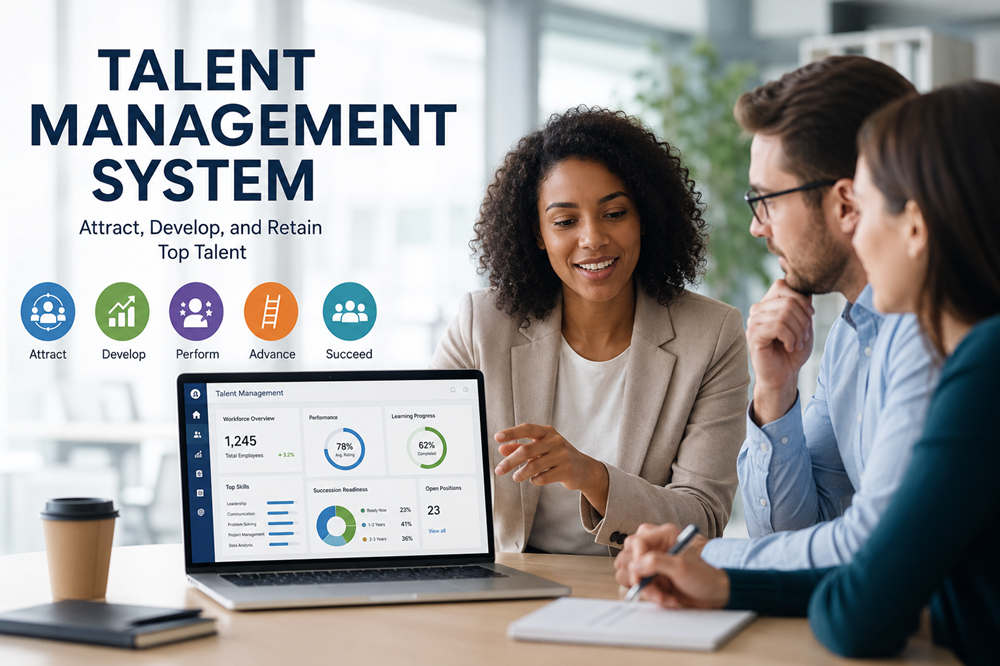
A talent management system is software that supports the processes used to attract, onboard, develop, evaluate, and retain employees. It can also help leaders identify workforce skills, plan internal movement, and prepare successors for important positions.
Some organizations use a standalone talent platform connected to their existing HR software. Others use talent management modules within a broader human capital management, or HCM, system that also handles employee records, payroll, benefits, attendance, and workforce administration.
The precise scope varies between products. One platform may focus on performance and learning, while another may cover recruiting, onboarding, compensation, career development, and succession. What defines the system is its focus on helping the organization manage employee contribution and growth over time.
What Does a Talent Management System Do?
Most talent management systems support three broad stages of the employee lifecycle: bringing people into the organization, helping them succeed in their current roles, and preparing them for future opportunities.
Attracting and Onboarding Employees
Recruiting tools can help employers create job requisitions, publish openings, organize applications, communicate with candidates, schedule interviews, collect feedback, and prepare offers.
When a candidate accepts a position, onboarding features coordinate the tasks needed to begin work. These may include completing forms, acknowledging policies, requesting equipment, meeting colleagues, and finishing introductory training.
Connecting recruitment with onboarding creates a smoother handoff between the hiring team, HR, the employee’s manager, and other departments involved in the new hire’s arrival.
Managing Performance and Development
Performance features help employees and managers establish goals, record feedback, hold check-ins, and complete formal reviews. Historical records make it easier to examine progress across several review periods rather than judging performance from recent events alone.
Learning and development tools can assign required training, maintain course catalogs, record certifications, and help employees create development plans. Managers may also use skills profiles to identify areas in which an individual or team needs additional preparation.
Some platforms include compensation planning, allowing authorized managers to review pay information, performance results, budgets, and proposed adjustments through a controlled approval process.
Supporting Career Growth and Succession
Career development tools help employees explore possible career paths, internal vacancies, short-term projects, mentoring relationships, and learning opportunities. Instead of requiring employees to search informally for their next move, the organization can make available opportunities more visible.
Succession planning features focus on roles that would be difficult to leave vacant. Leaders can identify possible successors, evaluate their readiness, record development needs, and review whether the organization has enough prepared candidates for critical positions.
Modern platforms may also use artificial intelligence to organize skills, suggest development activities, match employees with internal roles, assist candidate searches, or highlight succession risks. For example, current skills-based career development tools can generate recommendations based on employee capabilities and aspirations.
These recommendations should support human judgment rather than replace it. Managers still need to consider individual circumstances, job requirements, performance evidence, employee interests, and the fairness of the decision.
Benefits of a Talent Management System
A well-designed system can improve both administrative efficiency and the quality of workforce decisions.
More consistent talent processes: Common workflows reduce large differences in how departments conduct onboarding, set goals, complete reviews, and create development plans.
Better visibility into workforce skills: Leaders can identify existing capabilities, locate expertise across departments, and see where important skills are limited or missing.
Clearer employee development: Employees can understand what is expected in their current positions and which experiences or capabilities may help them qualify for future opportunities.
Stronger internal mobility: Managers can consider current employees for openings, projects, and assignments that might otherwise be filled externally.
More useful succession planning: Leadership teams can examine whether critical positions have credible successors instead of waiting until a vacancy occurs.
Less manual administration: Shared records and automated workflows can reduce repeated data entry, email follow-ups, spreadsheet tracking, and missing approvals.
More informed discussions: Talent reviews can draw on goals, skills, feedback, experience, learning progress, and career interests rather than relying only on personal impressions.
These outcomes are not automatic. A system can make a process easier to follow, but it cannot correct vague performance standards, poor management, biased promotion practices, or development programs that do not address genuine workforce needs.
How Is It Different From Other HR Systems?
HR technology categories are not rigid. Many modern HCM suites combine several types of software in one platform, while other organizations purchase separate products and connect them through integrations. The following terms describe each system’s primary purpose.
Talent management system: Supports recruiting, performance, learning, career development, internal mobility, compensation planning, and succession. Not every platform contains all these functions.
Human resource information system: An HRIS is primarily used to maintain core employee records and support administrative processes such as payroll data, benefits, attendance, job information, and reporting.
Applicant tracking system: An ATS manages recruiting activities such as job postings, applications, candidate communication, interviews, and hiring workflows. It may be one component of a larger talent platform.
Learning management system: An LMS delivers and tracks courses, certifications, training assignments, and educational content. When connected to talent management, learning can be linked with performance needs, skills gaps, and career plans.
A company therefore may not need four independent products. It should first determine which capabilities already exist in its current HR environment and where genuine gaps remain.
How to Choose and Implement a Talent Management System
Selecting a platform should begin with the workforce problem the organization needs to solve. Comparing long feature lists before defining that problem often leads to unnecessary complexity and poor adoption.
- Define the desired outcome. Identify whether the priority is improving onboarding, standardizing reviews, increasing skills visibility, strengthening internal mobility, organizing learning, or building a leadership pipeline. Translate the priority into a result that can be measured.
- Map the capabilities already available. Review the organization’s HRIS, recruiting tools, learning platform, payroll system, and manual processes. This reveals which functions need to be replaced, added, or connected.
- Separate essential features from optional ones. A growing company may only need onboarding, goals, reviews, and development plans. A large organization may also require complex permissions, multilingual support, regional workflows, compensation planning, and formal succession management.
- Test common user tasks. Employees, managers, recruiters, HR specialists, and administrators should evaluate the activities they will perform regularly. These may include setting a goal, completing a review, finding an internal candidate, approving training, changing a workflow, and producing a report.
- Examine integrations and data ownership. Determine how the platform will exchange information with core HR, payroll, identity management, collaboration tools, job boards, and external learning providers. Establish which system will be the official source for each type of employee data.
- Review reporting and measurement. The system should answer practical questions about review completion, skills availability, learning progress, internal hiring, leadership readiness, and succession coverage. A large dashboard library is not useful if the information does not support real decisions.
- Evaluate privacy and security. Talent platforms contain sensitive details about performance, compensation, career interests, potential, and succession. Review access permissions, audit records, data retention, hosting arrangements, account security, and controls for exporting information.
- Investigate AI features carefully. Ask which processes use automated scoring or recommendations, what employee data those features use, and whether people can understand, question, or override the output. The organization should also test for unreliable results and unequal effects on different groups.
Employers remain responsible for complying with federal employment discrimination laws when AI is used in employment decisions. The voluntary NIST AI Risk Management Framework also provides a useful structure for examining the reliability, transparency, security, and broader risks of AI systems.
- Calculate the total cost. Include data migration, integrations, configuration, training, support, consulting, additional modules, and future changes rather than comparing subscription prices alone.
- Prepare the organization for implementation. Assign ownership, simplify outdated processes, clean employee data, configure access rules, and test realistic scenarios before launch. Training should reflect each user’s responsibilities rather than offering the same general demonstration to everyone.
A phased rollout is often more manageable than introducing every feature at once. Current talent management implementation guidance treats recruiting, learning, performance, career development, security, and succession as distinct configuration areas, each requiring its own decisions and testing.
After launch, the organization should compare results with the original objective. Suitable measures may include adoption, review completion, internal placement rates, learning progress, succession coverage, data accuracy, and the time HR teams spend on manual work.
Conclusion
A talent management system helps an organization manage recruitment, employee performance, development, career movement, and succession through a more coordinated set of processes.
The right platform is not necessarily the one with the most modules or the most advanced AI. It is the one that addresses a defined workforce need, works with the organization’s existing technology, protects employee information, and remains practical for managers and employees to use.
When supported by clear expectations and responsible leadership, the system can help people find development opportunities while giving the organization a better understanding of the talent it already has and the capabilities it will need next.