Behavioral Theory of Leadership: How Leaders’ Actions Shape Effectiveness
Leadership was once studied mainly by looking for the personal qualities that distinguished successful leaders. Behavioral theory changed the focus. Instead of asking what leaders are like, it examines what they do.
This approach made leadership more practical to assess and develop. Actions such as setting expectations, listening to employees, giving feedback, and organizing work can be observed, discussed, and improved.
What Is the Behavioral Theory of Leadership?
The behavioral theory of leadership explains leadership through the actions people use to guide and influence others. It concentrates on observable conduct rather than treating leadership primarily as the result of personality, motivation, or natural ability.
These actions may include assigning responsibilities, communicating decisions, monitoring progress, supporting employees, resolving disagreements, or recognizing strong performance. What matters is not one isolated act but the pattern a leader establishes over time.
The theory strengthened the idea that leadership can be developed. A person may not be able to change every aspect of their personality, but they can learn to run clearer meetings, delegate more effectively, listen without interrupting, or address performance problems more constructively.
This does not mean personal qualities are irrelevant. Judgment, integrity, confidence, experience, and emotional control can all influence leadership. Behavioral theory simply directs attention toward the actions through which those qualities become visible to other people.
How Leadership Research Shifted From Traits to Behavior
Early leadership research attempted to identify characteristics shared by successful leaders. Researchers examined qualities such as intelligence, confidence, determination, sociability, and physical presence.
Trait research produced useful observations, but it did not uncover one dependable profile that explained leadership effectiveness in every setting. People with similar characteristics could behave differently, while leaders with noticeably different personalities could both succeed.
Researchers therefore began studying actions that could be observed and compared. They examined how leaders organized work, communicated with employees, made decisions, maintained standards, and responded to problems.
The shift had practical consequences. Organizations could define the behaviors expected from managers, build those behaviors into training, and give leaders feedback on actions they could change. Leadership development no longer depended entirely on finding people who already appeared to possess an ideal set of traits.
The Two Core Dimensions of Leadership Behavior
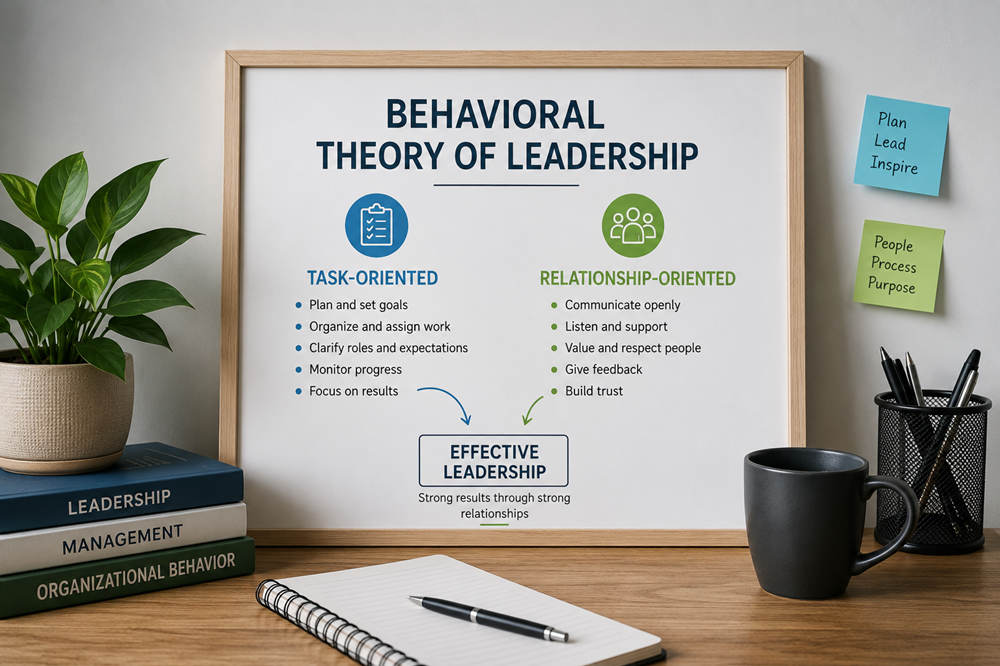
Much of the research behind behavioral leadership theory identified two broad dimensions: behavior directed toward completing the work and behavior directed toward supporting the people who complete it.
These dimensions are commonly described as task-oriented and relationship-oriented behavior. In the Ohio State leadership research, related concepts were called initiating structure and consideration. The two dimensions are independent, so a leader can demonstrate both rather than choosing one at the expense of the other.
Task-Oriented Behavior
Task-oriented behavior creates the structure needed to accomplish a goal. It helps employees understand what must be done, who is responsible, how work will be coordinated, and what standards will be used to judge the result.
Common task-oriented behaviors include:
- Setting goals and priorities
- Defining roles and decision authority
- Assigning responsibilities
- Establishing deadlines and procedures
- Coordinating work across the team
- Monitoring progress
- Addressing missed commitments
The behavioral approach to leadership describes initiating structure as the planning, scheduling, coordinating, problem-solving, and performance-related actions through which leaders organize work.
These behaviors are useful when responsibilities are unclear, the work is unfamiliar, several people must coordinate closely, or errors carry serious consequences. Clear structure reduces uncertainty and helps employees understand how their work contributes to the larger goal.
Problems arise when structure becomes control for its own sake. A leader who prescribes every minor step or monitors experienced employees too closely may reduce initiative and slow decision-making. Effective task behavior gives people enough direction to work confidently without taking away authority they are capable of using.
Relationship-Oriented Behavior
Relationship-oriented behavior concerns how leaders communicate with, support, and respond to team members. It includes actions that demonstrate respect and help create productive working relationships.
Examples include:
- Listening to employee concerns
- Inviting relevant input
- Communicating openly
- Recognizing useful contributions
- Showing respect for employees’ ideas
- Providing support during difficult work
- Encouraging professional development
- Building trust within the team
In behavioral leadership research, these actions are often associated with consideration. They influence whether employees feel able to raise concerns, admit mistakes, question assumptions, and contribute ideas.
Relationship-oriented leadership should not be confused with avoiding disagreement or trying to keep everyone comfortable. A considerate leader may still reject an idea, correct poor performance, or make an unpopular decision. The difference lies in addressing the issue directly without humiliating, dismissing, or unfairly blaming the people involved.
How Task and Relationship Behaviors Work Together
Task and relationship behaviors meet different needs. Task behavior gives work direction. Relationship behavior affects how people understand, accept, and respond to that direction.
Relying heavily on only one dimension can create predictable problems. A manager may establish detailed deadlines and procedures but ignore employees who identify flaws in the plan. The work is structured, but the leader loses information that could improve it.
Another manager may listen carefully and maintain a friendly atmosphere but leave responsibilities unclear. Employees feel supported, yet important decisions and tasks may have no clear owner.
Leaders can attend to both dimensions through actions such as:
- Setting a firm deadline while checking whether the team has the resources to meet it
- Giving corrective feedback while keeping the discussion focused on conduct rather than character
- Inviting informed debate while clarifying who will make the final decision
- Monitoring a high-risk project without controlling every routine choice
- Holding an employee accountable while examining whether unclear instructions contributed to the problem
Using both dimensions does not mean giving them equal attention in every situation. A serious safety problem may require immediate direction. A development conversation may require more listening and reflection. The leader’s task is to recognize what the work and the people need at that moment.
What Behavioral Leadership Looks Like at Work
Behavioral theory becomes useful when broad qualities are translated into actions. Describing someone as organized, supportive, or decisive says little about what the leader should repeat or change. Specific conduct provides a clearer basis for improvement.
Clarifying Responsibilities
Consider a team preparing to launch a new service. Marketing, operations, finance, and technical staff are involved, but no one knows who has final authority over pricing, customer communication, or launch readiness.
A leader applying task-oriented behavior identifies an owner for each decision, defines the expected result, establishes deadlines, and confirms that each owner has the authority and information needed to act.
The leader is not simply taking control. The useful behavior is removing ambiguity so other people can work independently.
Giving Useful Feedback
Feedback such as “You need to communicate better” does not tell an employee what happened or what to do differently.
Behaviorally specific feedback identifies the action, explains its effect, and describes the expected improvement. A leader might explain that interrupting a client several times prevented the team from understanding the full concern and ask the employee to pause and confirm the client has finished before responding.
The discussion remains focused on conduct that can be changed rather than becoming a judgment about the employee’s personality.
Responding to Poor Performance
Suppose an employee repeatedly misses a reporting deadline. A purely directive leader might issue a warning without investigating the cause. A leader concerned only with maintaining harmony might listen sympathetically but leave the standard unresolved.
A more complete response states the performance problem clearly, asks what is preventing timely completion, and establishes specific corrective steps. If the issue involves conflicting priorities, insufficient training, or an inefficient process, the leader helps remove the barrier. If expectations and resources were already clear, the employee remains accountable for improving the result.
This approach combines respect with responsibility. Listening does not make the deadline optional, and enforcing the deadline does not require ignoring relevant circumstances.
Strengths of the Behavioral Approach
Behavioral theory remains influential because it gives leaders and organizations a concrete way to discuss leadership.
It Makes Leadership Observable
Broad qualities can be interpreted in different ways. Asking a manager to become more transparent, supportive, or accountable may not produce meaningful change unless those expectations are connected to specific actions.
An organization can instead examine whether the manager explains major decisions, shares relevant information promptly, listens to concerns, clarifies responsibilities, and follows up consistently.
It Supports Leadership Development
People can practice observable behaviors. A leader can learn to ask better questions, structure meetings more clearly, delegate authority, prepare for difficult conversations, or make recognition more specific.
Behavioral theory does not suggest that everyone has identical leadership potential. It does show that effectiveness is not determined entirely by qualities a person either possesses or lacks.
It Improves the Quality of Feedback
Specific feedback is easier to understand and use. Telling a manager that employees feel excluded is less actionable than explaining that decisions are repeatedly announced after they have been made, even when team members possess information relevant to those decisions.
Behavioral feedback gives the leader an identifiable action to examine and change.
It Recognizes Both Results and Relationships
The two-dimensional approach prevents leadership from being reduced to productivity or popularity. Teams need sufficient direction to perform well, but they also need working relationships that support communication, trust, and cooperation.
Research has continued to support the relevance of both dimensions. A meta-analysis of consideration and initiating structure found that both were meaningfully related to leadership outcomes, although their relationships with particular measures of satisfaction, motivation, and performance were not identical.
Limitations of Behavioral Leadership Theory
Behavioral theory explains an important part of leadership, but observing actions alone cannot determine whether a leader will be effective.
The Same Behavior Can Produce Different Results
Detailed instructions may help an inexperienced team complete unfamiliar work. The same level of direction may frustrate specialists who already understand the task and need room to use their judgment.
A behavior should therefore be evaluated in relation to the people, work, risks, and conditions surrounding it. There is no single behavioral pattern that guarantees success in every environment.
Employees May Interpret Actions Differently
Some employees welcome frequent check-ins because they provide quick access to decisions and feedback. Others view the same behavior as unnecessary supervision.
Experience, confidence, cultural expectations, professional norms, and previous interactions with the leader can all shape how an action is received.
Visible Conduct Does Not Reveal Every Motive
Two leaders may ask employees for input while having very different intentions. One may genuinely want information that could change the decision. The other may have already decided and be asking only to create the appearance of participation.
The observable action is similar, but employees may eventually recognize the difference. Values, sincerity, and consistency influence whether a behavior builds trust.
Useful Behaviors Can Become Mechanical
Leadership cannot be reduced to completing a checklist. Scheduling one-on-one meetings does not demonstrate support when the leader ignores what employees say. Asking for ideas does not create participation when disagreement is punished. Delegating a task does not create autonomy when the leader continues to control every decision.
The quality and purpose of an action matter as much as its visible form.
How Leaders Can Apply Behavioral Theory
The theory is most useful when it helps leaders replace vague goals with manageable changes.
Describe the Behavior Precisely
A goal such as “become a better communicator” is too broad to guide improvement. The leader should identify what better communication would look like.
Possible behaviors include:
- Summarizing decisions at the end of meetings
- Explaining the reason behind major changes
- Sharing important information before employees are directly affected
- Confirming who owns each next step
A precise behavior is easier to practice and evaluate.
Ask for Feedback About Specific Situations
General questions such as “How am I doing as a leader?” often produce polite but unhelpful answers.
More focused questions include:
- Are responsibilities clear after our planning meetings?
- Do I provide enough context when priorities change?
- What do I do that makes concerns difficult to raise?
- When do my check-ins help, and when do they interrupt your work?
These questions give employees a concrete situation to consider and make useful feedback easier to provide.
Practice One Meaningful Change
Trying to transform every leadership habit at once makes progress difficult to sustain. A leader can begin with one action that affects an important team need.
For example, a manager working on delegation might begin by defining the required result and decision authority more clearly. Once that behavior becomes consistent, the manager can address another area, such as feedback or meeting facilitation.
Evaluate the Effect and Adjust
The leader should judge a change by its effect rather than its intention. Did responsibilities become clearer? Are concerns raised earlier? Do employees make more decisions without waiting for approval? Has additional structure improved performance, or has it created unnecessary work?
A behavior that helps one employee or project may need to be adjusted elsewhere. Reviewing the result prevents improvement efforts from turning into rigid habits.
What Behavioral Theory Contributes to Leadership Today
Leadership research now includes questions about context, ethics, identity, culture, motivation, power, and organizational change. Behavioral theory does not explain all of these issues, but its central insight remains valuable: people experience leadership through actions.
A leader may value transparency, but employees experience it when relevant information is shared. A leader may believe in accountability, but accountability becomes real through clear expectations and consistent follow-up. Concern for employees becomes meaningful through listening, fairness, support, and respect.
No single action or combination of actions works equally well in every situation. Even so, observable behavior gives leaders something concrete to examine. It turns leadership from an abstract collection of qualities into a practice that can be evaluated, refined, and improved.