
Which Best Explains How Contractionary Policies Can Hamper Economic Growth?
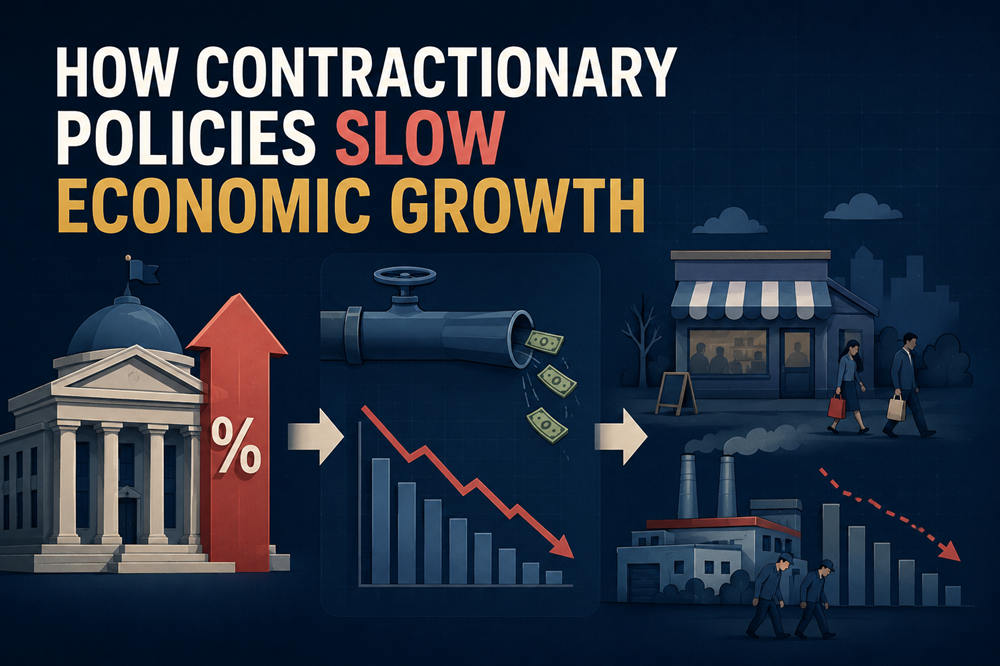
Contractionary policies can hamper economic growth by reducing spending across the economy. Higher interest rates make borrowing more expensive, tax increases may leave households with less disposable income, and government spending cuts reduce demand directly.
When customers spend less, businesses often respond by producing less, delaying expansion, and slowing their hiring. This can reduce GDP growth and, if the slowdown becomes severe, contribute to a recession.
What Is the Best Explanation?
The best explanation is:
Contractionary policies reduce aggregate demand, causing consumer spending, business investment, production, and employment to decline.
Aggregate demand is the total demand for goods and services produced within an economy. Its four main components are:
- Consumer spending
- Business investment
- Government spending
- Net exports
When one or more of these components decline, companies receive fewer orders. They may need fewer workers, less inventory, and less equipment. These changes slow the production of goods and services, which can weaken economic growth.
Contractionary policies generally fall into two categories: monetary policy and fiscal policy.
How Contractionary Monetary Policy Slows Growth
Contractionary monetary policy is used by a central bank to cool demand, usually when inflation is too high. In the United States, the Federal Reserve can adopt a more restrictive policy stance that pushes interest rates higher.
Higher rates affect the cost of mortgages, auto loans, credit cards, and business financing. As borrowing becomes more expensive, households and businesses become less willing to take on new debt.
A family may postpone buying a house because higher mortgage rates make the monthly payment unaffordable. Another household may delay replacing a car or avoid using a credit card for optional purchases.
Businesses face similar choices. A company may decide not to open another location, replace equipment, or launch a new product because the expected return no longer justifies the cost of borrowing.
The process is relatively simple:
- The central bank tightens monetary policy.
- Interest rates and borrowing costs rise.
- Consumers and businesses borrow and spend less.
- Demand for goods and services weakens.
- Businesses reduce production and investment.
- Economic growth slows.
Housing, construction, manufacturing, and vehicle sales are often among the first industries affected because purchases in these areas commonly depend on financing.
How Contractionary Fiscal Policy Slows Growth
Fiscal policy involves government decisions about taxes and public spending. The International Monetary Fund describes fiscal policy as contractionary when it reduces demand in the economy.
A government may adopt contractionary fiscal policy by:
- Raising taxes
- Reducing public spending
- Combining tax increases with spending cuts
Higher personal taxes can leave households with less money to spend. Families may respond by cutting back on restaurant meals, entertainment, travel, clothing, or other nonessential purchases.
Some business tax increases can also discourage investment, although the effect depends on the type of tax, how it is structured, and how the revenue is used.
Government spending cuts have a more direct effect on demand. If officials cancel a road project, for example, contractors lose work and suppliers receive fewer orders. Workers who would have earned income from the project also have less money to spend in their communities.
The type of spending cut matters. Reducing wasteful expenses may have a limited effect on future growth. Cutting productive investments in transportation, education, technology, or research can have more lasting consequences.
Effects on Businesses, Jobs, and GDP
Businesses usually expand when they expect customers to buy more. When demand weakens, the reason to increase production or hire additional workers disappears.
A company experiencing lower sales may:
- Order less inventory
- Reduce employee overtime
- Leave open positions unfilled
- Delay equipment purchases
- Cancel expansion plans
- Reduce working hours
- Lay off employees
Small businesses may be especially sensitive to higher interest rates because many depend on loans or credit lines to buy inventory, manage cash flow, and finance improvements.
Lower employment can deepen the slowdown. When workers lose hours or jobs, their income falls. Even people who remain employed may spend less if they are worried about job security.
That caution affects other businesses. A household that postpones a home renovation reduces income for contractors, hardware stores, and material suppliers. Those businesses may then cut their own spending.
These changes eventually appear in GDP. Consumer spending, business investment, and government spending are all major parts of economic output. When several decline at once, GDP grows more slowly and may begin to contract.
When Can Contractionary Policy Cause a Recession?
Contractionary policies do not always cause recessions. Policymakers often want a controlled slowdown that reduces inflation without creating widespread unemployment.
The risk of recession rises when tightening is too strong, lasts too long, or occurs while the economy is already weakening. Warning conditions include:
- Interest rates rising quickly
- Households and businesses carrying heavy debt
- Banks becoming less willing to lend
- Fiscal and monetary policies tightening together
- Consumer and business confidence falling
The delayed effect of monetary policy makes the decision especially difficult. An interest-rate increase can take months to influence borrowing, investment, hiring, and prices.
If policymakers continue raising rates before earlier increases have taken full effect, they may weaken demand more than intended. Businesses can then face falling sales, cut jobs, and create another decline in household spending.
A recession becomes more likely when this cycle spreads across industries rather than remaining limited to a few interest-sensitive markets.
Can Contractionary Policy Affect Long-Term Growth?
The most immediate effect is usually slower short-term demand. However, excessive tightening can also create longer-term problems.
Persistently high borrowing costs may cause businesses to cancel investments that would have improved productivity. A deep recession can force otherwise healthy companies to close, discourage new business formation, and keep people out of work long enough for their skills to weaken.
Fiscal policy can have similar consequences. Large cuts to infrastructure, education, and research may reduce current spending while also limiting the economy’s future productive capacity.
Still, contractionary policy is not always harmful over the long term. If it brings inflation under control without causing a severe downturn, it can support a more stable environment for saving, investing, hiring, and planning.
The outcome depends on the policy’s timing, size, duration, and design.
Why Policymakers Use Contractionary Measures
Policymakers use contractionary measures because an economy can grow too quickly for its available workers, materials, and production capacity. When demand outpaces supply, prices can rise rapidly.
Persistent inflation reduces purchasing power and makes financial planning harder. Families cannot easily predict what groceries, housing, or transportation will cost. Businesses also face uncertainty about wages, supplies, prices, and future profits.
The Federal Reserve Bank of St. Louis explains that contractionary monetary policy may be used to bring inflation back toward its target. The aim is to cool excessive demand without causing an unnecessary collapse in employment or production.
The source of inflation matters. Contractionary policy tends to work more directly when inflation is being driven by excessive spending. It is less precise when prices are rising because of shortages or supply disruptions.
Higher interest rates cannot produce more oil, food, housing, or computer chips. They can only reduce the amount consumers and businesses are willing or able to buy. Inflation may ease, but the resulting decline in demand can carry a significant economic cost.
The Bottom Line
Contractionary policies hamper economic growth by reducing aggregate demand. Higher interest rates discourage borrowing and investment, tax increases may limit private spending, and government spending cuts remove demand from the economy.
Businesses respond to weaker sales by reducing production, postponing investments, and slowing hiring. GDP growth may then decline, and overly aggressive tightening can contribute to a recession.
Policymakers accept this risk when they believe controlling inflation is necessary for economic stability. Their challenge is to reduce demand enough to ease price pressures without weakening the economy more than necessary.