
How Do Students With a Growth Mindset See Their Mistakes and Learn?
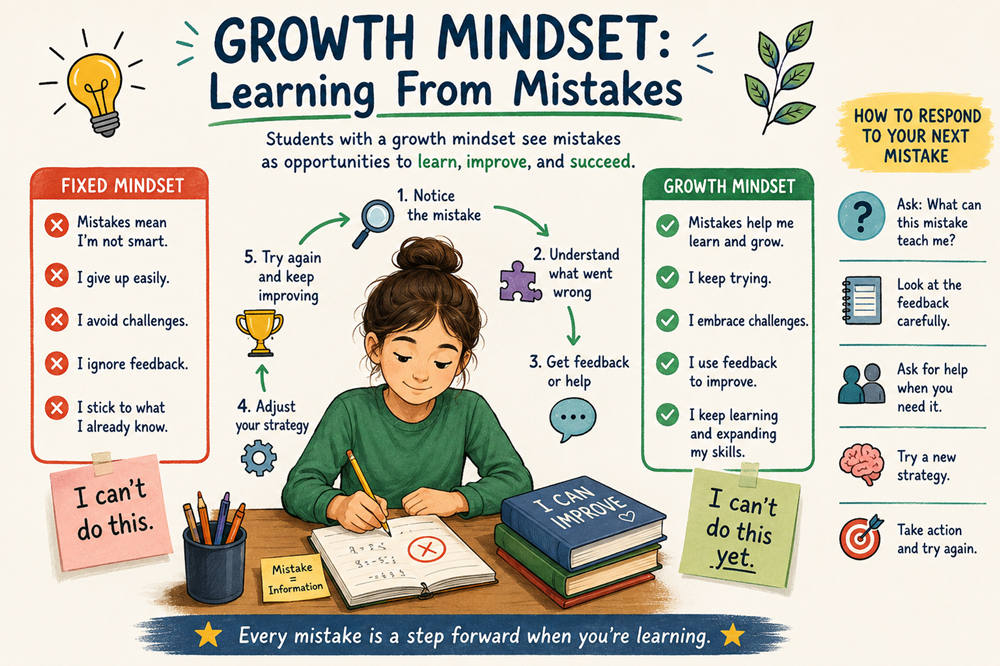
Students with a growth mindset see mistakes as chances to learn, adjust, and improve. A wrong answer or disappointing grade may still frustrate them, but they are less likely to treat it as proof that they are incapable.
Instead, the mistake gives them information. They can figure out what went wrong, use feedback, try a different approach, and work toward a better result. Stanford describes growth mindset in similar terms: abilities can develop, challenges are worth taking on, and failures can be reframed as learning opportunities.
How Students With a Growth Mindset See Their Mistakes
A student with a growth mindset does not automatically connect a mistake with a lack of intelligence.
Imagine getting a math problem wrong. One reaction might be:
“I’m terrible at math.”
A more growth-minded reaction would be:
“Which part of this problem did I misunderstand?”
The second response changes what happens next. Instead of stopping at the mistake, the student looks for its cause.
That might mean reviewing the problem, checking the teacher’s comments, comparing the answer with a worked example, or asking for help.
Research involving school-aged children has found that stronger growth-mindset beliefs were associated with greater attention to mistakes and better accuracy after errors.
The point is not to feel good about getting something wrong. It is to use the mistake instead of letting it define you.
Mistakes Do Not Mean a Student Lacks Ability
One of the simplest ways to understand growth mindset is to compare these two statements:
“I can’t do this.”
and
“I can’t do this yet.”
The first sounds final. The second leaves room for learning.
A student may struggle with fractions today, have trouble organizing an essay, or perform poorly on a science quiz. A growth mindset does not pretend those problems are not real. It simply avoids turning a current struggle into a permanent label.
A low test score can mean many things. Maybe the student misunderstood a concept, used an ineffective study method, rushed through the test, or needs more practice.
The useful question is not:
“Am I smart enough?”
It is:
“What do I need to work on next?”
Stanford’s student guidance on growth mindset similarly encourages students to see abilities as developable and challenges as part of learning rather than evidence that improvement is impossible.
Mistakes Only Help When Students Learn From Them
Making mistakes by itself does not produce improvement.
A student could complete the same type of problem incorrectly again and again without learning much. What matters is what happens after the error.
A useful process looks like this:
Make a mistake → Notice it → Find the cause → Get feedback → Adjust → Try again
For example, suppose a student keeps getting fraction problems wrong.
After checking the work, the student realizes that the real problem is finding a common denominator. Now there is something specific to practice.
The same approach works in writing.
A teacher might return an essay with comments about weak evidence. Instead of focusing only on the grade, the student can look at where evidence was missing and improve that part of the next assignment.
Mistakes become useful when they point toward a better next step.
Stanford’s guidance for students also encourages using a wrong homework or exam answer as an opportunity to learn, rather than simply moving on from it.
How Mistakes and Feedback Help Students Improve
Feedback is especially valuable when students know how to use it.
Suppose a teacher writes:
“Explain this idea more clearly.”
A student could read the comment, feel disappointed, and ignore it.
Or the student could return to that paragraph and ask:
- What information is missing?
- Would an example make this clearer?
- Did I assume the reader already understood something?
- How can I explain it differently next time?
Now the feedback has a purpose.
The same idea applies to corrected math problems, spelling mistakes, science reports, presentations, and almost any other schoolwork.
The American Psychological Association explains growth mindset as involving not only effort but also good learning strategies, support from others, and opportunities to develop.
That matters because growth mindset is not simply about trying harder.
Sometimes the best response is to stop using a strategy that is not working.
A student might:
- ask the teacher for another explanation,
- practice a different type of problem,
- use flashcards instead of rereading notes,
- study with a classmate,
- break an assignment into smaller steps,
- review previous mistakes, or
- get extra help with a difficult concept.
Persistence is useful, but productive persistence includes knowing when to change the approach.
Growth Mindset vs. Fixed Mindset After a Mistake
A fixed mindset and a growth mindset can lead students to interpret the same situation very differently.
| Situation | Growth Mindset Response | Fixed Mindset Response |
|---|---|---|
| Gets an answer wrong | “What did I misunderstand?” | “I’m bad at this.” |
| Receives a poor grade | “What should I change?” | “I’m not smart enough.” |
| Finds an assignment difficult | Tries another approach or seeks help | May see difficulty as proof of low ability |
| Receives feedback | Looks for useful information | May take it personally |
| Makes the same mistake again | Looks for the cause | May become discouraged |
| Faces a challenging task | Sees a chance to develop | May prefer something easier |
These are examples, not strict personality types.
A student can show a growth mindset in one subject and a more fixed mindset in another. Someone might confidently work through writing mistakes but become discouraged quickly when struggling with algebra.
Students can also shift between the two depending on the situation.
The important question is not whether someone is permanently a “growth mindset student.” It is how the student responds when learning becomes difficult.
A Simple Growth Mindset Example
Imagine two students receive disappointing grades on the same math test.
The first student looks at the grade and thinks:
“I knew I wasn’t a math person.”
The student puts the test away without checking the incorrect answers.
The second student is disappointed too, but reviews the test.
Most of the mistakes involve equations with negative numbers. The student asks the teacher to explain two of the problems, practices several similar questions, and spends more study time on that skill before the next test.
Both students struggled.
The difference is what they did with the struggle.
The second student did not simply “stay positive.” The student found the problem and took a specific action to improve it.
That is what growth mindset looks like in practice.
Why This Approach to Mistakes Matters
If students believe every mistake proves they are not smart enough, difficult schoolwork can start to feel threatening.
They may avoid answering questions, choose easier work, hide confusion, or give up before they have had enough time to understand the material.
A growth mindset offers another way to interpret difficulty.
Not understanding something immediately does not mean a student will never understand it.
That can make it easier to stay involved long enough to identify the problem and work on it.
However, growth mindset should not be treated as a magic formula for academic success. Research examining growth mindset shows that its effects can depend on the student, intervention, and surrounding learning environment.
Students still need good teaching, useful feedback, time to practice, appropriate resources, and support when they are struggling.
Growth mindset mainly helps shape how a student responds to that struggle.
How Students Can Respond to Their Next Mistake
You do not need a complicated routine every time you get something wrong.
Start with one question:
“What can this mistake tell me?”
Then choose a specific next step.
For example:
“I rushed through the directions, so I’ll slow down next time.”
“I don’t understand this formula, so I’ll ask my teacher about it.”
“My essay needs stronger evidence, so I’ll gather sources before I start writing the next one.”
“Rereading my notes didn’t prepare me well, so I’ll practice answering questions instead.”
“I keep making the same grammar mistake, so I’ll practice that rule separately.”
These responses are useful because they turn a vague feeling of failure into something manageable.
The goal is not to avoid every mistake. That is unrealistic when you are learning something new.
The goal is to notice mistakes, understand them, and use what you learn on the next attempt.
The Key Takeaway
Students with a growth mindset see their mistakes as useful information rather than permanent proof that they lack ability.
They can still feel disappointed when something goes wrong. The difference is that they are more likely to examine the mistake, learn from feedback, change their strategy, ask for help when necessary, and try again.
A mistake tells you what happened on one attempt. It does not have to decide what happens on the next one.