Rapid Growth Population Pyramid Explained: Shape, Causes, and What It Reveals About Population Change
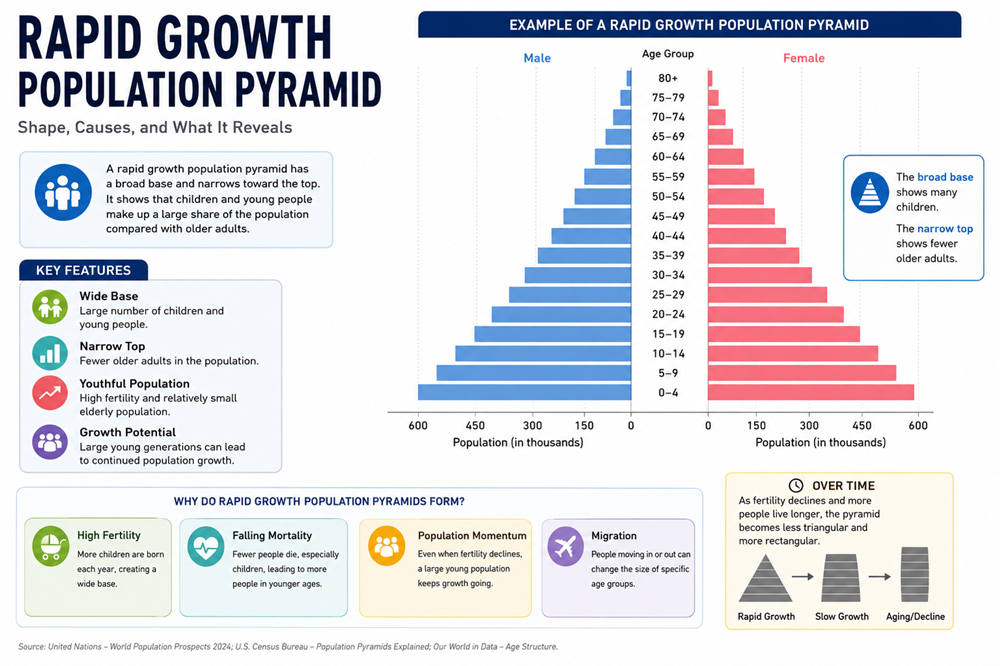
A rapid growth population pyramid has a broad base and becomes progressively narrower toward the top. It shows that children and young people make up a large share of the population compared with older adults.
This shape, sometimes called an expansive population pyramid, is usually associated with relatively high fertility and a youthful population. It also suggests strong potential for continued population growth as large younger generations move into adulthood.
What Is a Rapid Growth Population Pyramid?
A population pyramid is a graph that shows the age and sex structure of a population. Younger age groups appear at the bottom, while older age groups appear toward the top. Males are generally shown on one side and females on the other.
The U.S. Census Bureau uses age-and-sex data to understand population composition and how demographic changes can influence future social and economic trends.
In a rapidly growing or expansive population, the youngest generations are much larger than older generations. This gives the graph its distinctive triangular appearance.
The shape usually points to a population with:
- A large percentage of children
- Relatively high fertility
- A small proportion of elderly people
- Strong potential for future population growth
However, the pyramid primarily shows age structure, not the population growth rate by itself. Births, deaths, migration, and the population’s existing age distribution all influence how population size changes over time.
What Does a Rapid Growth Population Pyramid Look Like?
The clearest sign is a wide base.
Age groups such as 0–4, 5–9, and 10–14 may be noticeably larger than middle-aged and older groups. The bars then generally become shorter as age increases.
A typical rapid-growth pyramid therefore resembles a triangle:
Wide bottom → gradually narrowing middle → narrow top
The broad base represents a large number of children relative to older age groups. A narrow upper section shows that older adults account for a smaller share of the population. Historical population pyramid data show how high fertility and mortality can produce this strongly triangular structure.
The shape does not have to be perfectly smooth. Migration, wars, baby booms, changes in fertility, disease, and other demographic events can create noticeable bulges or gaps within particular generations.
Why Do Rapid-Growth Population Pyramids Form?
The shape develops mainly from the interaction of fertility, mortality, age structure, and migration.
High Fertility
High fertility is usually the most important reason for a broad base.
When many children are born each year, younger age groups become larger than the generations above them. If high fertility continues for several generations, the population develops a strongly triangular age structure.
Falling Mortality
Rapid growth can also occur when death rates decline while fertility remains relatively high.
Improvements in healthcare, sanitation, nutrition, clean water, and living conditions can allow more children to survive and more adults to reach older ages. When mortality falls while fertility remains high, births can substantially exceed deaths.
This pattern forms part of the demographic transition, the long-term shift toward longer lives and smaller families.
Population Momentum
A youthful population can continue growing even after families begin having fewer children.
Suppose a country already has millions of children and teenagers. Over time, this large generation moves into adulthood and the reproductive ages.
Even if each person has fewer children than previous generations did, there may be so many potential parents that the total number of births remains high.
This effect is known as population momentum. The United Nations’ World Population Prospects 2024 identifies momentum created by earlier population growth as a major driver of population increase through the middle of this century.
Migration
Migration can also change a population pyramid.
Large numbers of young adults moving into a country can widen certain working-age groups. Emigration can have the opposite effect.
For that reason, you should not assume that every unusual feature in a population pyramid comes from births and deaths alone.
What Does a Rapid Growth Population Pyramid Tell You?
A broad-based pyramid gives you several useful clues about a population.
The Population Is Relatively Young
Children and teenagers represent a large share of the total population, while elderly people represent a smaller share.
A triangular population pyramid is therefore strongly associated with a youthful age structure. Population pyramids make these differences particularly easy to see because each age group is displayed separately.
Continued Growth Is Possible
A large younger generation creates built-in potential for future growth.
As those children enter adulthood, many will have children of their own. This means population growth can continue even when fertility begins declining.
The UN estimates that today’s youthful global age structure, created by earlier growth, will account for a large share of population increase through 2054.
Demand for Schools and Child Services May Be High
A country with a very young population needs enough services for its large number of children.
This can mean greater demand for:
- Schools and teachers
- Child healthcare
- Vaccination programs
- Housing
- Nutrition programs
- Transportation and infrastructure
As those children grow older, demand gradually shifts toward higher education, employment, housing, and other services needed by young adults. Changes in age structure can therefore have important social and economic consequences.
Large Numbers of Young People Will Enter the Workforce
Today’s large child population eventually becomes tomorrow’s working-age population.
If fertility begins falling, the share of working-age people can increase relative to dependent children. Under favorable conditions, this change can contribute to a demographic dividend.
The opportunity is not automatic. Education, healthcare, employment, productivity, and economic conditions all influence whether a country benefits from its changing age structure. UN demographic research links demographic dividends to changes in the balance between workers and dependents.
Rapid Growth vs. Stable and Aging Population Pyramids
The differences become clearer when the main shapes are compared.
| Population Pattern | Typical Shape | What It Usually Suggests |
|---|---|---|
| Rapid or expansive growth | Broad base, narrow top | High fertility and a youthful population |
| Slow or stable growth | More rectangular | Age groups are more evenly distributed |
| Aging or possible decline | Narrow base, wider middle | Low fertility and fewer young people |
As fertility falls and survival improves, population pyramids generally become less triangular and more rectangular. Very low fertility can eventually produce a base that is narrower than the middle-aged sections of the population.
A narrow base does not automatically mean a population is shrinking. Migration, mortality, and the relative size of older generations also influence total population change.
Example of a Rapid Growth Population Pyramid
Imagine a country where:
- 40% of the population is younger than 15
- 55% is between ages 15 and 64
- 5% is age 65 or older
Its population pyramid would probably have a very broad lower section and a narrow top.
If fertility remains relatively high and births continue to exceed deaths, the population could grow quickly. Even if fertility later declines, the large number of young people moving into reproductive ages could keep the population growing through population momentum.
The example shows why age structure matters. Two countries can have similar total populations today but very different population futures depending on how their people are distributed across age groups.
How Rapid-Growth Population Pyramids Change Over Time
A rapid-growth pyramid does not stay triangular forever.
As countries move through the demographic transition, fertility commonly declines and more people survive to older ages. The youngest generations then become smaller relative to the generations before them.
The base starts narrowing.
At the same time, previously large generations move upward through the pyramid as they age. The middle becomes wider, and eventually the upper portion grows as more people reach older ages.
The general shift can look like this:
Broad triangle → narrower pyramid → more rectangular structure
The global population pyramid provides a clear example of how age structure changes as fertility, mortality, and longevity change over time.
The United Nations describes the broader demographic transition as a historic movement toward longer lives and smaller families, producing major changes in population size and age structure.
How to Recognize Rapid Growth Quickly
If you need to identify a rapid-growth population pyramid on a test, worksheet, or graph, focus on three features:
- The base is much wider than the upper sections.
- Children and young people make up a large share of the population.
- The pyramid generally narrows as age increases.
These features point toward a youthful, expansive population structure.
Just remember that the graph itself primarily shows who is in the population by age and sex. Whether the total population is currently growing rapidly also depends on fertility, mortality, migration, and existing age structure.
A rapid growth population pyramid is therefore best understood as a broad-based, youthful age structure that creates strong potential for continued population growth.