Growth Mindset Bulletin Board Ideas That Help Students Build Confidence and Resilience
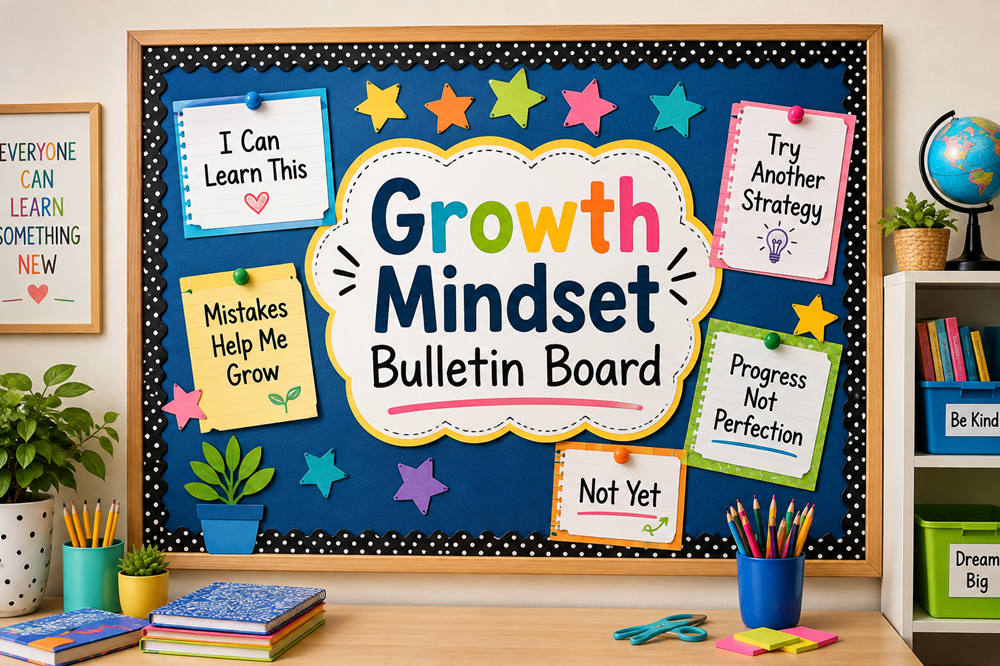
A growth mindset bulletin board can give students simple reminders that learning takes time, mistakes can be useful, and skills improve through practice, feedback, and better strategies.
The best boards are not just colorful classroom decorations. They give students practical language and ideas they can use when work feels difficult, especially when they are frustrated, discouraged, or tempted to give up.
What Is a Growth Mindset Bulletin Board?
A growth mindset bulletin board is a classroom display built around the idea that abilities can develop through learning, practice, support, and effective strategies. PERTS describes a growth mindset culture as one in which students see abilities as improvable through effort, feedback, and effective learning strategies.
Instead of focusing only on perfect results, the board can highlight progress, reflection, problem-solving, effort, and improvement.
For example, a student might move from saying:
“I’m bad at math.”
to:
“I don’t understand this yet, but I can work on it.”
That small change does not pretend the task is easy. It simply leaves room for progress.
A good bulletin board reinforces this message throughout the school year and gives students useful ways to respond when they hit a challenge.
Best Growth Mindset Bulletin Board Ideas
There are plenty of ways to build a growth mindset display. You do not need an elaborate design. A clear theme, a few strong messages, and some student participation are usually enough.
“I Can’t Do It Yet” Board
The word yet is one of the simplest ways to introduce growth mindset thinking.
Use a title such as:
“I Can’t Do It… Yet!”
Then let students add skills they are currently working on.
Examples might include:
- Solving long division problems
- Reading a more difficult book
- Writing stronger paragraphs
- Speaking in front of the class
- Understanding fractions
- Improving spelling
- Staying organized
- Learning multiplication facts
Students can update their cards when they notice progress.
This works because it reminds them that struggling with something now does not mean they will always struggle with it.
Mistakes Help Us Learn
A mistake-themed board can help students become less afraid of getting things wrong.
The goal is not to celebrate mistakes for their own sake. A mistake becomes useful when a student looks at it, understands what happened, and tries something different.
Create three simple areas:
What happened?
What did I learn?
What will I try next?
Students can add short reflections after assignments, quizzes, projects, or classroom activities.
This approach also connects naturally with metacognition and self-regulated learning, where students learn to plan, monitor, and evaluate how they learn.
Change Your Words, Change Your Mindset
This type of board gives students better ways to respond to negative thoughts.
| Instead of Saying | Try Saying |
|---|---|
| “I’m not good at this.” | “I’m still learning this.” |
| “This is impossible.” | “What strategy can I try?” |
| “I made a mistake.” | “What can I learn from this mistake?” |
| “Everyone is better than me.” | “I can focus on my own progress.” |
| “I give up.” | “I need another approach.” |
| “I’m just not a math person.” | “Math is something I can improve with practice.” |
| “I’ll never remember this.” | “I need a better way to practice it.” |
| “I got a bad grade.” | “This grade shows me what I need to improve.” |
You can add new examples throughout the year based on the kinds of comments students actually make.
That makes the board feel more connected to real classroom experiences.
Challenge Accepted
A Challenge Accepted board works well for students who tend to avoid difficult tasks.
Students can write down one challenge they are currently working on.
Examples include:
- Reading a harder book
- Improving a test score
- Revising an essay
- Asking more questions in class
- Completing a difficult project
- Improving time management
- Participating in group discussions
Later, students can add what helped them make progress.
Maybe they asked for help, changed their study method, practiced more often, or broke the task into smaller steps.
This shifts the focus from simply “working harder” to finding better ways forward.
Celebrate Progress, Not Perfection
Students often notice who gets the highest grade but overlook their own improvement.
A progress board can change that.
Create sections such as:
- Something I understand better now
- A skill I improved
- A habit I am working on
- A challenge I handled differently
- Something I kept practicing
- A goal I reached
This lets students recognize small improvements that might otherwise go unnoticed.
A student who improves from 60% to 75% has made meaningful progress even if someone else scored higher.
Our Brains Learn and Adapt
A brain-themed bulletin board can introduce the idea that learning involves changes in the brain.
The brain has a capacity known as plasticity, meaning it can reorganize and adapt in response to experience. The Center on the Developing Child at Harvard University offers a useful overview of how experience and brain development are connected.
You can place a large brain illustration in the center and surround it with words such as:
- Practice
- Feedback
- Curiosity
- Challenge
- Reflection
- Strategy
- Learning
- Persistence
For younger students, keep the message simple: practice and learning experiences help build the connections involved in developing skills.
For older students, connect the idea to study habits, revision, memory, feedback, and repeated practice.
Growth Mindset Quote Wall
A quote wall can work well if you keep it simple.
Rather than covering the board with dozens of sayings, choose a few strong messages and rotate them during the year.
Possible phrases include:
- I can learn this.
- I am still learning.
- Mistakes give me information.
- I can try another strategy.
- Feedback helps me improve.
- Progress matters more than perfection.
- Asking for help is part of learning.
- Hard does not mean impossible.
- I can improve with practice.
- I do not have to understand everything right away.
You can also let students choose a phrase that helped them during a difficult assignment and explain why.
That makes the quotes more meaningful than simply displaying them.
Student Progress Board
A student progress board focuses on improvement instead of only displaying the best work in the class.
You might feature:
- Revised writing
- Before-and-after work samples
- Reading progress
- Improved organization
- Completed goals
- Better study habits
- Increased participation
- Stronger problem-solving
This creates more opportunities for students to be recognized.
A student does not have to be the top performer to show meaningful growth.
Growth Mindset Phrases for Your Bulletin Board
Short phrases usually work better than long explanations because students can understand them quickly.
Useful options include:
- I am still learning.
- I can improve with practice.
- I can ask for help.
- Mistakes give me information.
- I can try another way.
- This may take time.
- Feedback helps me grow.
- My progress matters.
- I can break this into smaller steps.
- I can learn from other people.
- I can change my strategy.
- I can keep going after a setback.
- I can reflect and try again.
- I do not need to get everything right the first time.
- One difficult moment does not define my ability.
Choose phrases that students can actually use when they are stuck.
How to Make a Growth Mindset Bulletin Board Interactive
Students are more likely to notice a bulletin board when they help create and update it.
Add Student Goals
Give each student a card where they can write one realistic goal.
Later, they can add a short update explaining what they improved or what strategy helped.
Create a “What I Learned” Section
Students can write something they recently understand better.
For example:
“I learned that rereading the question helps me avoid simple mistakes.”
The lesson does not always have to be academic. Students can also reflect on organization, study habits, teamwork, or asking for help.
Add a Mistake Reflection Area
Let students share a mistake and what they learned from it.
These can be anonymous if students are more comfortable that way.
The point is to show that mistakes happen and that reviewing them can help students decide what to change next.
Rewrite Fixed-Mindset Statements
Place negative statements on removable cards and ask students to rewrite them.
For example:
“I’m terrible at writing.”
could become:
“My writing improves when I revise and use feedback.”
This gives students practice turning an unhelpful thought into something more realistic and useful.
Create a Strategy Bank
This may be one of the most useful additions to the board.
Instead of telling students only to “keep trying,” give them specific ideas they can use when they are stuck.
Strategy cards might say:
- Ask a question.
- Look at an example.
- Break the task into smaller steps.
- Check your notes.
- Try a different method.
- Review your feedback.
- Ask someone to explain it another way.
- Practice one part at a time.
- Take a short pause and return to the task.
The Education Endowment Foundation’s guidance on metacognition similarly emphasizes teaching students practical strategies for planning, monitoring, and evaluating their learning.
Students can choose a strategy when they are struggling instead of repeating the same unsuccessful approach.
Growth Mindset Bulletin Board Ideas by Grade Level
The main message can stay the same across grade levels, but the design and language should match the students.
Elementary School
Younger students usually respond well to bright visuals, simple wording, and interactive activities.
Good themes include:
- The Power of Yet
- Mistakes Help Us Learn
- We Keep Growing
- Try Another Way
Use short phrases, colorful cards, drawings, and simple student reflections.
Middle School
Middle school students often respond better to realistic examples rather than overly childish slogans.
Focus on situations involving:
- Grades
- Difficult assignments
- Friendship challenges
- Speaking in class
- Handling feedback
- Managing frustration
- Learning new skills
A fixed-mindset versus growth-mindset board works especially well at this age because students can connect the statements to things they actually say.
High School
For high school students, keep the design simple and more mature.
Good topics include:
- Study strategies
- Academic setbacks
- Improving grades
- Career goals
- College preparation
- Time management
- Building new skills
- Learning from feedback
Older students may respond better to practical advice than cheerful slogans.
Teachers looking at the broader learning process can also explore the Australian Education Research Organisation’s overview of how students learn, which covers evidence-based approaches to teaching and learning.
Tips for Making the Board Actually Effective
A growth mindset board has more value when teachers connect it to real classroom experiences.
Do Not Reduce Growth Mindset to “Try Harder”
Effort matters, but effort alone is not always enough.
Students may also need:
- A different strategy
- More practice
- Clearer instructions
- Extra time
- Feedback
- Better resources
- Help from a teacher or classmate
PERTS similarly frames growth mindset around the possibility of improving academic abilities through effective learning strategies, rather than treating effort by itself as the whole answer.
A better question is:
“What can I try differently?”
That encourages problem-solving instead of simply repeating the same approach.
Give Specific Feedback
Instead of saying:
“Good job.”
Try something more specific:
“Your second draft is easier to follow because you reorganized the middle paragraph.”
Specific feedback helps students understand what they did differently and why it worked.
Make It Safe to Talk About Mistakes
Students will not see mistakes as part of learning if they feel embarrassed every time they make one.
Treat errors calmly and use them as opportunities to explain what can be changed.
Teachers can also model this by correcting their own mistakes without making a big deal out of them.
Keep the Board Fresh
A bulletin board that never changes can quickly become part of the background.
You do not need to redesign it every month.
Small updates are enough.
Rotate student goals, change the featured phrase, add new reflections, or highlight a different strategy.
Refer to the Board During Lessons
The board becomes more useful when you actually use it.
For example, during a difficult assignment, you might say:
“This is a good time to choose one of the strategies from our board.”
That connects the display to real learning instead of leaving it as decoration.
Final Takeaway
A growth mindset bulletin board works best when it gives students something useful to do, not just something nice to look at.
Keep the messages simple, include real strategies, let students contribute, and focus on progress rather than perfection. When students can look at the board during a difficult moment and find a better next step, the display is serving a real purpose in the classroom.