What Is the Difference Between Growth and Development? Key Differences Clearly Explained
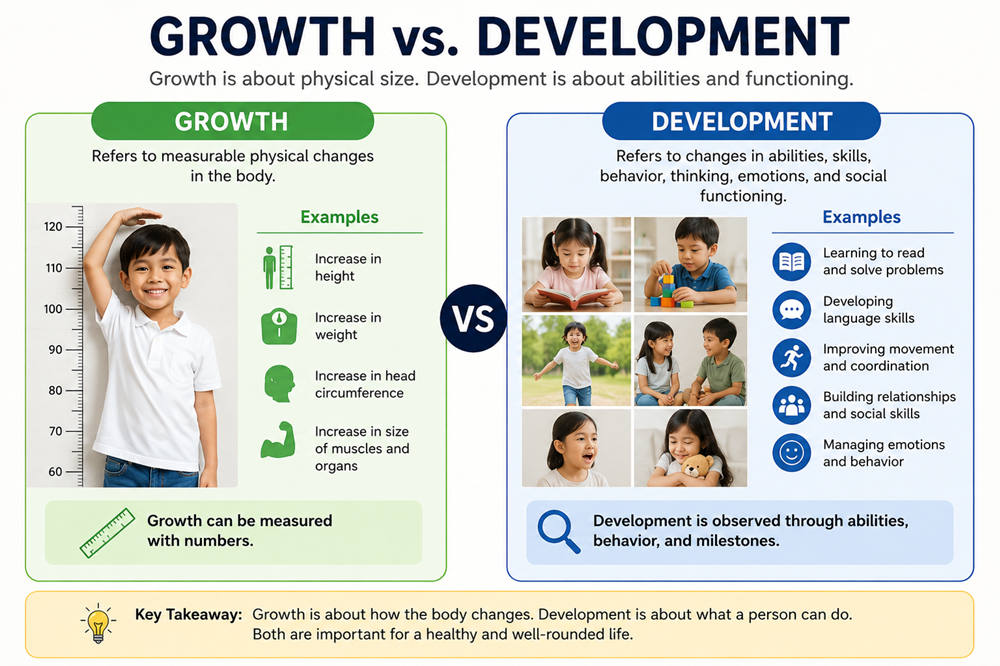
Growth and development often happen together, especially during childhood, but they are not the same thing. Growth mainly refers to measurable physical changes, such as increases in height and weight, while development refers to changes in abilities, skills, behavior, thinking, emotions, and social functioning.
A child getting taller is experiencing growth. A child learning to speak, solve problems, manage emotions, or interact with others is experiencing development.
What Is Growth?
Growth is an increase in the physical size of the body or its parts. Because it involves physical change, it can usually be measured with numbers.
Common measures of growth include:
- Height or body length
- Weight
- Head circumference in young children
- Body size
- Changes in the size of muscles, bones, and organs
The World Health Organization uses measurements such as length or height, weight, body mass index, and head circumference when monitoring children’s physical growth.
For example, if a child grows from 40 inches to 44 inches tall, that is growth. If a baby’s weight increases from 15 pounds to 20 pounds, that is also growth.
Growth is particularly noticeable during infancy, childhood, and adolescence, when the body can change rapidly.
What Is Development?
Development is broader than physical growth. It describes changes in what a person can do and how that person functions.
Development can involve several areas:
- Physical and motor development: walking, running, balancing, grasping, and coordinating movements
- Cognitive development: thinking, remembering, learning, and solving problems
- Language development: understanding language, speaking, and communicating
- Social development: interacting, cooperating, sharing, and building relationships
- Emotional development: recognizing feelings and learning to manage emotions
UNICEF describes early childhood development as multidimensional, including physical, social, emotional, and mental aspects of a child’s well-being.
Development is not simply about becoming bigger. It is about gaining or changing abilities.
For example, when a toddler learns to use a spoon, put words together into a sentence, or take turns during a game, the child is developing new skills.
The CDC’s developmental milestones similarly look at what children can do in areas such as playing, learning, speaking, acting, and moving.
Growth vs. Development: Key Differences
The easiest way to understand the difference is to compare the two directly.
| Growth | Development |
|---|---|
| Mainly involves physical change | Involves changes in abilities and functioning |
| Usually quantitative | Can involve both measurable and qualitative changes |
| Often measured with numbers | Often observed through abilities, behavior, and milestones |
| Includes height, weight, and body size | Includes language, movement, thinking, emotions, and social skills |
| Most obvious during periods of rapid physical growth | Continues as people gain and change abilities |
| Focuses mainly on the body | Covers several areas of human functioning |
In simple terms, growth tells you how the body is changing physically, while development tells you how a person’s abilities and functioning are changing.
The terms are closely connected, but they should not be used as if they mean exactly the same thing.
Examples of Growth and Development
A few everyday examples make the distinction easier to see.
| Example | Growth or Development? |
|---|---|
| A child gets three inches taller | Growth |
| A baby gains weight | Growth |
| A toddler begins speaking in sentences | Development |
| A child learns to complete a puzzle | Development |
| A child learns to ride a bicycle | Development |
| A child becomes better at taking turns | Development |
| A teenager becomes better at managing frustration | Development |
Some changes can involve both.
For example, physical growth helps strengthen muscles and other body systems, while practice and neurological maturation help a child develop the coordination needed to walk, run, or ride a bicycle.
This is why growth and development are often discussed together even though they describe different kinds of change.
How Growth and Development Are Connected
Growth and development influence each other throughout childhood.
As the body and nervous system mature, children become physically capable of learning new skills. A baby, for example, needs sufficient muscle strength and coordination before sitting, standing, and walking independently.
But physical growth alone does not determine development.
Children also develop through interaction, play, communication, learning, and relationships with caregivers. UNICEF’s Care for Child Development approach emphasizes responsive caregiving, play, and communication as ways to support motor, cognitive-language, and social-emotional skills.
Nutrition and health also matter because the developing body and brain need adequate resources. At the same time, children need opportunities to explore, communicate, practice skills, and interact with others.
That means a child can be growing physically as expected while still needing extra support in another developmental area, such as language or social skills.
Likewise, children who are smaller or larger than their peers are not automatically ahead or behind in every area of development.
Why Understanding the Difference Matters
Knowing the difference between growth and development helps you look at a child’s progress more completely.
Height and weight can tell you something about physical growth, but they cannot tell you how well a child communicates, solves problems, moves, interacts with others, or manages emotions.
That distinction matters for several reasons:
- Parents and caregivers can pay attention to both physical growth and emerging abilities.
- Teachers can recognize that children of similar ages and sizes may have very different strengths and learning needs.
- Healthcare professionals can consider physical growth alongside developmental milestones when evaluating a child’s progress.
The CDC distinguishes developmental monitoring from simple physical measurements by focusing on how children change over time in areas such as language, movement, thinking, behavior, and emotions.
It is also important not to confuse physical size with maturity. A taller or heavier child is not necessarily more advanced in language, emotional control, decision-making, or social skills.
The Simple Difference Between Growth and Development
The difference is straightforward: growth is mainly about measurable physical changes, while development is about changes in abilities and functioning.
Getting taller or gaining weight are examples of growth. Learning to talk, solve problems, coordinate movements, form relationships, and manage emotions are examples of development.
Growth and development are closely related, but looking at both gives you a much clearer picture of how a person is changing over time.