How Smart Growth Promotes Long-Term Sustainable Development for Stronger and Healthier Communities
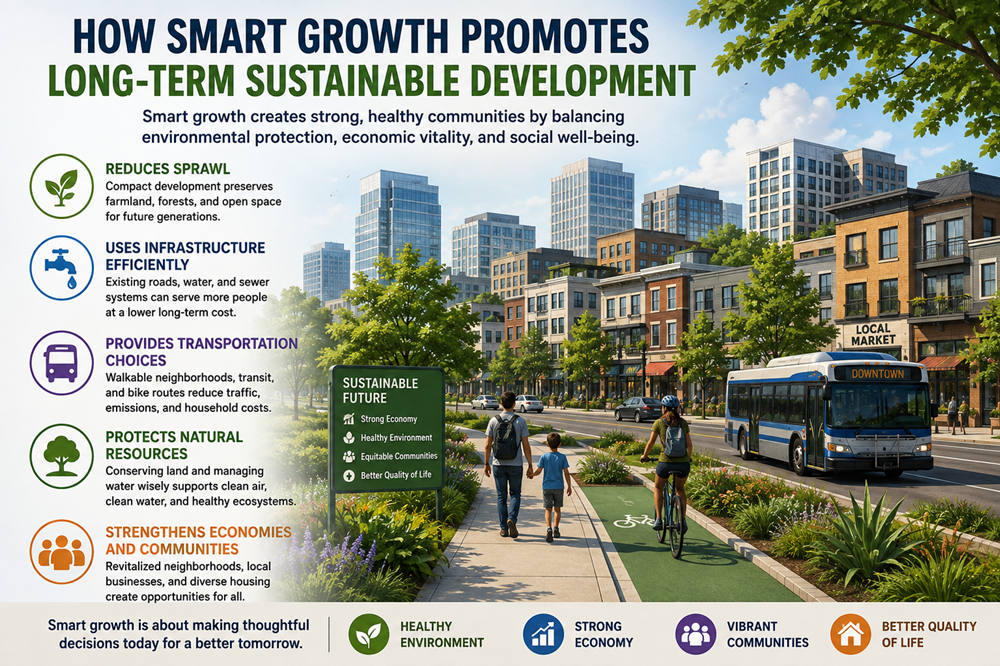
The way a community grows today can shape its costs, transportation, environment, and quality of life for decades. Smart growth tries to make those decisions more thoughtful by encouraging compact neighborhoods, efficient infrastructure, transportation choices, and protection of important natural areas.
Smart growth promotes long-term sustainable development by helping communities accommodate growth while using land and public resources efficiently, protecting the environment, and supporting strong local economies and neighborhoods. The goal is not to stop development. It is to make development work better over time.
What Is Smart Growth?
Smart growth is an approach to planning that focuses on where development happens and how communities are designed.
Instead of continually spreading homes, stores, offices, and roads farther outward, smart growth encourages communities to make better use of places that are already developed. It can include compact building patterns, mixed land uses, walkable neighborhoods, different housing options, public transportation, and protection of farmland and open space.
The U.S. Environmental Protection Agency identifies ten major smart-growth principles, including directing development toward existing communities, providing transportation choices, preserving open space, creating walkable neighborhoods, and using compact building design.
These principles are closely connected. A neighborhood where homes, stores, parks, schools, and transportation are reasonably close together may require less land and make everyday destinations easier to reach.
That can create benefits that continue long after the development itself is completed.
How Smart Growth Promotes Long-Term Sustainable Development
1. Smart Growth Reduces Urban Sprawl
One of the clearest benefits of smart growth is reducing unnecessary urban sprawl.
Sprawl happens when development spreads across large areas, often with homes, businesses, and services separated from one another. As communities expand outward, more undeveloped land may be converted into subdivisions, commercial areas, roads, and parking lots.
Smart growth encourages communities to look first at land within or near existing developed areas.
An empty lot, abandoned shopping center, former industrial site, or underused property may provide an opportunity for new housing or businesses without requiring development to move farther into surrounding countryside.
Compact development can also fit more homes and services into a smaller area. That helps reduce pressure on farmland, forests, wildlife habitat, and other open spaces. Protecting these areas is an important part of open-space conservation and long-term land-use planning.
The point is not that every community needs high-rise buildings or very dense neighborhoods. Smart growth can look different in a city, suburb, or small town. The common idea is to use land deliberately instead of consuming more of it than necessary.
2. Smart Growth Makes Better Use of Infrastructure
Growth requires more than houses and businesses. Communities also have to provide roads, water and sewer systems, emergency services, schools, utilities, and other infrastructure.
Where development happens can make a major difference in how expensive those services are to provide.
Imagine a new neighborhood built several miles beyond the edge of town. The community may need to extend roads, water pipes, sewer lines, and public services to reach it.
Now imagine new housing built on vacant or underused land closer to the town center. Much of the basic infrastructure may already be nearby.
Compact development can therefore help communities get more value from investments they have already made. EPA information on the economic effects of smart growth notes that water, sewer, and road infrastructure can cost less in compact development than in more dispersed development.
That matters for sustainability because communities do not only pay to build infrastructure. They must maintain it for decades.
A road built today eventually needs repairs. Water and sewer lines require maintenance. Emergency services need enough staff and equipment to cover the areas they serve.
Development patterns can even affect water-system efficiency. EPA research on efficient water use explains that dispersed development requires longer pipes, while compact development can use shorter transmission systems and existing infrastructure more efficiently.
Smart growth helps communities consider those long-term obligations before expanding outward.
3. Smart Growth Gives People More Transportation Choices
Land-use decisions also affect how people travel.
When homes are far from workplaces, schools, stores, and other destinations, driving may be the only practical option for many trips. When destinations are closer together, walking, cycling, public transportation, and shorter drives become more realistic.
Smart-growth planning often places housing, businesses, public spaces, and transportation connections closer together.
For example, a mixed-use neighborhood might include apartments, stores, restaurants, offices, sidewalks, bike routes, and access to public transit. Residents can still drive, but they may not need a car for every trip.
The EPA explains that coordinating transportation and land-use planning can increase access to opportunities, provide transportation choices, improve community health, and reduce pollution.
Transportation choice is also a social issue.
Children, older adults, people with disabilities, and households without cars may have difficulty getting around places where driving is required for almost everything. Communities with several transportation options can make jobs, shopping, services, and recreation accessible to more people.
Smart growth therefore does more than address traffic. It connects community design with everyday mobility.
4. Smart Growth Helps Protect Natural Resources
Sustainable development requires communities to think about what happens to land and natural resources as they grow.
Every new road, parking lot, subdivision, and commercial development changes the landscape. Some development is necessary, but its location and design can determine how much environmental impact it creates.
Smart growth can reduce that impact by directing more development toward existing communities and conserving important undeveloped areas.
Planning for the conservation of farmland, forests, wildlife habitat, waterways, and other natural areas can protect ecological functions while leaving communities with valuable recreational and open spaces.
Water is another important part of the picture. Development replaces natural surfaces with rooftops, streets, driveways, and parking lots. When rain falls on these hard surfaces, more water can run into drainage systems and waterways instead of soaking naturally into the ground.
EPA guidance on smart growth and water explains that development patterns can affect stormwater flow, water quality, and local watersheds. Green infrastructure and thoughtful land-use planning can help communities manage these effects.
That does not mean density automatically makes a project environmentally friendly. A poorly located dense development can still damage sensitive land. Good planning also needs to consider waterways, wildlife habitat, stormwater, soil conditions, and local ecosystems.
The important difference is that smart growth considers those effects before development decisions are made.
Protecting natural areas today leaves communities with more farmland, open space, healthy ecosystems, and recreational land in the future.
5. Smart Growth Can Strengthen Existing Communities
Smart growth is not only about conserving land. It can also help communities invest in neighborhoods and business districts that already exist.
When development continually moves toward the edge of a region, older commercial areas and neighborhoods may receive less investment. Vacant properties can remain unused even though roads, utilities, public services, and buildings are already available.
Smart growth encourages infill and redevelopment where appropriate.
An abandoned commercial building might become housing. An empty downtown property could become shops or offices. A former industrial site may be cleaned up and given a new use.
These projects can bring residents, customers, jobs, and investment back into existing communities.
Smart growth can also support equitable development, which considers whether residents have access to housing, infrastructure, jobs, transportation, clean air and water, and other community necessities.
That makes smart growth an economic and social strategy as well as a land-use strategy.
Smart Growth Supports the Three Parts of Sustainability
Sustainable development is often discussed in terms of three connected areas: environmental, economic, and social sustainability. The United Nations describes sustainable development as bringing together economic growth, social inclusion, and environmental protection rather than treating them as unrelated goals.
Smart growth can support all three at the community level.
Environmentally, it can conserve land, support transportation alternatives, and reduce pressure on sensitive natural areas.
Economically, it can make better use of existing infrastructure, encourage redevelopment, and help direct investment into established communities.
Socially, it can create neighborhoods where housing, jobs, services, transportation, and public spaces are easier for residents to reach.
These benefits are most useful when they work together. A development that protects open space but leaves residents isolated from jobs and services is not necessarily sustainable. Neither is development that creates short-term economic activity while leaving a community with infrastructure it cannot afford to maintain.
Smart growth looks at the larger picture.
A Simple Example of Smart Growth
Suppose a growing town needs 1,000 additional homes.
One option is to build several subdivisions outside the existing town.
The development may require new roads, longer utility lines, additional water and sewer infrastructure, and expanded public services. Residents might also need to drive several miles to reach jobs, stores, schools, and other destinations.
Another option is to spread those 1,000 homes across several smart-growth projects.
Some homes could be built on vacant lots. An old commercial site could be redeveloped into apartments and shops. Townhouses might be added near the downtown area. Additional housing could be placed close to an existing transit route.
Both approaches provide 1,000 homes.
The difference is how much new land and infrastructure are required and how easily residents can reach the places they use every day.
The second approach may preserve more undeveloped land, use existing infrastructure more efficiently, and give residents additional transportation choices. EPA’s examples of smart-growth development similarly show how communities can combine housing and transportation choices with protection of natural and working lands.
That simple example captures the basic idea behind smart growth: communities can accommodate development without automatically expanding farther outward every time they grow.
Why Long-Term Planning Matters
Development decisions can last much longer than the people who make them.
A road may remain in service for generations. A neighborhood’s street pattern can influence how residents travel for decades. Once farmland or natural habitat is covered by buildings and pavement, reversing that decision can be difficult.
Smart growth asks communities to think about those long-term effects before development occurs.
Can housing be built near existing services?
Can vacant land be reused?
Can important natural areas remain undeveloped?
Can people reach jobs and businesses without needing a long car trip every time?
Can the community afford to maintain the infrastructure being built today?
Those questions are at the heart of sustainable development.
Smart growth does not mean that every community should develop in exactly the same way. A rural town will have different needs from a major city. What matters is making growth decisions with future costs, resources, environmental effects, and residents’ needs in mind.
When communities use land carefully, invest in places they already have, protect valuable natural areas, and create practical transportation choices, growth is more likely to remain manageable over the long term. That is how smart growth turns sustainable development from a broad idea into decisions people can see in their neighborhoods, streets, and communities.