Tamagotchi Gen 2 Growth Chart and Complete Guide to Every Character Evolution Path
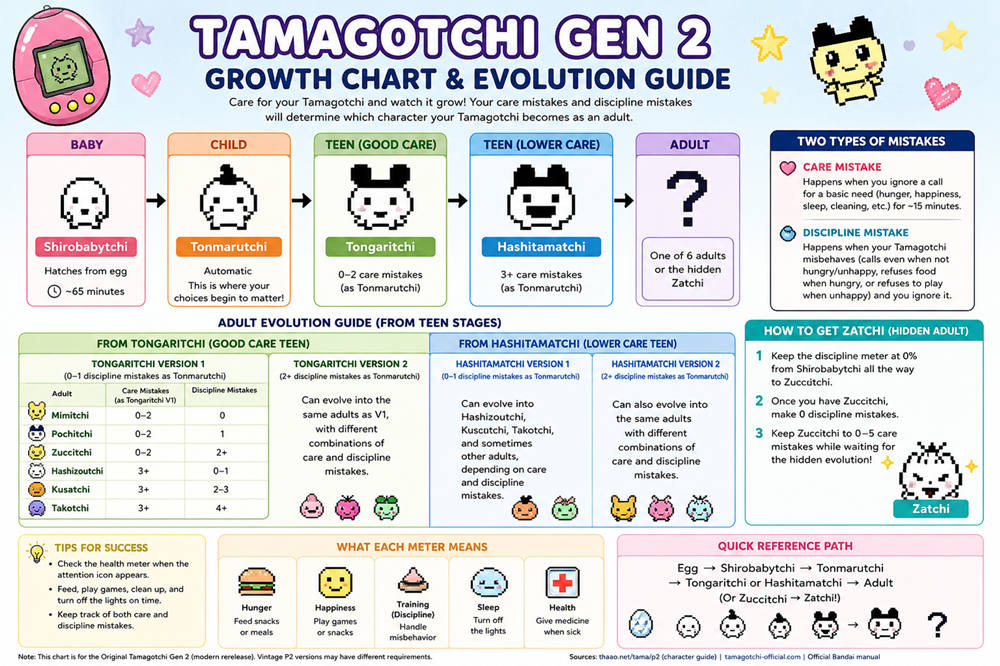
The Tamagotchi Gen 2 growth chart shows how your virtual pet moves from baby to child, teenager, and finally an adult. The early stages happen automatically, but once you reach Tonmarutchi, your care mistakes and discipline choices start changing the evolution path.
This guide focuses on the modern Original Tamagotchi Gen 2 rerelease. Vintage P2 models can use different evolution programming, so their requirements are not always identical.
Tamagotchi Gen 2 Growth Chart
The basic Gen 2 path is:
Egg → Shirobabytchi → Tonmarutchi → Tongaritchi or Hashitamatchi → Adult
A special path can continue from Zuccitchi to the hidden adult Zatchi. The standard adult characters include Mimitchi, Pochitchi, Zuccitchi, Hashizoutchi, Kusatchi, and Takotchi. Bandai’s current Original Tamagotchi character information uses slightly different English spellings for some characters, including Zukitchi and Hashizotchi.
| Stage | Character | Main Requirement |
|---|---|---|
| Baby | Shirobabytchi | Hatches from egg |
| Child | Tonmarutchi | Automatic |
| Teen | Tongaritchi | 0–2 care mistakes |
| Teen | Hashitamatchi | 3+ care mistakes |
| Adult | Mimitchi | Excellent care and correct discipline route |
| Adult | Pochitchi | Good care |
| Adult | Zuccitchi | Low care mistakes with more missed discipline |
| Adult | Hashizoutchi | Moderate-care combinations |
| Adult | Kusatchi | Lower-care combinations |
| Adult | Takotchi | Higher mistake combinations |
| Hidden Adult | Zatchi | Special Zuccitchi route |
The important part is that care mistakes and discipline mistakes are counted separately on the rerelease. Two Tamagotchis that look identical as teenagers can belong to different hidden versions based on earlier discipline, which changes their adult options. The detailed Tamagotchi P2 character guide breaks down these hidden evolution conditions.
How Gen 2 Evolution Works
Shirobabytchi
Shirobabytchi is the baby stage. It always becomes Tonmarutchi, so mistakes during this short period do not affect your later adult character.
The baby stage lasts about 65 minutes before Shirobabytchi evolves into Tonmarutchi. It is a useful time to learn how feeding, games, medicine, cleaning, lights, and the health meter work without worrying about ruining a particular evolution route.
Tonmarutchi
Tonmarutchi is where your choices begin to matter.
On the Gen 2 rerelease:
- 0–2 care mistakes → Tongaritchi
- 3 or more care mistakes → Hashitamatchi
Discipline during this stage also creates a hidden Version 1 or Version 2 of the teenager. You cannot see that version on the screen, but it affects which adults are available later.
Tongaritchi
Tongaritchi is the better-care teen branch and gives you access to adults including Mimitchi, Pochitchi, and Zuccitchi.
However, simply getting Tongaritchi does not guarantee Mimitchi. Your earlier discipline determines which hidden Tongaritchi version you have, while your care and discipline during the teen stage determine the final adult.
Hashitamatchi
Hashitamatchi appears when Tonmarutchi receives three or more care mistakes.
Its main adult possibilities are Hashizoutchi, Kusatchi, and Takotchi. As with Tongaritchi, there are two hidden versions based on discipline mistakes during the child stage.
Tamagotchi Gen 2 Adult Evolution Requirements
The simplest adult routes come from Tongaritchi Version 1, which is reached by keeping Tonmarutchi at 0–2 care mistakes and making no more than one discipline mistake during that stage.
| Adult | Care Mistakes as Tongaritchi V1 | Discipline Mistakes |
|---|---|---|
| Mimitchi | 0–2 | 0 |
| Pochitchi | 0–2 | 1 |
| Zuccitchi | 0–2 | 2+ |
| Hashizoutchi | 3+ | 0–1 |
| Kusatchi | 3+ | 2–3 |
| Takotchi | 3+ | 4+ |
These are the easiest routes to follow, but they are not every possible combination. Tongaritchi Version 2 and Hashitamatchi have additional paths to several of the same adults.
How to Get Mimitchi
Mimitchi requires one of the best-care routes.
First, raise Tonmarutchi into Tongaritchi Version 1. Then keep Tongaritchi to 0–2 care mistakes and zero discipline mistakes.
That means responding to both genuine care calls and discipline calls rather than simply keeping the hunger and happiness meters full.
How to Get Pochitchi
From Tongaritchi Version 1, Pochitchi requires:
- 0–2 care mistakes
- Exactly 1 discipline mistake
Tongaritchi Version 2 can also become Pochitchi under slightly different conditions, so accidentally missing one earlier discipline call does not necessarily end your Pochitchi attempt.
How to Get Zuccitchi
Zuccitchi comes from a low-care-mistake path where more discipline calls are missed.
From Tongaritchi Version 1:
- 0–2 care mistakes
- 2 or more discipline mistakes
Tongaritchi Version 2 can also become Zuccitchi with low care mistakes and more missed discipline.
Zuccitchi is especially important because it is the adult needed for the hidden Zatchi evolution.
How to Get Hashizoutchi
Hashizoutchi has several possible routes.
From Tongaritchi Version 1, one straightforward path is:
- 3 or more care mistakes
- 0–1 discipline mistakes
It can also come from Hashitamatchi with good enough care during the teen stage.
How to Get Kusatchi
Kusatchi generally appears in the middle-to-lower-care branches.
From Tongaritchi Version 1, one clear route is:
- 3 or more care mistakes
- 2–3 discipline mistakes
Hashitamatchi can also evolve into Kusatchi through several combinations, so receiving Hashitamatchi does not lock your Tamagotchi into one adult.
How to Get Takotchi
Takotchi sits near the high-mistake end of the chart.
One simple Tongaritchi Version 1 route requires:
- 3 or more care mistakes
- 4 or more discipline mistakes
Hashitamatchi can also become Takotchi through higher mistake combinations.
How to Get Zatchi
Zatchi is the hidden Gen 2 adult, and its route is easy to misunderstand because your discipline strategy changes after you reach Zuccitchi.
To get Zatchi on the rerelease:
- Raise your Tamagotchi from Shirobabytchi to Zuccitchi while keeping the discipline meter at 0%.
- Once you have Zuccitchi, make 0 discipline mistakes.
- Keep Zuccitchi to 0–5 care mistakes while waiting for the hidden evolution.
The important distinction is that you avoid building discipline before reaching Zuccitchi. After you get Zuccitchi, respond properly to its discipline calls so you do not record a discipline mistake. The full hidden-character conditions are detailed in the P2 growth and character guide.
What Counts as a Care Mistake?
A care mistake happens when your Tamagotchi calls for a normal need and you leave that need unresolved for about 15 minutes.
Common examples include:
- Hunger falls to zero and you do not feed it.
- Happiness falls to zero and you do not restore it.
- Your Tamagotchi falls asleep and you do not turn off the lights.
The P2 care guide explains how attention calls, care mistakes, discipline, hunger, happiness, and other everyday mechanics work across the P2 versions.
If you are trying for a specific adult, keeping a simple count of care mistakes can save a lot of confusion later.
What Is a Discipline Mistake?
A discipline mistake is different from a normal care mistake.
Sometimes your Tamagotchi calls even though it does not have a normal unmet need. You may need to discipline it when it calls despite being happy and fed, refuses food while hungry, or refuses to play while unhappy.
Bandai’s Original Tamagotchi instructions cover these discipline situations along with feeding, lights, health checks, games, medicine, and other basic controls.
On the rerelease, ignoring a misbehavior call can produce a discipline mistake that affects evolution.
An easy way to remember the difference is:
Care mistake: You ignored something your Tamagotchi genuinely needed.
Discipline mistake: You ignored a misbehavior call that required discipline.
Caring for Your Gen 2 Tamagotchi
If you are targeting a particular adult, keep track of both care and discipline mistakes. That is much easier than trying to remember several days of interactions after your Tamagotchi evolves.
Use the health meter regularly to check hunger, happiness, age, weight, and discipline. When the attention icon appears, checking these meters can help you determine whether your Tamagotchi needs normal care or discipline.
Gen 2 also uses the classic higher-or-lower Number game. A number appears and you guess whether the next number will be higher or lower. Bandai confirms that this Number game is one of the gameplay differences between Gen 1 and Gen 2 Original Tamagotchi.
Playing helps restore happiness without relying entirely on snacks.
You should also turn the lights off when your Tamagotchi sleeps, clean up droppings, and use medicine when the skull symbol appears. These basic actions may sound small, but regular care helps you stay on the evolution path you are targeting.
Original P2 vs. Modern Gen 2 Rerelease
Not every Tamagotchi P2 growth chart online applies to the same device.
Vintage Japanese P2 releases, the North American P2, and modern Gen 2 rereleases have differences in their evolution programming. The rerelease is particularly important because discipline mistakes are part of its adult evolution calculations.
Character rosters can differ as well. Some Japanese releases include characters that are not part of the same English P2 lineup.
If you have a modern device sold as Original Tamagotchi Gen 2, use a growth chart specifically written for the rerelease. Bandai’s current Gen 2 product information confirms that these devices use Gen 2 programming and that your care determines which of the seven adult outcomes you receive.
If you own a genuine 1990s P2, use evolution requirements for that particular vintage release rather than assuming modern care thresholds are identical.
Tamagotchi Gen 2 Growth Chart Quick Reference
| Character | Stage | Easy Way to Remember the Route |
|---|---|---|
| Shirobabytchi | Baby | Automatic |
| Tonmarutchi | Child | Automatic after about 65 minutes |
| Tongaritchi | Teen | 0–2 care mistakes |
| Hashitamatchi | Teen | 3+ care mistakes |
| Mimitchi | Adult | Excellent care, no discipline mistakes on V1 route |
| Pochitchi | Adult | Good care, one discipline mistake on V1 route |
| Zuccitchi | Adult | Good care with more missed discipline |
| Hashizoutchi | Adult | More care mistakes but relatively good discipline |
| Kusatchi | Adult | Middle/lower-care combinations |
| Takotchi | Adult | Higher mistake combinations |
| Zatchi | Hidden Adult | 0% discipline route to Zuccitchi, then careful adult-stage care |
For most players, the easiest way to use the Tamagotchi Gen 2 growth chart is to start counting mistakes once Shirobabytchi becomes Tonmarutchi. From there, your care determines the teen branch, while the combination of care and discipline helps determine which adult you eventually receive.