Signs of a Growth Spurt in Children and Teens Parents Should Know
Yesterday’s jeans suddenly look cropped, shoes that seemed roomy feel tight, and your child appears noticeably taller in family photos. These are some of the clearest signs of a growth spurt.
Growth does not happen at exactly the same rate throughout childhood. Periods of faster growth are especially noticeable during puberty, when height, body proportions, and clothing sizes can change surprisingly quickly. Appetite may increase too, although hunger alone does not confirm that a growth spurt is happening.
What Is a Growth Spurt?
A growth spurt is a period when a child or teenager grows more quickly than usual. The most noticeable change is usually an increase in height, although weight and body proportions also change as the body develops.
Growth is relatively steady through much of childhood before speeding up during puberty. The American Academy of Pediatrics explains that the pubertal years are a particularly rapid period of height growth.
Every child follows a slightly different schedule. Genetics, nutrition, general health, and the timing of puberty all influence how quickly someone grows.
Common Signs of a Growth Spurt
You usually cannot identify a growth spurt from one symptom. Looking at several physical changes over weeks or months gives you a much clearer picture.
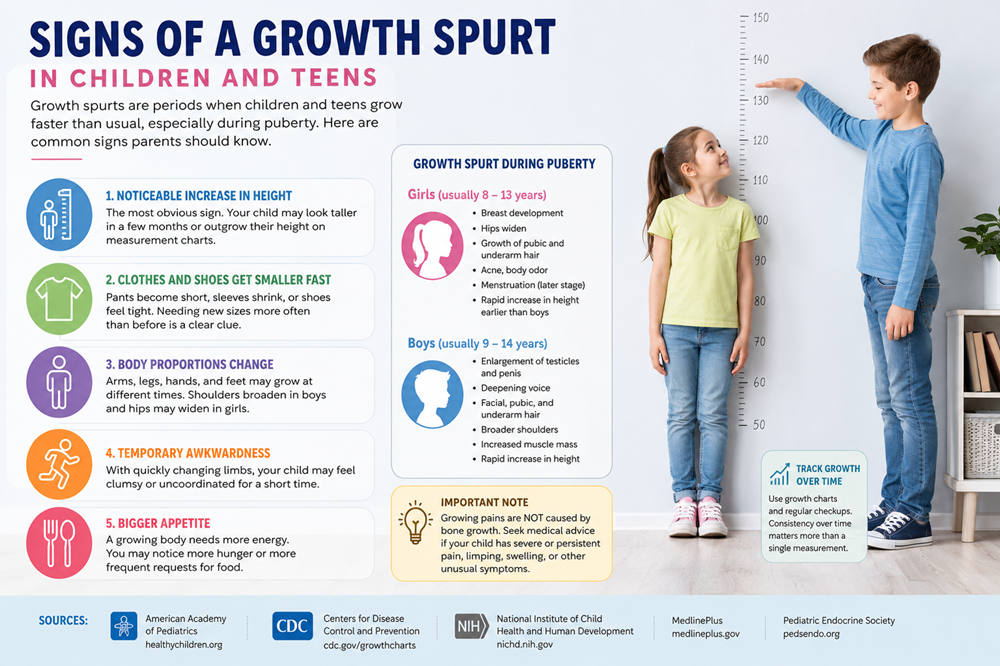
1. A Noticeable Increase in Height
Getting taller faster than usual is the strongest sign of a growth spurt.
You might notice that your child suddenly appears taller next to siblings, classmates, furniture, or even in photos taken only a few months apart.
During puberty, the change can become especially obvious. The physical changes that happen during puberty include rapid increases in height and changes in body proportions.
There is no need to measure height every week. Changes over several months are much more useful than small differences between individual measurements.
2. Clothes and Shoes Become Too Small Quickly
Sometimes your child’s wardrobe reveals a growth spurt before the measuring tape does.
Common clues include:
- Pants suddenly sitting above the ankles
- Sleeves becoming noticeably shorter
- Waistbands or shirts feeling tighter
- Shoes becoming uncomfortable
- Needing new clothing sizes sooner than expected
During puberty, hands and feet often grow before some other parts of the body. Arms, legs, shoulders, hips, and the trunk then continue changing as development progresses. The American Academy of Pediatrics describes these changing body proportions during puberty as part of normal adolescent development.
If your child is growing quickly, check shoe fit regularly rather than waiting until they complain about discomfort.
3. Body Proportions Begin to Change
A growth spurt is not always simply a taller version of the same body shape.
During puberty, different parts of the body may grow at different times. Hands and feet can become larger first, followed by longer arms and legs. Shoulders may broaden in boys, while hips commonly widen in girls.
For a while, this can make teenagers look slightly out of proportion. That appearance usually changes naturally as the rest of the body catches up.
4. Temporary Awkwardness or Clumsiness
Rapid changes in height and limb length can temporarily affect how comfortable teenagers feel in their bodies.
A child who suddenly has longer legs or larger feet may seem a little more awkward when running, playing sports, or moving through tight spaces. MedlinePlus information on adolescent development describes changes in physical coordination that can occur as the adolescent body develops.
Normal occasional clumsiness is different from persistent balance problems, weakness, or frequent unexplained falls. Those symptoms deserve medical attention rather than being blamed on growth.
5. A Bigger Appetite May Appear
Some children and teenagers seem hungrier during periods of rapid development.
You may notice larger meals, more requests for snacks, or hunger returning sooner after eating. The American Academy of Pediatrics notes that calorie needs rise during rapid growth and that an increase in appetite can accompany early adolescence.
However, appetite is not a reliable way to confirm a growth spurt. Exercise, daily routine, sleep, and many other factors can affect hunger.
Instead of focusing on how much your child eats at one meal, offer regular balanced meals and snacks with foods that provide protein, carbohydrates, healthy fats, vitamins, and minerals.
Signs of a Growth Spurt During Puberty
Puberty is when growth spurts usually become easiest to notice.
According to the National Institute of Child Health and Human Development, puberty typically begins between ages 8 and 13 in girls and ages 9 and 14 in boys. The exact timing varies considerably between children.
Along with getting taller, girls may experience:
- Breast development
- Growth of pubic and underarm hair
- Changes in body shape
- Acne
- Menstruation later in puberty
Boys may experience:
- Enlargement of the testicles and penis
- Pubic, underarm, and facial hair
- Increased muscle development
- Broadening shoulders
- A deeper voice
- Acne
Both boys and girls normally experience a rapid increase in height during puberty. MedlinePlus notes that the pubertal growth spurt generally lasts about two to three years.
Girls usually enter their major height spurt earlier than boys. This is why girls in early adolescence may temporarily be taller than boys of the same age. The AAP’s guide to physical development in girls during puberty explains that girls generally reach their fastest height growth earlier than boys.
Puberty also brings emotional and hormonal changes, but moodiness by itself is not a useful sign that someone is currently growing faster.
Are Growing Pains a Sign of a Growth Spurt?
Despite the name, growing pains are not believed to result from bones growing quickly.
The American Academy of Pediatrics explains in its guidance on growing pains that growth itself is not considered the cause, even during an adolescent growth spurt.
So, leg pain should not be treated as proof that a child is becoming taller.
Occasional mild aches may happen in active children, but contact a healthcare professional when pain:
- Is severe or persistent
- Causes limping
- Occurs with swelling
- Comes with fever
- Is associated with redness or warmth
- Regularly interferes with normal activities
Persistent pain deserves its own explanation rather than automatically being blamed on a growth spurt.
How Long Does a Growth Spurt Last?
There is no universal timetable.
Some periods of faster growth may be noticeable over several months. Puberty-related growth happens over a much longer period, with the major height spurt generally lasting around two to three years, according to MedlinePlus guidance on puberty.
Growth also does not necessarily happen at one smooth, steady pace. A teenager might gain height quickly, slow down for a while, and then continue growing.
Comparing two children of the same age therefore tells you very little. One may already be well into puberty while another has barely started, yet both can be developing normally.
How Parents Can Support Healthy Growth
You cannot make a healthy child grow taller by using a special food, supplement, or exercise routine. What you can do is provide the basic conditions the body needs for normal development.
Provide Balanced Meals
Offer a varied diet that includes sources of:
- Protein
- Fruits and vegetables
- Whole grains
- Calcium
- Healthy fats
- Iron and other essential nutrients
A bigger appetite does not mean every meal needs to become oversized. Regular meals and nutritious snacks are usually a better approach than encouraging a child to eat past comfortable fullness.
Make Sleep a Priority
Sleep is important for children’s overall physical and mental health.
Children and teenagers have different sleep needs depending on age. The American Academy of Pediatrics provides practical guidance on healthy sleep habits for children and teens, including the importance of consistent routines and sufficient sleep.
Extra sleep should not, however, be treated as a diagnostic sign of a growth spurt. Persistent unexplained fatigue should be discussed with a healthcare professional.
Encourage Regular Physical Activity
Children can continue exercising and playing sports while growing.
Regular activity helps support healthy bones, muscles, coordination, and cardiovascular health. There is generally no reason to restrict ordinary physical activity simply because a child is getting taller.
Pain, weakness, or an injury is a different matter and should be addressed rather than pushed through.
Keep an Eye on Clothing and Footwear
Rapid growth can make shoes and clothing uncomfortable surprisingly quickly.
Check whether shoes still leave enough room and whether clothing restricts movement. This simple step is particularly useful when your child is clearly moving through sizes faster than usual.
Track Growth Over Time
One height measurement cannot tell you much about a child’s overall growth.
Doctors use CDC growth charts to compare repeated measurements and look at a child’s pattern over time. The CDC emphasizes that growth charts contribute to the overall assessment of a child’s health rather than serving as a diagnostic tool by themselves.
A child does not need to be in a particular height percentile to be healthy. What often matters more is whether growth follows an expected pattern for that individual.
When Should You Talk With a Pediatrician?
Being shorter, taller, earlier, or later to mature than classmates does not automatically mean something is wrong. There is a broad range of normal development.
Still, it is worth discussing growth with a pediatrician if your child:
- Stops gaining height as expected
- Suddenly moves away from their previous growth pattern
- Loses weight without an obvious reason
- Has persistent fatigue or weakness
- Experiences severe or ongoing bone or joint pain
- Develops swelling, limping, or other physical symptoms
- Shows signs of puberty unusually early
- Has not begun puberty within the expected age range
Puberty beginning before age 8 in girls or before age 9 in boys is considered precocious puberty, according to NICHD.
At the other end of the range, evaluation may be appropriate if a girl has no breast development by age 13 or a boy has no testicular enlargement by age 14. The Pediatric Endocrine Society provides referral guidance for delayed puberty, including the age-14 threshold for boys, while its delayed puberty guide for girls identifies lack of breast development by 13 as delayed.
A pediatrician can look at previous height and weight measurements, family growth patterns, puberty development, nutrition, and overall health to decide whether further evaluation is needed.
The Takeaway
The clearest signs of a growth spurt are physical: noticeable height gain, quickly outgrown clothing and shoes, and changing body proportions. A bigger appetite or temporary awkwardness may appear around the same time, particularly during puberty, but these signs alone do not prove that rapid growth is happening.
Growing pains are also poorly named—growth itself is not considered the cause of those aches.
Rather than comparing a child with friends or siblings, pay attention to their own growth pattern over time. Most differences in timing are normal, but sudden changes, persistent pain, unexplained weight loss, or unusually early or delayed puberty are good reasons to talk with a pediatrician.