
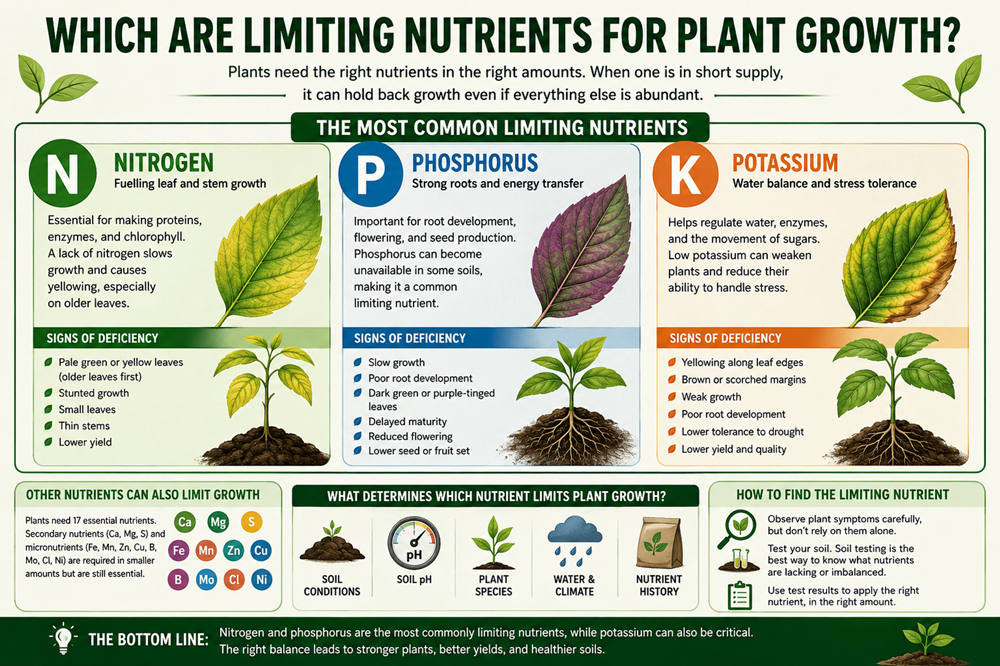
Which Are Limiting Nutrients for Plant Growth and Why Do They Matter?
Plants need sunlight, water, carbon dioxide, and a steady supply of mineral nutrients to grow. When an essential nutrient is in short supply, it can hold back growth even when the plant has plenty of everything else.
Nitrogen and phosphorus are two of the most common limiting nutrients for plant growth. Potassium can also become limiting, especially in agricultural soils or environments with low available potassium. Research on terrestrial ecosystems shows that nitrogen, phosphorus, and potassium can act individually or together as limiting nutrients.
What Is a Limiting Nutrient?
A limiting nutrient is an essential nutrient that a plant cannot obtain in sufficient amounts to support its potential growth.
Think of it as the nutrient in shortest supply compared with what the plant needs. A plant could have plenty of phosphorus and potassium, for example, but still grow poorly if nitrogen is severely lacking.
Adding more of the nutrients that are already plentiful will not necessarily solve the problem. Growth usually improves only when the actual limitation is addressed.
The limiting nutrient is not the same everywhere. It can change with the plant species, soil, climate, previous fertilizer use, and other growing conditions. USDA nutrient-management guidance considers factors such as soil properties, crop needs, climate, nutrient sources, and management conditions when determining how nutrients should be supplied.
Nitrogen as a Limiting Nutrient
Nitrogen is one of the nutrients plants need in relatively large amounts.
It is needed to make proteins, enzymes, nucleic acids, and chlorophyll. Because chlorophyll helps plants capture light for photosynthesis, a shortage of nitrogen can quickly affect both appearance and growth.
Common signs of nitrogen deficiency include:
- Pale green leaves
- Yellowing of older leaves
- Slow or stunted growth
- Smaller leaves
- Thin stems
- Reduced crop growth or yield
Nitrogen deficiency often appears first on older leaves because plants can move nitrogen from older tissue into younger, actively growing tissue.
Nitrogen can become limiting for several reasons. Plants continually remove it from the soil, while nitrate can move through the soil with water and may eventually leave the root zone. Nitrogen can also be lost through erosion and biological processes that release nitrogen compounds into the atmosphere.
For this reason, nitrogen management is especially important in agriculture. The University of Minnesota Extension’s nutrient-management guidance notes that nitrogen is frequently deficient in crop production and that excessive nitrogen can also be lost to ground or surface water.
Phosphorus as a Limiting Nutrient
Phosphorus is another major nutrient that frequently restricts plant productivity.
Plants use phosphorus in several basic biological processes, including energy transfer, cell division, root development, and reproduction. It is also part of important molecules such as DNA, RNA, and ATP.
When phosphorus is limited, plants may show:
- Slow growth
- Poor root development
- Delayed maturity
- Reduced flowering
- Lower seed or fruit production
- Dark green foliage
- Purple or reddish leaves in some species
Purple leaves can sometimes indicate phosphorus stress, but color alone is not enough to diagnose a deficiency. Cold temperatures, plant genetics, and other stresses can produce similar symptoms.
One reason phosphorus can become limiting is that plants can only use phosphorus that is available to their roots. Soil may contain considerable total phosphorus while only a smaller portion is readily accessible.
Phosphorus can also interact with minerals in the soil and become less available. Its movement through soil is relatively limited, which means roots often need to grow close to available phosphorus to absorb it effectively.
A large Nature Communications meta-analysis of phosphorus limitation found widespread evidence that phosphorus can restrict aboveground plant production across natural terrestrial ecosystems.
Potassium as a Limiting Nutrient
Potassium is the third nutrient in the familiar N-P-K fertilizer system.
Plants require substantial amounts of potassium, although its role is different from nitrogen and phosphorus. Potassium helps regulate water balance, enzyme activity, movement of sugars, and the opening and closing of stomata.
Stomata are tiny openings in leaves that allow plants to exchange gases and control water loss.
Adequate potassium also helps plants maintain normal physiological function during environmental stress.
Possible signs of potassium deficiency include:
- Yellowing along leaf edges
- Brown or scorched leaf margins
- Weak growth
- Poor root development
- Reduced tolerance to drought or other stresses
- Lower crop quality or yield
Potassium does not limit every ecosystem, but its importance should not be overlooked. A 2026 Nature Communications meta-analysis of potassium fertilization found substantial cereal-yield responses to potassium application across the studies analyzed.
The USDA’s Nutrient Management Conservation Practice Standard considers potassium alongside nitrogen and phosphorus when nutrient-management plans are developed for crop production.
Can Other Nutrients Limit Plant Growth?
Yes. Nitrogen, phosphorus, and potassium receive the most attention, but plants require many other essential nutrients.
These include secondary nutrients such as:
- Calcium
- Magnesium
- Sulfur
Plants also need much smaller amounts of micronutrients, including:
- Iron
- Manganese
- Zinc
- Copper
- Boron
- Molybdenum
- Chlorine
- Nickel
Calling them micronutrients does not mean they are optional. It simply means plants require smaller quantities.
The University of Minnesota Extension’s guide to fertilizing plants explains that plants require 17 essential nutrients and identifies nitrogen, phosphorus, and potassium as primary macronutrients, with calcium, magnesium, and sulfur classified as secondary macronutrients.
Any essential nutrient can limit plant growth when its available supply falls below what the plant requires. However, which nutrient becomes limiting depends heavily on local growing conditions.
What Determines Which Nutrient Limits Plant Growth?
You cannot identify a limiting nutrient simply by knowing that a plant needs N, P, and K. The surrounding environment matters just as much.
Soil Conditions
Different soils store and release nutrients differently.
Sandy soils, for example, generally allow water to move through them quickly, making some nutrients easier to lose from the root zone. Soils containing more clay and organic matter can retain certain nutrients differently.
The University of Minnesota Extension explains that soil texture, organic matter, and pH all affect nutrient availability and that sandy soils are more prone to losses of nutrients such as nitrogen, potassium, and sulfur.
Soil nutrient history also matters. Repeatedly harvesting crops removes nutrients from a field. Without replacement through natural processes, fertilizers, manure, crop residues, or other sources, some nutrients may eventually become depleted.
Soil pH
Soil pH affects how available many nutrients are to plant roots.
A nutrient may be present in the soil yet remain difficult for the plant to absorb because of soil chemistry. This is particularly important for phosphorus and several micronutrients.
That is one reason applying more fertilizer is not always the correct response to poor plant growth.
Plant Species
Different plants have different nutritional requirements.
Fast-growing crops may need larger nutrient supplies than plants adapted to naturally nutrient-poor environments. The nutrient demands of a corn crop, lawn, fruit tree, houseplant, and native grassland are not identical.
Some plants also have biological partnerships that help them obtain nutrients. Legumes such as beans and clover, for example, can form relationships with nitrogen-fixing bacteria, giving them access to nitrogen through a process that differs from plants without this partnership.
Water and Climate
Plants absorb many nutrients from the soil solution, so water availability strongly affects nutrient uptake.
Too little water can reduce the movement of nutrients toward roots. Too much water can contribute to nutrient losses and may also deprive roots of the oxygen they need to function properly.
Temperature can matter as well because it influences plant growth, root activity, microbial processes, and nutrient cycling.
For these reasons, modern nutrient-management recommendations consider the combination of crop, soil, climate, nutrient sources, and site conditions instead of relying on one standard fertilizer rate for every situation.
How Can You Tell Which Nutrient Is Limiting?
Plant appearance can provide clues, but symptoms are not always reliable enough to identify the problem by themselves.
Yellow leaves are a good example. They might indicate a nitrogen shortage, but they could also result from another nutrient deficiency, damaged roots, excess water, disease, or poor growing conditions.
Start by looking at the entire situation:
- Where do symptoms appear first?
- Are older or younger leaves affected?
- Has growth slowed?
- What is the soil pH?
- Have nutrients recently been added?
- Is the soil unusually wet or dry?
- Do nearby plants show the same symptoms?
A soil test can provide much better information than guessing from leaf color alone. In agricultural systems, plant tissue testing may also help determine whether plants are actually absorbing enough of particular nutrients.
The USDA recommends basing nutrient-management plans on current soil-test results and using tissue testing when appropriate.
Testing also helps prevent unnecessary fertilizer use. Applying nutrients a plant does not need wastes fertilizer and increases the risk of nutrients leaving the soil and reaching surface water or groundwater.
Which Nutrients Most Commonly Limit Plant Growth?
The simplest answer is nitrogen and phosphorus. Both are widely recognized as major constraints on plant productivity across terrestrial ecosystems.
Potassium can also be an important limiting nutrient, particularly in agricultural soils where available potassium is insufficient for the crop’s needs. Research examining N, P, and K co-limitation shows that plant productivity can be controlled by combinations of these nutrients rather than a single nutrient in isolation.
Other essential nutrients can become limiting too, but there is no nutrient that limits every plant in every environment.
What matters is balance. When one essential nutrient is in short supply, adding more of the nutrients that are already abundant will not fix the underlying problem. Identifying the actual limitation allows you to give the plant what it needs instead of simply adding more fertilizer.