
Transactional Model of Communication Explained With Examples, Elements, Benefits, and Key Limitations
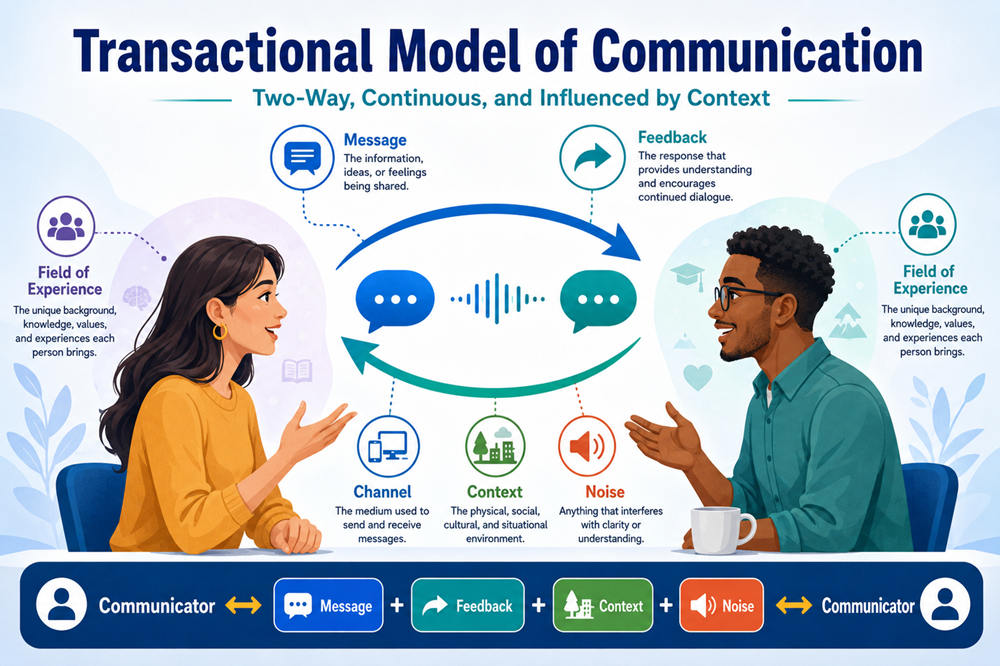
The transactional model of communication explains how people create meaning together during an interaction. Everyone involved sends and receives messages at the same time through words, tone, facial expressions, gestures, and other signals.
This model reflects everyday conversations more accurately than simple one-way communication models. It also considers feedback, relationships, personal experiences, surroundings, and anything that may interrupt or change the message.
What Is the Transactional Model of Communication?
The transactional model of communication describes communication as an ongoing process in which every participant is both a sender and a receiver.
When you talk with someone, you do not simply deliver information and wait for a reply. You also watch their facial expression, listen to their tone, notice their posture, and adjust what you say based on those reactions.
The other person does the same with you.
For example, imagine that you are explaining a problem to a coworker. While you speak, they may nod, look confused, ask a question, or avoid eye contact. Those reactions give you information about how well your message is being understood.
Communication is therefore something people create together. Its meaning depends on more than the words being spoken.
A simple way to picture the model is:
Communicator ↔ message, feedback, context, and noise ↔ communicator
The arrows move in both directions because communication is continuous rather than one-sided.
Elements of the Transactional Model of Communication
The model includes several connected elements. Each one affects how a message is created, delivered, and understood.
Communicators
The people involved in the interaction are called communicators.
The term is used instead of separating people into fixed senders and receivers. During a conversation, everyone regularly switches between speaking, listening, observing, reacting, and interpreting.
Even when one person is doing most of the talking, the other person may still communicate through eye contact, posture, silence, or facial expressions.
Message
A message is the information, feeling, idea, or signal being communicated.
Messages can be verbal or nonverbal communication. They may include:
- Spoken words
- Written sentences
- Tone of voice
- Facial expressions
- Hand gestures
- Posture
- Eye contact
- Images and symbols
- Emojis
- Silence
Several messages can appear at once. Someone may say, “I’m fine,” while speaking quietly and avoiding eye contact. The words suggest that nothing is wrong, but the nonverbal signals may communicate discomfort or sadness.
Encoding and Decoding
Encoding happens when you turn an idea or feeling into a message. You may choose certain words, gestures, images, or expressions to communicate what you mean.
Decoding happens when another person interprets that message.
The two processes do not always produce the same meaning. A message can be clear to the person sending it but confusing to the person receiving it.
For example, a manager may say, “Try to finish this soon,” meaning by the end of the week. An employee may understand “soon” to mean within the next few hours.
Clear wording and follow-up questions can prevent this type of misunderstanding.
Channel
The channel is the method used to deliver the message. Choosing the correct communication channel can make information easier to understand.
Common communication channels include:
- Face-to-face conversations
- Phone calls
- Video meetings
- Emails
- Text messages
- Letters
- Workplace messaging platforms
- Social media
The best channel depends on the message.
A quick schedule update may work well through text. A sensitive discussion about performance or conflict may be better handled in person or through video because participants can hear tone and observe body language.
Using the wrong channel can make communication less clear. A long emotional message sent through text, for example, may be misunderstood because it lacks vocal and facial cues.
Feedback
Feedback is the response that shows how a message is being received.
It may be direct, such as asking a question or offering an opinion. It may also be subtle, such as nodding, smiling, pausing, or looking away.
Feedback helps communicators decide whether they should continue, explain something differently, or correct a misunderstanding.
However, feedback is not always easy to interpret. Silence might mean agreement, confusion, nervousness, respect, or lack of interest. You may need to ask a question instead of assuming what it means.
Noise
Noise is anything that interferes with communication. It can affect the message before, during, or after it is delivered.
Common types of noise include:
- Physical noise: Traffic, music, nearby conversations, or construction sounds
- Psychological noise: Stress, anger, anxiety, assumptions, or prejudice
- Semantic noise: Technical language, vague wording, slang, or unfamiliar expressions
- Physiological noise: Illness, fatigue, hunger, hearing loss, or physical discomfort
- Digital noise: Poor internet service, frozen video, delayed messages, or autocorrect errors
Noise does not have to stop communication completely. It may simply make a message harder to understand.
For example, an employee who is worried about losing their job may interpret neutral feedback as criticism. In this situation, emotional stress acts as psychological noise.
Context
Context is the situation surrounding the interaction. It influences what messages mean and how people respond.
Context can include:
- The physical setting
- The relationship between participants
- Cultural expectations
- Professional roles
- Previous conversations
- The emotional atmosphere
- The time and place
The same sentence can have different meanings in different settings.
“Come and see me later” may sound casual when said by a friend. The same words may cause concern when spoken by a supervisor after a difficult meeting.
Field of Experience
A person’s field of experience includes their education, culture, beliefs, language, values, memories, and previous knowledge.
People with similar experiences may understand each other quickly. Those with different backgrounds may need to explain terms, ideas, or expectations more carefully.
For example, an experienced software developer may understand technical instructions that confuse a new employee. The difference is not necessarily intelligence. The two people simply have different levels of experience with the subject.
Transactional Model of Communication Example
Consider a teacher helping a student solve a math problem.
The teacher begins by explaining the steps aloud. While listening, the student frowns and stops writing. The teacher notices the reaction and realizes that the first explanation may not be clear.
Instead of repeating the same words, the teacher uses a simpler example. The student asks a question, and the teacher responds. After another explanation, the student nods and completes the problem correctly.
This interaction includes all the main parts of the transactional model:
- The teacher and student are both communicators.
- The explanation and question are verbal messages.
- Facial expressions and gestures are nonverbal messages.
- Speech is the main channel.
- The student’s reactions provide feedback.
- Difficult terminology may create semantic noise.
- The classroom and teacher-student relationship form part of the context.
- Their knowledge of mathematics affects how they understand the lesson.
The teacher does not communicate successfully simply by speaking. Success depends on noticing the student’s response and adjusting the explanation.
Real-Life Examples of Transactional Communication
The transactional model can be used to understand many everyday situations.
Workplace Conversation
A supervisor gives an employee feedback about a recent project. The employee listens, asks questions, and explains some of the difficulties they faced.
The supervisor may change the advice after hearing this information. Both people shape the discussion rather than following a strict sender-and-receiver pattern.
Personal Relationship
Two partners discuss how to divide household responsibilities. Their tone, expressions, previous disagreements, and expectations all affect the conversation.
Even a reasonable suggestion may sound critical if the discussion begins when one person is already tired or upset.
Customer Service Interaction
A customer contacts a company about a missing order. The customer’s frustration affects the employee’s response, while the employee’s tone may either calm or worsen the situation.
The discussion changes as both people react to each other.
Online Messaging
People also use transactional communication through email, text messages, and social media.
Feedback may include replies, emojis, reaction buttons, punctuation, or response time. However, online communication can be harder to interpret because facial expressions and vocal tone are often missing.
A short reply such as “Okay” might sound friendly, dismissive, irritated, or neutral depending on the relationship and previous messages.
Advantages of the Transactional Model of Communication
The transactional model offers a realistic way to understand human interaction.
It Shows Communication as a Shared Process
The model recognizes that listeners are not passive. Their questions, expressions, and reactions influence the direction of the conversation.
This makes the model useful for studying meetings, interviews, negotiations, counseling sessions, classroom discussions, and personal relationships.
It Includes Verbal and Nonverbal Communication
Words are only one part of a message. Tone, facial expressions, posture, timing, and silence can be equally important.
By including these signals, the model gives a fuller picture of how people communicate.
It Accounts for Context
Messages do not exist separately from the situation in which they occur.
The model recognizes that culture, relationships, professional roles, and previous experiences can change how a message is understood.
It Helps Explain Misunderstandings
Noise, unclear wording, emotional stress, and different experiences can all change a message.
The model helps you identify why communication failed instead of assuming that one person simply did not listen.
Limitations of the Transactional Model of Communication
The model is useful, but it does not explain every communication situation perfectly.
It Can Be Complicated
Many elements happen at the same time. This makes the model more realistic, but it can also make it harder to study or illustrate.
It Fits Direct Interaction Better
The model works especially well for conversations in which people can respond to each other.
It is less straightforward when describing television broadcasts, recorded announcements, signs, or other messages that offer little immediate feedback.
Feedback Can Be Misread
People may notice a reaction but interpret it incorrectly.
A speaker might assume that a quiet listener agrees, even though the listener is confused or uncomfortable. The model includes feedback, but it cannot guarantee that feedback will be understood accurately.
Meaning Cannot Be Fully Predicted
People may react differently to the same words because of their memories, beliefs, emotions, and experiences.
The model explains why these differences matter, but it cannot predict every interpretation.
Transactional Model vs. Linear Model of Communication
The linear model describes communication as a one-way process.
A sender creates a message and delivers it to a receiver through a channel. The receiver does not provide immediate feedback within the model.
It is useful for explaining:
- Radio broadcasts
- Television advertisements
- Public announcements
- Recorded messages
- Emergency alerts
The transactional model is different because it focuses on interaction. Everyone involved can influence the message as communication takes place.
The linear model asks how information moves from one point to another. The transactional model looks at how people create and interpret meaning together.
Transactional Model vs. Interactive Model of Communication
The interactive model adds feedback to the communication process.
One person sends a message, the other receives it, and then the roles switch. Communication moves back and forth in turns.
The transactional model goes further by showing that people can send and receive signals at the same time.
While one person speaks, the other may communicate through a smile, a confused expression, a pause, or a change in posture. These reactions can affect the speaker before the listener says anything.
The main difference is that the interactive model shows alternating communication, while the transactional model shows continuous communication.
How to Improve Transactional Communication
Understanding the model can help you communicate more effectively in daily life.
Choose the Right Channel
Match the communication method to the importance and complexity of the message.
Use written communication for instructions, dates, or information that needs to be saved. Consider face-to-face or video communication for emotional, detailed, or sensitive subjects.
Watch for Nonverbal Signals
Pay attention to facial expressions, posture, gestures, and changes in tone. The APA’s explanation of body language shows how thoughts and feelings may be expressed through posture, movement, and facial expressions.
These signals may reveal confusion or discomfort that a person has not expressed directly.
Ask Clear Questions
Do not rely only on nods or short replies.
Ask questions such as:
- “How do you understand the next step?”
- “Is there anything I should explain differently?”
- “What concerns do you have about this plan?”
These questions provide more useful feedback than simply asking, “Do you understand?”
Reduce Noise
Choose a quiet setting, remove unnecessary distractions, and avoid using unfamiliar terms without explanation. The CDC Clear Communication Index also provides guidance for making important messages easier to understand.
During online meetings, test your connection, microphone, and camera before an important discussion.
Consider the Other Person’s Perspective
Think about their knowledge, culture, role, and previous experience with the subject.
A message that is clear to you may require more context for someone encountering the topic for the first time.
Listen Before Responding
Active listening involves focusing on what the other person is saying instead of planning your next reply.
Summarize their point, ask relevant questions, and confirm important details before moving forward.
Why the Transactional Model Matters
The transactional model matters because it reflects how most real conversations work. People communicate through words and behavior while responding to each other in changing situations.
It also shows that clear communication is a shared responsibility. Speaking clearly is important, but so are listening, observing feedback, choosing the right channel, and checking whether the message was understood.
When you pay attention to these parts of communication, you can reduce misunderstandings and handle personal, academic, and workplace conversations more effectively.