
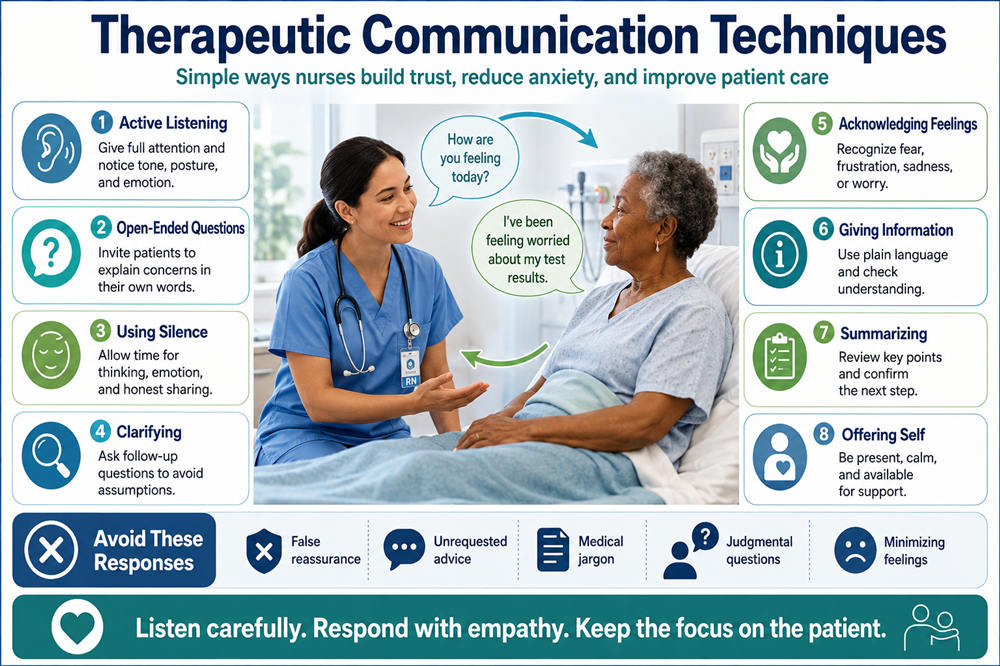
Therapeutic Communication Techniques Nurses Can Use to Build Trust and Improve Patient Care
Therapeutic communication techniques help nurses understand patients, collect accurate information, and respond to difficult emotions without sounding dismissive or judgmental. These skills are useful when patients feel afraid, confused, angry, embarrassed, or overwhelmed.
The goal is not to provide the perfect response every time. It is to listen carefully, use clear language, respect the patient’s experience, and keep the conversation focused on safe, supportive care.
What Is Therapeutic Communication?
Therapeutic communication is a purposeful conversation between a nurse and a patient. It is used to gather information, explain care, identify concerns, reduce anxiety, and help patients express their thoughts and feelings.
Unlike casual conversation, therapeutic communication keeps the focus on the patient. The nurse listens without judgment, maintains professional boundaries, and avoids making the discussion about personal experiences.
Good therapeutic communication can help a patient feel respected and more comfortable discussing symptoms, fears, treatment concerns, and personal needs.
Therapeutic Communication Techniques
Different situations require different responses. The following techniques can help nurses communicate more clearly while giving patients space to speak honestly.
1. Active Listening
Active listening means giving the patient your full attention. You listen to the words while also noticing tone, facial expressions, posture, and pauses.
Avoid checking a screen, interrupting, or planning your response while the patient is still speaking. When appropriate, sit at the patient’s level and maintain comfortable eye contact.
Example:
“You said the dizziness began after your medication changed and is worse in the morning. Is that correct?”
Repeating the main details shows that you listened and gives the patient an opportunity to correct anything you misunderstood.
2. Using Silence
Silence gives patients time to think, manage their emotions, or decide what they want to say next.
You do not need to fill every pause. A patient who has received difficult news may need a quiet moment before continuing.
Stay present and use open body language so the silence does not feel dismissive.
Example:
A patient begins crying after discussing a diagnosis. Instead of immediately asking another question, the nurse remains nearby and allows the patient time to speak.
3. Asking Open-Ended Questions
Open-ended questions encourage patients to answer in their own words. They often reveal more useful information than questions that can be answered with only “yes” or “no.”
Examples include:
- “What brought you in today?”
- “How have you felt since the procedure?”
- “What concerns you most about the treatment?”
- “How is the pain affecting your daily routine?”
Open-ended questions work best at the beginning of a discussion or when you need to understand the patient’s full experience.
4. Using Broad Openings
Broad openings let the patient decide where to begin.
You might say:
- “What would you like to talk about?”
- “Where would you like to start?”
- “Tell me what has been happening.”
- “What feels most important right now?”
This technique can uncover concerns that may not appear on a standard symptom checklist. A patient may be more worried about missing work or caring for a child than about the treatment itself.
5. Restating
Restating means repeating the main point of the patient’s message using similar words.
Patient: “I haven’t slept well since I came home.”
Nurse: “You have been having trouble sleeping since your discharge.”
Restating confirms that you heard the message and invites the patient to provide more detail.
Use it selectively. Repeating every statement can make the conversation sound unnatural.
6. Reflecting
Reflection directs an idea, feeling, or question back to the patient.
Patient: “Do you think I should agree to the surgery?”
Nurse: “What worries you most about having the surgery?”
The nurse does not make the decision for the patient. Instead, the response helps the patient examine their concerns, values, and priorities.
Reflection can also address emotion:
“You seem disappointed by the test results.”
The patient can then confirm or correct that observation.
7. Clarifying
Clarification helps when a patient’s message is unclear or incomplete.
You might say:
- “What do you mean when you say you feel strange?”
- “Can you describe the pain in more detail?”
- “When did the symptoms begin?”
- “I want to make sure I understand. Did the dizziness begin yesterday?”
Clarification is especially important when the information may affect medication, treatment, or safety decisions.
Do not guess what a patient means. Ask directly and respectfully.
8. Focusing
Focusing guides the conversation toward an important subject.
A patient may discuss several concerns at once, making it difficult to identify the most urgent issue.
Example:
“You mentioned that you had trouble breathing last night. Let’s talk more about that first.”
Focusing does not mean ignoring the patient’s other concerns. It helps organize the conversation so immediate needs can be addressed before moving to less urgent topics.
9. Exploring
Exploring encourages the patient to give more information.
Useful responses include:
- “Tell me more about that.”
- “What happened next?”
- “How did that make you feel?”
- “What were you thinking at the time?”
This technique is helpful when a brief comment may point to a larger concern.
Do not pressure a patient to discuss something they are not ready to share. Respect personal boundaries and signs of discomfort.
10. Sharing Observations
Sharing an observation means calmly describing something you have noticed.
Examples include:
- “I notice that you become quiet when we discuss discharge.”
- “You are holding your stomach while you speak.”
- “Your hands are shaking.”
- “You seem more tired today.”
Describe what you can see without deciding what it means for the patient.
Avoid statements such as “You are hiding something” or “You are obviously anxious.” Those responses can sound accusing and may cause the patient to withdraw.
11. Acknowledging Feelings
Acknowledging feelings shows that you recognize the patient’s emotional response.
You might say:
- “That sounds frightening.”
- “You seem frustrated by the delay.”
- “This has been a difficult day for you.”
- “You appear worried about what happens next.”
This does not mean claiming that you fully understand the patient’s experience. Phrases such as “I know exactly how you feel” can sound insincere or dismissive.
Recognize the emotion without taking attention away from the patient.
12. Presenting Reality
Presenting reality may be used when a patient is confused, disoriented, or experiencing something the nurse does not observe.
The response should be calm and respectful.
Example:
“I understand that you hear a voice, but I do not hear it.”
This response does not argue with the patient or confirm the perception. It states what the nurse observes while recognizing that the experience feels real to the patient.
Avoid ridicule, confrontation, or long debates.
13. Offering Self
Offering self lets a patient know that you are available.
Examples include:
- “I can stay with you for a few minutes.”
- “I am here if you would like to talk.”
- “We can sit quietly together.”
- “I will remain with you while we wait.”
This technique can be helpful when a patient is frightened, grieving, lonely, or waiting for difficult information.
Support does not always require advice. Sometimes calm presence is enough.
14. Giving Information
Clear information can reduce anxiety and help patients participate in their care.
A nurse may explain:
- What will happen during a procedure
- Why a test is needed
- When medication will be given
- What symptoms should be reported
- Who will be involved in the patient’s care
- What to expect after discharge
Use plain language and avoid unnecessary medical terms. The CDC Clear Communication Index provides practical guidance for making health information easier to understand.
After explaining something, ask the patient to repeat the key information in their own words. This is more useful than asking, “Do you understand?”
Example:
“Just so I know I explained it clearly, can you tell me how you will take this medication at home?”
15. Encouraging Comparison
Encouraging comparison helps a patient connect the current situation with a past experience.
You might ask:
- “Have you experienced this before?”
- “What helped you manage it last time?”
- “How is this pain different from the pain you had before?”
- “What worked when you previously felt anxious?”
Past experiences may reveal triggers, coping skills, or changes in symptoms.
Use the information to understand the patient, not to assume that the same solution will work again.
16. Summarizing
Summarizing brings together the main points of the discussion.
Example:
“We discussed when the dizziness began, how it affects your balance, and the medication change. I will share those details with the care team.”
A summary can confirm important facts, correct misunderstandings, and prepare the patient for the next step.
It is especially helpful during assessments, discharge teaching, handoffs, and emotionally difficult conversations.
Therapeutic Communication Examples
The difference between a helpful response and an unhelpful one is often small but important.
When a Patient Feels Afraid
Patient: “I’m scared about tomorrow’s procedure.”
Avoid: “Don’t worry. Everything will be fine.”
Try: “What worries you most about the procedure?”
The second response invites the patient to explain the fear instead of dismissing it.
When a Patient Is Angry
Patient: “I have been waiting all morning, and nobody tells me anything.”
Avoid: “We are very busy today.”
Try: “You are frustrated by the wait and the lack of information. I will check on the delay.”
This response recognizes the concern and offers a reasonable next step.
When a Patient Is Grieving
Patient: “I still can’t believe my husband is gone.”
Avoid: “You need to stay strong.”
Try: “You miss him deeply. I can stay while you talk about him.”
The therapeutic response allows the patient to grieve without telling them how they should feel.
When a Patient Refuses Medication
Patient: “I don’t want to take that medication.”
Avoid: “You have to take it because the doctor ordered it.”
Try: “What concerns you about the medication?”
The patient may be worried about side effects, cost, past reactions, or the purpose of the drug.
Nontherapeutic Communication to Avoid
Some common responses can block communication even when the nurse has good intentions.
False Reassurance
Statements such as “Everything will be fine” make promises that cannot be guaranteed.
Try acknowledging the concern instead:
“I can see that you are worried. What questions can I answer?”
Unrequested Advice
Telling a patient what you would do places your beliefs at the center of the discussion.
Instead of saying, “You should have the surgery,” ask what information the patient needs before deciding.
Accusing “Why” Questions
A question such as “Why didn’t you take your medication?” may sound judgmental.
A more useful response is:
“What made it difficult to take the medication as prescribed?”
Minimizing Feelings
Comments such as “It could be worse” or “At least they found it early” may make the patient feel unheard.
Recognize the emotion before offering information or discussing next steps.
Medical Jargon
Technical language may confuse patients and discourage questions.
Use familiar words, explain necessary medical terms, and check understanding. Clear explanations are an important part of patient and family engagement.
Approval or Disapproval
Statements such as “That was the right decision” or “You should not have done that” may make a patient hide information or seek the nurse’s approval.
Use neutral questions that help the patient discuss the decision and its effects.
Changing the Subject
Moving away from fear, grief, or another difficult topic may signal that you do not want to hear about it.
Stay with the concern unless an urgent safety issue requires the conversation to change.
How Nurses Can Improve Therapeutic Communication
Therapeutic communication becomes stronger with practice and reflection.
Create the Right Setting
Choose a quiet and private space when possible. Reduce interruptions and position yourself so the patient does not feel rushed or ignored.
Use Plain Language
Give information in short, manageable parts. Explain unfamiliar terms and ask the patient to describe the instructions in their own words.
Pay Attention to Nonverbal Communication
Your posture, expression, distance, eye contact, and tone affect how a patient receives your message.
Keep your posture open and avoid appearing impatient. Also remember that preferences for eye contact, touch, and personal space can differ between patients and cultures.
Review Difficult Conversations
After a challenging interaction, consider what helped and what created tension.
Ask yourself:
- Did I interrupt?
- Did I make an assumption?
- Did the patient have enough time to respond?
- Was my explanation clear?
- What could I say differently next time?
The goal is not to criticize yourself. It is to build stronger habits for future conversations.
Why Therapeutic Communication Matters
Therapeutic communication helps nurses collect accurate information, identify patient concerns, explain care, and build professional trust. It also gives patients a safer way to discuss fear, pain, treatment choices, and personal needs.
A helpful response does not need to be long or complicated. Listening carefully, acknowledging the patient’s experience, and asking one clear question can make the conversation more supportive and useful.