Erik Erikson Stages of Development Explained Clearly From Infancy Through Late Adulthood
The Erik Erikson stages of development describe how people face different social and emotional challenges from infancy through old age. Instead of treating personality as something formed only during childhood, Erikson argued that development continues throughout your entire life.
His theory includes eight psychosocial stages. Each centers on a conflict, such as trust versus mistrust or identity versus role confusion. How you handle these challenges can influence your confidence, relationships, identity, and sense of purpose, but an imperfect outcome at one stage does not permanently determine what happens later. Erikson’s approach is still widely discussed in the study of lifespan development.
What Are Erik Erikson’s Stages of Development?
Erik Erikson was a psychologist and psychoanalyst who developed the psychosocial theory of development. He was influenced by Sigmund Freud but placed much more emphasis on relationships, society, culture, and experiences throughout the lifespan.
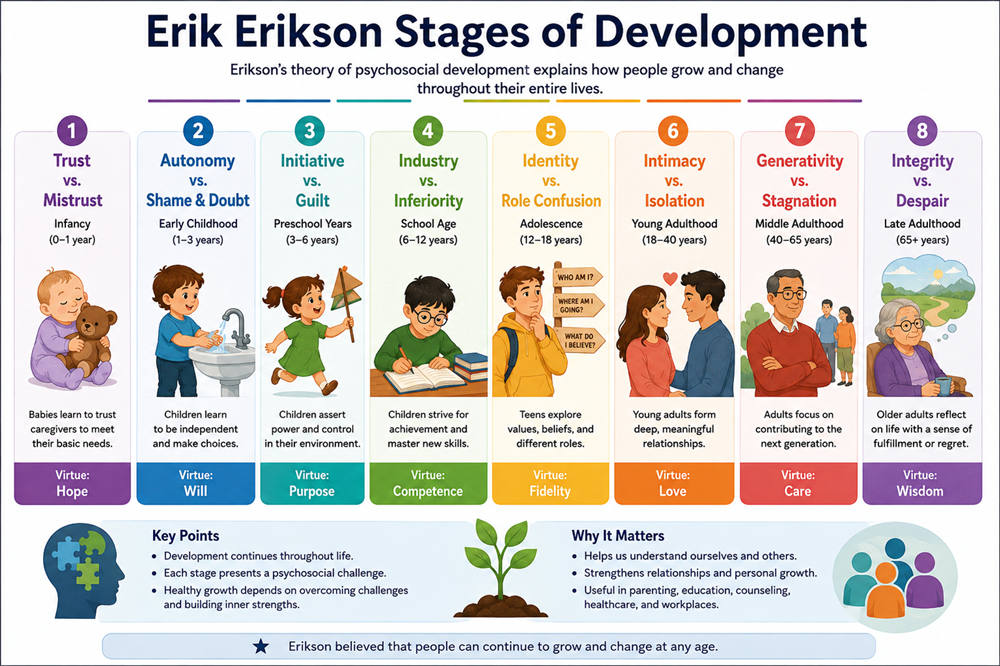
Erikson proposed eight stages running from infancy to late adulthood. At each stage, a person faces a major psychosocial conflict. The word psychosocial reflects the interaction between your psychological development and the social world around you. A detailed overview of Erikson’s psychosocial stages is available through the National Library of Medicine.
The conflicts are not meant to suggest that one side is always good and the other is always bad. Healthy development involves learning to balance both sides. For example, trust is important, but a person also needs enough caution to recognize situations that may not be safe.
Another important point is that the stages should not be treated as strict deadlines. Age ranges commonly used in textbooks are approximate, and later experiences can bring earlier developmental issues back into focus.
The 8 Erik Erikson Stages of Development
Stage 1: Trust vs. Mistrust — Infancy
The first stage begins at birth and is generally associated with the first year of life.
Babies depend almost entirely on caregivers for food, comfort, warmth, safety, and affection. When caregivers respond consistently to those needs, an infant begins developing a basic sense that other people and the surrounding world can be trusted.
That does not mean every need must be met immediately. What matters is a reasonably reliable pattern of care.
When care is highly unpredictable, neglectful, or frightening, mistrust may become stronger. The child may experience the world as less secure or dependable.
Erikson associated successful development during this stage with the virtue of hope. The basic lesson is that needs can be met and difficult moments can pass. The National Library of Medicine’s summary of the eight psychosocial stages also identifies hope as the strength associated with trust versus mistrust.
Stage 2: Autonomy vs. Shame and Doubt — Early Childhood
The second stage generally occurs between about ages 1 and 3.
Toddlers are beginning to discover that they can act independently. They may want to choose their clothes, feed themselves, walk without assistance, select toys, or insist on doing simple tasks without help.
These everyday moments are part of a much larger developmental question: Can I do things for myself?
Parents and caregivers can support autonomy by giving children safe, age-appropriate choices while still setting necessary limits. A toddler who is allowed to try, make manageable mistakes, and practice new skills can gradually become more confident.
Constant criticism or excessive control can contribute to shame and self-doubt instead. A child may begin questioning whether they are capable of handling things independently.
The virtue associated with this stage is will—the growing ability to make choices and act with greater independence.
Stage 3: Initiative vs. Guilt — Preschool Years
From roughly ages 3 to 6, children become increasingly interested in initiating activities rather than simply reacting to what adults ask them to do.
They invent games, ask questions, make plans, explore new interests, and experiment with social roles through play.
The central issue is whether a child feels comfortable taking initiative.
A supportive environment does not mean allowing every behavior. Children still need boundaries. However, when adults encourage curiosity and guide children’s efforts without constantly dismissing them, children can learn that taking action is worthwhile.
If initiative is repeatedly discouraged or treated as troublesome, children may begin feeling excessive guilt about their ideas or desires.
Successful development is associated with purpose. OpenStax’s discussion of lifespan theories provides additional context for how Erikson placed this stage within his larger developmental model.
Stage 4: Industry vs. Inferiority — School Age
The fourth stage is generally connected with the elementary-school years, approximately ages 6 to 12.
Children are now developing skills that can be compared with recognizable standards. Schoolwork, sports, hobbies, friendships, household responsibilities, and creative activities can all become opportunities to experience achievement.
The central question begins to resemble: Can I become good at things that matter?
Encouragement matters, but empty praise is not the goal. Children benefit from opportunities to practice, improve, complete meaningful tasks, and see the connection between effort and progress.
Repeated failure without support can contribute to feelings of inferiority. A child who constantly believes everyone else is smarter, faster, more talented, or more capable may begin avoiding challenges altogether.
Erikson associated healthy development during this period with competence: the belief that effort and practice can help you develop useful abilities.
Stage 5: Identity vs. Role Confusion — Adolescence
During adolescence, the focus shifts strongly toward identity.
Teenagers begin asking questions such as:
- Who am I?
- What do I believe?
- Where do I belong?
- What kind of person do I want to become?
- What might I do with my adult life?
Trying different interests, social groups, values, styles, goals, and possible career paths can be part of this process. Exploration is not necessarily a sign that something is wrong. It can help adolescents build a clearer sense of self.
Role confusion occurs when it becomes difficult to develop a reasonably coherent identity or direction.
Erikson considered identity especially important because it influences later adult relationships and responsibilities. However, identity formation does not suddenly end at adulthood. The broader field of identity and personality development continues to draw on Erikson’s framework when examining development across the lifespan.
The virtue associated with this stage is fidelity, meaning the ability to remain connected to your values and commitments while participating in relationships and society.
Stage 6: Intimacy vs. Isolation — Young Adulthood
After developing a stronger sense of identity, attention increasingly turns toward close adult relationships.
Intimacy involves more than romance. It can include deep friendships, long-term partnerships, emotional openness, trust, commitment, and the ability to share important parts of yourself with another person.
The challenge is maintaining closeness without completely losing your own identity.
People who struggle to form or maintain meaningful connections may experience isolation. That does not mean being single automatically represents failure. Someone can have strong intimacy through friendships, family relationships, community ties, or other close bonds.
The virtue associated with this stage is love—the capacity to build committed, caring relationships while respecting both your own identity and another person’s individuality.
Stage 7: Generativity vs. Stagnation — Middle Adulthood
During middle adulthood, Erikson believed people often become increasingly concerned with what they are contributing beyond themselves.
This is generativity.
Parenting is one obvious example, but generativity is much broader than raising children. A person may contribute by mentoring younger colleagues, teaching, volunteering, creating something valuable, caring for relatives, building a business, supporting a community, or passing knowledge to another generation.
The underlying question is whether your efforts feel useful and connected to something larger than your immediate needs.
Stagnation can emerge when a person feels disconnected, unproductive, or uninterested in contributing to others.
Erikson linked successful development at this stage with the virtue of care. The current StatPearls review of Erikson’s theory describes generativity through activities such as parenting, coaching, teaching, and engagement with the next generation.
Stage 8: Integrity vs. Despair — Late Adulthood
The final stage is generally associated with later adulthood.
At this point, people may look back on their lives and consider what their experiences, relationships, choices, achievements, mistakes, and losses have meant.
Integrity involves accepting your life as a whole. It does not require believing that every decision was correct or that everything went according to plan. Instead, it means being able to recognize the value and meaning of your life while accepting that some things cannot be changed.
Despair may develop when reflection is dominated by regret, bitterness, or the feeling that life was wasted.
Erikson associated successful navigation of this stage with wisdom. In this context, wisdom includes the ability to face the realities of aging and mortality while maintaining a sense of meaning and perspective. OpenStax also discusses psychosocial development in the context of older adulthood.
Why Erikson’s Psychosocial Development Theory Matters
One reason Erikson’s theory remains widely taught is that it looks beyond childhood.
Earlier psychological theories often placed the greatest emphasis on the first years of life. Erikson instead described development as a lifelong process in which adulthood contains important psychological challenges of its own. OpenStax includes his model among the major theories of human growth and development.
The theory also highlights the importance of social relationships. Parents and caregivers matter early in life, but peers, teachers, friends, partners, coworkers, families, and communities become important in different ways as life progresses.
This makes Erikson’s framework useful for thinking about experiences such as starting school, developing an identity, building relationships, becoming a parent or mentor, entering retirement, and reflecting on life in older age.
It should not, however, be used as a rigid checklist. People develop under different cultural, family, economic, and personal circumstances. The exact timing of milestones can vary significantly.
More importantly, struggling during one period does not mean someone is permanently stuck. Erikson’s framework describes continuing development rather than a simple pass-or-fail test at each age.
Erikson vs. Other Developmental Theories
Erikson’s model is easier to understand when you compare what it emphasizes with other well-known developmental theories.
Sigmund Freud’s psychosexual theory strongly influenced Erikson, but Freud concentrated mainly on childhood and psychosexual development. Erikson expanded the stage approach across the lifespan and focused more heavily on social relationships and identity. OpenStax provides a useful comparison of these major lifespan theories.
Jean Piaget’s theory asks a different question. Piaget focused primarily on cognitive development—how children’s thinking and reasoning change as they grow. Erikson focused on psychosocial challenges such as trust, independence, identity, relationships, and contribution to society.
These theories therefore do not simply compete to explain the same thing. Each emphasizes a different part of human development.
Key Takeaway
The Erik Erikson stages of development describe eight major psychosocial challenges across the lifespan:
- Trust vs. Mistrust — developing basic trust and hope
- Autonomy vs. Shame and Doubt — developing independence and will
- Initiative vs. Guilt — developing initiative and purpose
- Industry vs. Inferiority — developing skill and competence
- Identity vs. Role Confusion — developing identity and fidelity
- Intimacy vs. Isolation — developing close relationships and love
- Generativity vs. Stagnation — contributing to others and developing care
- Integrity vs. Despair — reflecting on life and developing wisdom
These stage-conflict and virtue pairings are consistent with the current National Library of Medicine summary of Erikson’s model.
The useful part of Erikson’s theory is not deciding whether you have perfectly “passed” every stage. Human development is more flexible than that. The model gives you a way to understand how your needs and challenges can change across life—from learning whether the world feels safe, to finding out who you are, building meaningful relationships, contributing to others, and eventually making sense of the life you have lived.