What Is Soaking in Mormon Culture and Why Is It So Controversial?
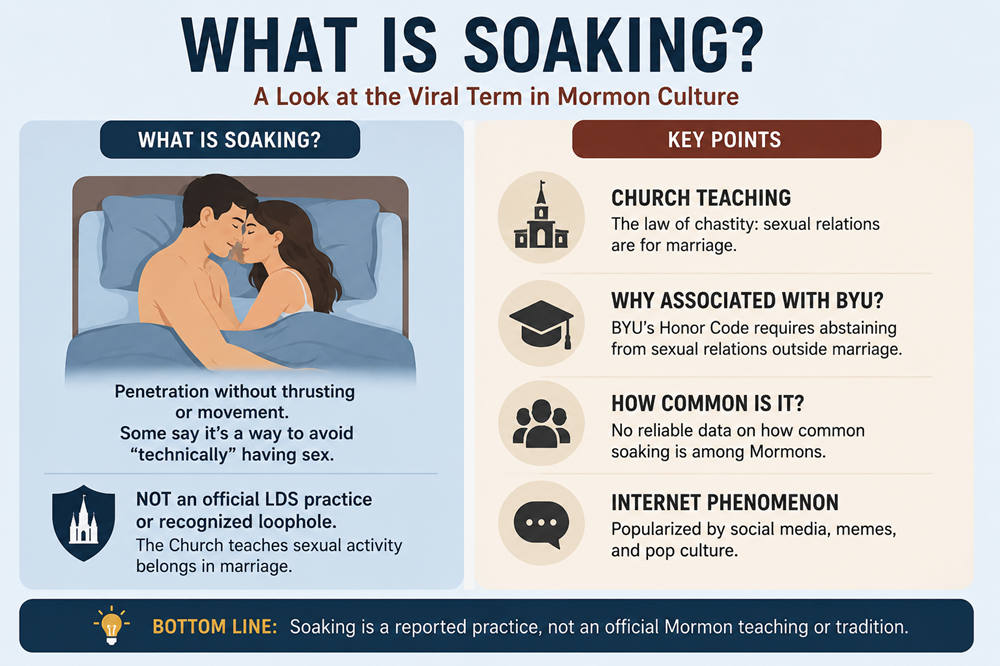
Soaking is a term you may have heard through TikTok, television, memes, or stories about Brigham Young University. It describes a reported sexual practice in which penile-vaginal penetration occurs without continued thrusting or deliberate movement.
Online, soaking is often portrayed as a supposed way for unmarried Latter-day Saints to avoid technically having premarital sex. It is not an official Mormon practice, Church tradition, or recognized loophole in LDS teachings about chastity. Official Church guidance reserves sexual activity for marriage.
What Does Soaking Mean in Mormon Culture?
In the way the term is normally used, soaking involves penetration while both partners remain relatively still.
The supposed logic is simple: if neither person is thrusting, they can claim they are not actually having sex. That idea is why soaking is sometimes called a “Mormon sex loophole” online.
But the loophole is an internet interpretation rather than something found in Church teaching.
There is also an important distinction between saying soaking has been reported among some Latter-day Saints and saying it is a normal part of Mormon culture. The first is plausible and supported by personal accounts. The second is much harder to justify because there is no reliable research showing how widespread the behavior actually is. Reporting on the subject has similarly noted the lack of prevalence studies.
Soaking is better understood as a reported behavior that has become strongly associated with Mormonism through anecdotes and online culture.
Why Is Soaking Associated With Mormon Culture?
The connection comes mainly from the Church’s strong emphasis on sexual chastity before marriage.
The Church of Jesus Christ of Latter-day Saints teaches the law of chastity, which says sexual relations should occur only within marriage. Its current youth guidance also treats sexual behavior more broadly than intercourse alone.
That creates a clear religious expectation for unmarried members.
The soaking story revolves around trying to follow the wording of that expectation while finding a technical exception. If movement were what made penetration “sex,” according to the supposed reasoning, then remaining still might allow someone to claim the rule had not been broken.
But that interpretation does not match official Church teaching.
Current LDS guidance says God approves of sexual activity within marriage and also tells unmarried members not to engage in intimate touching of another person’s private areas. The standard therefore does not depend on whether thrusting occurs.
What Does the LDS Church Actually Teach About Premarital Sex?
The Church’s position is much more straightforward than the internet debate around soaking can make it seem.
Its explanation of the law of chastity defines chastity as avoiding sexual relations outside marriage. The guidance also discusses sexually appropriate actions rather than defining sexual conduct according to a particular type of movement.
The Church’s For the Strength of Youth guidance similarly says sexual activity is reserved for marriage and specifically addresses intimate touching outside marriage.
That means soaking is not a doctrinal workaround.
Remaining still during penetration does not create a category that official LDS teachings describe as acceptable for unmarried people. Calling soaking a “loophole” therefore describes how some people allegedly rationalize the behavior, not what the Church permits.
What Does BYU Have to Do With Soaking?
Brigham Young University appears frequently in soaking stories because it is sponsored by The Church of Jesus Christ of Latter-day Saints and maintains conduct standards based partly on LDS beliefs.
Under the current Church Educational System Honor Code, members of the university community commit to living a chaste and virtuous life, including abstaining from sexual relations outside marriage.
BYU therefore provides an obvious setting for stories about young adults trying to balance romantic relationships, sexual attraction, and strict religious expectations.
That does not establish soaking as a BYU tradition.
Stories about students soaking have spread far beyond the campus through TikTok, Reddit, memes, podcasts, television, and entertainment reporting. Over time, the BYU connection became part of the popular image of soaking even though there are no reliable statistics showing that the behavior is common among BYU students.
It is more accurate to say that BYU is strongly associated with the soaking story, not that soaking is a normal part of student life there.
Is Soaking Actually Common Among Mormons?
There is no reliable number.
You can find personal accounts from people who say they encountered soaking or knew people who practiced it. You can also find former Church members who say they never heard of the term until it became popular online.
What you cannot find is a substantial body of research showing how many Latter-day Saints actually engage in soaking.
That matters because viral stories can easily make unusual behavior seem ordinary.
Media coverage examining soaking has noted the absence of even small prevalence studies specifically measuring the practice. Without that evidence, claims that soaking is widespread among Mormons should be treated cautiously.
A more reasonable description is that the practice has been reported among some individuals, while its actual frequency remains unknown.
With millions of Latter-day Saints living across different countries and communities, it would be misleading to use an internet-famous sexual story to characterize Mormon relationships in general.
What Is Jump Humping?
A related internet term you may encounter is jump humping.
According to the story, a couple remains still while soaking and another person creates movement by jumping on or shaking the bed. The supposed reasoning is that because the couple did not create the movement themselves, they can still claim they were not actively having sex.
This is best understood as an extension of the same “technical loophole” idea.
Jump humping has become particularly recognizable because it makes the soaking story even more unusual and memorable. It is regularly repeated in memes and social-media explanations of Mormon soaking.
However, evidence that jump humping is a widespread real-world practice is even thinner than the evidence surrounding soaking itself. It should not be presented as an established LDS custom.
Why Did Soaking Become Such a Big Internet Meme?
Soaking became perfect material for internet culture because it combines religion, sex, college life, and an unusual attempt to follow the technical wording of a rule.
For people unfamiliar with the LDS Church, the idea sounds strange enough to be memorable. For social-media creators, it offers an easy story that can be explained quickly and provoke surprise or humor.
The term did not originate with the latest wave of TikTok videos, but social media dramatically increased its visibility. By the early 2020s, videos about soaking and jump humping were reaching large audiences, helping push what had once been a more obscure story into mainstream pop culture. Media coverage has continued to revive the subject when Mormon culture appears in popular television and online discussions.
That popularity creates a problem: the internet reputation of soaking is much larger and easier to document than the real-world prevalence of the practice.
A viral joke can be repeated millions of times without proving that the behavior behind it is common.
Is Soaking Really a Mormon Loophole?
No—not in terms of official LDS teaching.
The supposed loophole only works if you define sex very narrowly and assume that penetration becomes prohibited only once movement begins.
Church guidance does not make that distinction.
The law of chastity addresses sexual relations and sexual behavior outside marriage more broadly, while current youth guidance also specifically discusses intimate touching.
Someone might personally convince themselves that remaining still changes what they are doing, but that does not turn the idea into an LDS rule.
Calling soaking a “Mormon loophole” is therefore most accurate when describing the story and reasoning surrounding the practice, not an exception recognized by the Church.
Soaking Is More Internet Phenomenon Than Mormon Tradition
Soaking has become closely linked with Mormon culture in popular conversation, especially through stories involving BYU, TikTok videos, memes, reality television, and former-member anecdotes.
But those associations need context.
Soaking is not a Mormon ritual, doctrine, official teaching, or approved method of avoiding the law of chastity. It is a reported sexual behavior surrounded by a much larger body of internet folklore, jokes, and cultural commentary.
Its exact prevalence among Latter-day Saints is unknown, and there is little basis for treating it as something most Mormon young adults do.
The simplest explanation is this: soaking is a reported practice made famous as a supposed Mormon chastity loophole, but the loophole itself is not recognized by official LDS teachings.