How to Create a Company Culture Employees Actually Want to Be Part Of
Company culture is built through everyday behavior, not slogans on a wall. It shows up in how managers lead, how employees communicate, what gets rewarded, and what happens when something goes wrong.
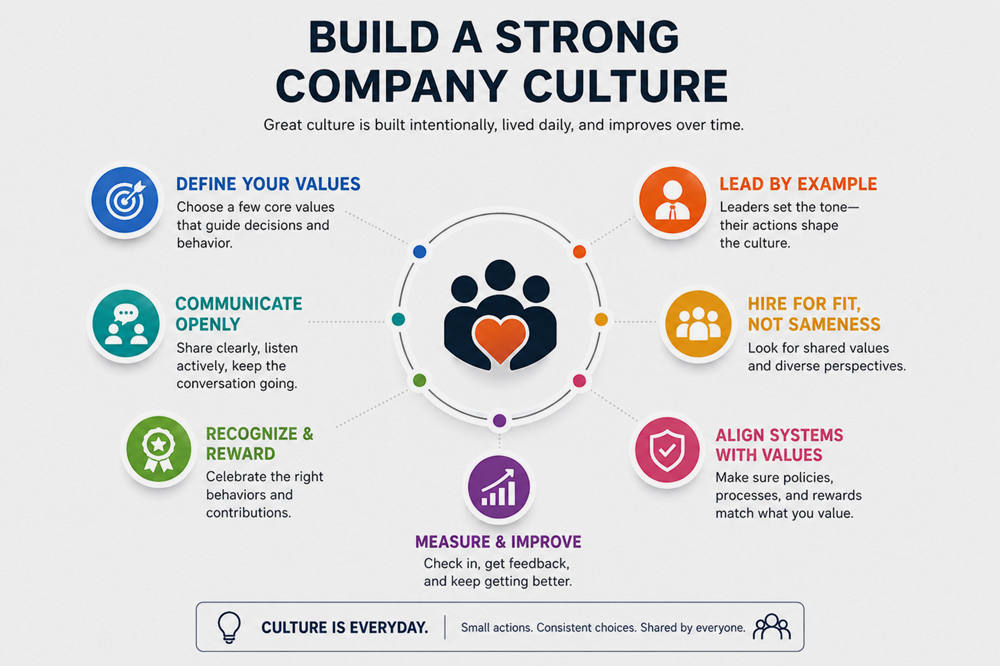
To create a company culture intentionally, decide what your organization stands for, turn those values into clear behaviors, and reinforce them through leadership, hiring, policies, feedback, and recognition. Those everyday signals eventually become “how things are done here.”
What Is Company Culture?
Company culture is the shared set of values, expectations, habits, and behaviors that influence how people work together. Organizational culture becomes visible through the employee experience, including the way people are managed and how everyday work gets done.
You can usually see the real culture by asking simple questions:
- How are decisions made?
- Can employees disagree with a manager?
- What happens when someone makes a mistake?
- Which behaviors earn praise or promotions?
- How do teams handle pressure?
- Are people expected to help one another?
- Do leaders follow the same standards as everyone else?
The answers tell you much more than a list of corporate values.
For example, a business may say it values work-life balance. If managers regularly expect employees to answer nonurgent messages late at night, the everyday behavior sends a different message.
That gap between stated values and actual experience is exactly what you need to address when building culture intentionally.
How to Create a Company Culture
There is no perfect culture that every company should copy. A construction company, software startup, hospital, accounting firm, and restaurant all have different needs.
What matters is creating clear expectations that support the way your particular organization needs to work.
1. Decide What You Want Your Company to Stand For
Start with a small number of principles that genuinely matter to the business.
They might include:
- Accountability
- Respect
- Customer service
- Collaboration
- Quality
- Innovation
- Reliability
- Transparency
- Continuous learning
Avoid picking values simply because they sound impressive.
Instead, ask what qualities employees need to demonstrate for the company to succeed. A healthcare business may place particular emphasis on safety and accuracy. A creative agency might need experimentation and open feedback. A customer-service business may emphasize responsiveness and empathy.
Your values should be useful when employees have to make decisions without a detailed rulebook.
2. Turn Values Into Everyday Behaviors
Words such as integrity, teamwork, and excellence can mean almost anything unless you explain what they look like at work.
Suppose collaboration is one of your values. You might define it as:
- Sharing information other teams need
- Asking for input before making decisions that affect others
- Giving coworkers credit for their contributions
- Helping when another team member is overloaded
- Disagreeing without becoming disrespectful
Now employees can see what collaboration actually means.
A practical organizational culture framework should connect values with recognizable workplace behavior instead of leaving them as abstract statements.
You do not need a rule for every possible situation. A few clear examples for each value are usually more useful than a long culture handbook.
3. Make Leaders Follow the Same Culture
Employees pay more attention to what leaders do than what leaders say.
A manager cannot promote open communication while reacting badly whenever someone offers criticism. A company cannot claim accountability matters if executives regularly blame others for their own mistakes.
Leadership behavior is especially visible during difficult moments.
Employees notice how managers respond to:
- Missed deadlines
- Customer complaints
- Poor performance
- Disagreements
- Business setbacks
- Employee mistakes
- Pressure to hit targets
Those moments show people which values really matter.
Managers are especially important because they translate company priorities into daily work. Gallup’s research on leadership, engagement, and company culture highlights how much influence managers have over employees’ workplace experience.
4. Hire for Values Without Hiring for Sameness
Every person you hire influences the workplace.
Along with skills and experience, consider how candidates handle responsibility, feedback, teamwork, conflict, and decision-making.
Instead of asking vague questions about “culture fit,” use situations that reveal how someone works.
For example:
“Tell me about a time you strongly disagreed with a coworker. What did you do?”
The response can tell you something about communication and conflict without requiring candidates to have the same personality as your existing team.
Culture fit should not mean hiring people who look, think, socialize, or communicate exactly like everyone already there. You can have shared workplace principles while still benefiting from different backgrounds, viewpoints, and working styles.
5. Make Culture Part of Onboarding
New employees should not have to spend their first few months guessing which unwritten rules matter.
Use onboarding to explain things such as:
- How teams communicate
- How employees ask for help
- How feedback works
- How decisions are made
- What managers expect
- What employees can expect from managers
- How disagreements should be handled
- Which behaviors are encouraged
Give examples instead of simply presenting a slide containing five company values.
A thoughtful employee onboarding process gives new hires a chance to understand the organization’s culture, mission, values, structure, and expectations from the beginning.
Then keep reinforcing those expectations after onboarding ends.
6. Communicate Clearly
Unclear communication creates its own culture—usually one built around rumors, assumptions, and uncertainty.
Managers should explain expectations and provide useful context when priorities change.
That might include explaining:
- What the team is trying to accomplish
- Why a decision was made
- Who owns a responsibility
- What success looks like
- Which priorities have changed
- What employees should do when problems arise
Not every business decision can be completely transparent. Confidential information sometimes needs to remain confidential.
But when you can explain something, explain it.
Employees should not constantly have to guess what leadership wants.
7. Give Employees a Real Voice
Communication should not flow only from leadership to employees.
Create ways for people to raise concerns, suggest improvements, question processes, and share what they are experiencing.
Depending on the size of your company, that might happen through:
- One-on-one meetings
- Team discussions
- Employee surveys
- Anonymous feedback
- Town halls
- Stay interviews
- Suggestion channels
The channel matters less than what happens afterward.
If employees repeatedly raise a reasonable problem and nobody responds, they may stop believing that feedback matters.
You cannot implement every suggestion, but you can acknowledge what employees are saying and explain what will—or will not—change.
Meaningful employee voice gives people a way to express opinions, concerns, and suggestions about matters affecting their work. It works best when managers listen rather than treating feedback as a box-checking exercise.
8. Recognize the Behaviors You Want More Of
People pay attention to what gets rewarded.
If you say teamwork matters but promotions consistently go to employees who hit their own targets while making coworkers’ jobs harder, the reward system is teaching a different value.
Recognition can reinforce the culture you want.
For example:
- Recognize employees who help colleagues solve difficult problems.
- Praise someone who handles a customer complaint particularly well.
- Celebrate an employee who takes responsibility for fixing a mistake.
- Highlight a team that improves an inefficient process.
- Reward managers who develop strong employees rather than simply hitting numbers.
Recognition does not always need to be financial. Timely praise, development opportunities, additional responsibility, awards, bonuses, and promotions can all send signals about what the company values.
Effective employee recognition works best when it connects to meaningful contributions and the behaviors an organization actually wants to encourage.
9. Apply Standards Consistently
Culture loses credibility when certain employees are allowed to ignore the rules.
Suppose respect is one of your core values, but a high-performing salesperson regularly insults coworkers. If management continually overlooks the behavior because the employee brings in revenue, everyone learns that sales numbers matter more than respect.
That lesson is stronger than anything written in a values statement.
Your standards should apply to managers, executives, new employees, long-term staff, and top performers.
That does not mean every situation deserves the same response. It means nobody should receive a permanent exemption from the behaviors your company says are important.
Consistent workplace accountability also depends on employees knowing what is expected and understanding how their work connects to wider organizational standards.
10. Use Workplace Traditions With a Purpose
Traditions and rituals can make cultural values more visible when they connect to something meaningful.
Useful examples might include:
- Welcoming new employees
- Sharing customer success stories
- Recognizing team accomplishments
- Celebrating important milestones
- Holding regular learning sessions
- Reviewing lessons after major projects
- Giving teams time to share useful knowledge
Keep them genuine.
A company picnic or Friday lunch cannot compensate for poor management, unfair treatment, or chronic overwork. Social activities can support a good culture, but they cannot create one by themselves.
11. Make Policies Match Your Values
Look at what your company actually rewards, requires, and permits.
Review areas such as:
- Hiring
- Pay
- Promotions
- Performance reviews
- Scheduling
- Time off
- Remote work
- Employee development
- Recognition
- Management training
- Discipline
Then ask whether those systems support the culture you claim to want.
For example, a company may say collaboration matters while every bonus is based entirely on individual results. Another may say employees should keep learning while giving them neither training opportunities nor time to develop new skills.
Hiring, onboarding, performance management, recognition, communication, and other workplace systems can all either reinforce or contradict your culture. SHRM’s guidance on building and maintaining organizational culture specifically treats these practices as connected rather than separate HR activities.
When policies and values contradict each other, employees tend to follow the policy that affects their pay, workload, or career.
12. Check Whether the Culture Is Actually Working
Culture changes as the organization changes.
Growth, new managers, remote work, acquisitions, leadership changes, and shifting business priorities can all affect how employees work together.
Pay attention to signals such as:
- Employee feedback
- Turnover
- Absenteeism
- Exit interviews
- Manager performance
- Internal promotions
- Recurring complaints
- Team conflicts
- Engagement surveys
Do not judge the entire culture from one number.
Instead, look for patterns.
If several teams repeatedly mention poor communication from managers, investigate it. If strong employees frequently leave one department, find out why. If employees do not understand the company’s priorities, improve how those priorities are communicated.
Tools that focus on organizational climate and culture can also help leaders examine the policies, behaviors, and working practices employees actually experience instead of relying only on stated values.
Common Mistakes When Building Company Culture
Even a well-intentioned culture effort can fail when the company’s actions contradict its message.
Watch for these common mistakes:
- Creating values nobody uses: Values need to influence decisions and behavior.
- Confusing perks with culture: Free lunches and office parties cannot fix poor leadership.
- Ignoring bad behavior from high performers: Exceptions quickly become cultural signals.
- Collecting feedback but never responding: Employees notice when speaking up leads nowhere.
- Rewarding the wrong things: Incentives often influence behavior more strongly than slogans.
- Copying another company’s culture: Your culture needs to fit your own people, customers, goals, and work.
- Leaving culture entirely to HR: HR can support it, but managers and leaders shape much of employees’ daily experience.
What Does a Healthy Company Culture Look Like?
A healthy culture does not mean everyone always agrees or enjoys every decision.
Instead, employees generally know what is expected and can see that workplace practices match the organization’s stated priorities.
Healthy signs include:
- Leaders generally model the behavior they expect.
- Employees know what success looks like.
- People can raise reasonable concerns.
- Managers communicate clearly.
- Good work receives meaningful recognition.
- Problems are addressed instead of continually ignored.
- Workplace policies support stated values.
- Employees can disagree without treating each other disrespectfully.
- People understand how their work contributes to the organization.
Different teams can still have different personalities and working styles. The goal is not to make everyone behave identically. It is to give people a shared understanding of how the company works and what standards matter.
Building Culture Happens Every Day
You do not create a company culture once and then move on.
You create it every time a manager responds to a mistake, someone earns a promotion, an employee raises a concern, a new person is hired, or leadership chooses what behavior to reward or tolerate.
When your values, leadership, policies, and everyday decisions point in the same direction, employees no longer need a poster to tell them what the company stands for. They can see it in the way the workplace actually operates.