What Is Calligraphy and What Role Does It Play in Islamic Culture and Art?
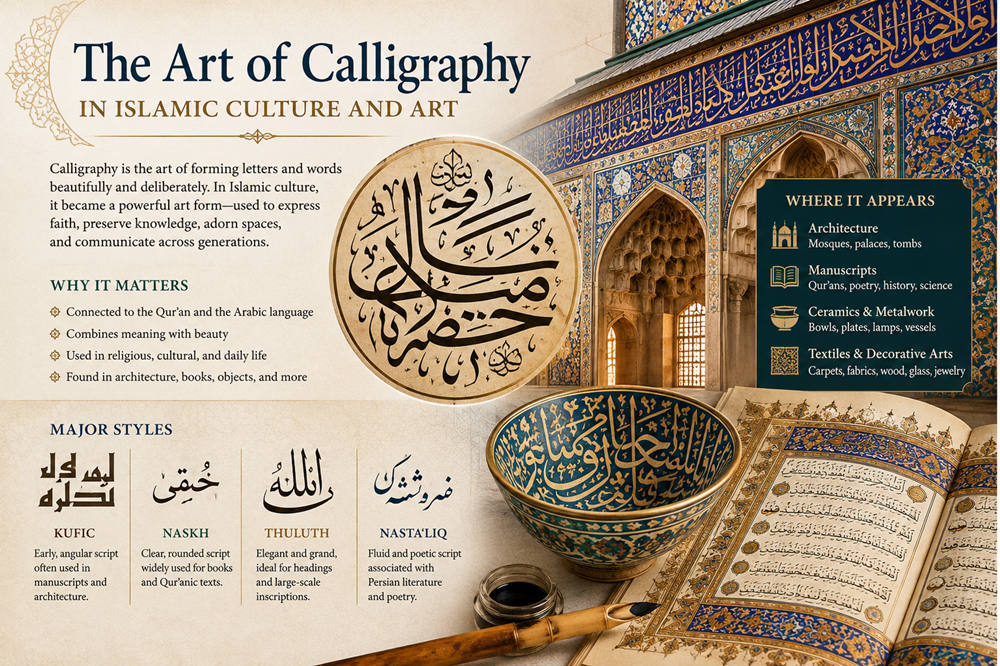
Calligraphy is the art of forming letters and words beautifully and deliberately. In Islamic culture, it developed into one of the most important visual arts, appearing in Qur’an manuscripts, mosques, palaces, ceramics, textiles, metalwork, and many other objects.
Its special place in Islamic art is closely connected to the Qur’an, which was revealed in Arabic. But Islamic calligraphy was never limited to religious writing. Artists also used it for poetry, historical inscriptions, blessings, names, official texts, and decoration.
What Is Calligraphy?
Calligraphy is more than neat handwriting. A calligrapher deliberately controls the shape, size, spacing, proportion, and movement of letters to create a balanced composition.
The words still communicate a message, but their appearance is important too. A line of calligraphy can be bold and angular, soft and flowing, or arranged into an elaborate decorative design.
This gives calligraphy two jobs at once. You can read the words for their meaning while also viewing the writing as art.
Arabic script is especially suited to this kind of artistic treatment because its connected letters can be extended, curved, compressed, enlarged, or arranged in different ways. Artists used those possibilities to create scripts ranging from highly readable book hands to monumental inscriptions designed for buildings.
Why Is Calligraphy Important in Islamic Culture?
The importance of calligraphy in Islamic culture begins largely with the written Qur’an.
Muslims believe the Qur’an contains God’s revelation delivered to the Prophet Muhammad in Arabic. Because preserving and transmitting its words accurately mattered greatly, writing the Qur’an became a serious and respected task.
Over time, scribes developed increasingly sophisticated ways of presenting the text. The writing could be carefully proportioned and accompanied by decorative elements such as gold, colored ink, verse markers, and illuminated designs.
Calligraphy soon extended beyond Qur’anic manuscripts.
It appeared in religious buildings, royal settings, books of poetry, official documents, household objects, and works made for wealthy patrons. An inscription could provide a religious verse, name a ruler, record when a building was constructed, offer a blessing, or simply add beauty to an object.
That versatility helped calligraphy become a visual tradition shared across many Islamic societies, even though styles differed by time and region.
The Role of Calligraphy in the Qur’an
The Qur’an played a major role in the development of Arabic calligraphy.
Early Qur’anic manuscripts show that Arabic writing did not always look like the standardized scripts familiar today. Between roughly the seventh and twelfth centuries, different approaches to writing the Qur’an developed as scribes experimented with letterforms, spacing, page layouts, and systems that made the text clearer to read.
Some early manuscripts used relatively simple forms of Arabic writing. Later examples became more carefully organized and visually elaborate.
The page itself became part of the experience.
A scribe might leave generous spaces around the text, stretch horizontal letters across a line, use gold to mark verses, or combine black writing with colored decorative details. These choices added visual richness while keeping attention on the sacred words.
For a calligrapher, beauty did not mean making the Qur’an unnecessarily difficult to read. Precision remained important. The challenge was to combine clarity, respect for the text, and visual harmony.
Calligraphy as a Major Form of Islamic Art
Once Arabic writing became an established artistic medium, artists could do much more than place straightforward lines of text on a page.
They could stretch letters, repeat them, intertwine forms, change their scale, or combine them with geometric and vegetal patterns. A written phrase could become the main decoration of an object or building.
This flexibility made calligraphy useful in very different settings.
On a manuscript page, the writing might be small and precise. On the wall of a mosque, the same artistic principles could be used on a monumental scale. On a ceramic bowl, an inscription might follow the curve of the rim and become part of the object’s design.
Even when a viewer cannot read the language, the visual qualities remain noticeable: long vertical strokes, sweeping curves, repeating forms, strong contrasts, and carefully measured spaces.
The result is an art form in which the message and its appearance are closely connected.
Where Calligraphy Appears in Islamic Art
Islamic calligraphy can be found on far more than handwritten religious books.
Architecture
Calligraphic inscriptions commonly appear on mosques, madrasas, tombs, palaces, gateways, domes, walls, and other architectural features.
They may contain Qur’anic verses, religious phrases, names, dates, or information about a building’s patron or construction.
Because architectural inscriptions can be enormous, calligraphers had to think about how the letters would look from a distance as well as how they would fit the surrounding structure.
Manuscripts
The Qur’an is the best-known example, but calligraphy was also important in books of poetry, history, science, literature, and religious scholarship.
Some manuscripts combined calligraphy with illumination or figurative painting, particularly in Persian and later South Asian court traditions.
Ceramics and Metalwork
Calligraphy appears on bowls, plates, lamps, trays, boxes, vessels, and other objects.
These inscriptions were not necessarily religious. Some contained blessings or good wishes, while others included poetry, sayings, names, or praise for a patron.
Textiles and Other Decorative Arts
Artists also incorporated writing into carpets, woven fabrics, woodwork, glass, jewelry, and other decorative objects.
The wide range of surviving examples shows how deeply calligraphy became part of Islamic art, rather than remaining limited to books or religious spaces.
Major Styles of Islamic Calligraphy
Islamic calligraphy includes many scripts rather than one universal style. Different scripts developed for different regions, periods, materials, and purposes.
Kufic
Kufic is famous for its strong, angular appearance. Forms commonly described as Kufic were especially important in early Qur’anic manuscripts and later appeared in architectural and decorative settings.
Its straight lines and geometric character could work particularly well alongside architectural patterns and ornament.
Artists also developed increasingly decorative variations, sometimes extending letters into interlaced or vegetal forms.
Naskh
Naskh has a more rounded, flowing appearance and became widely used for manuscripts.
Its relatively clear letterforms made it useful for longer texts, including copies of the Qur’an. Forms of naskh continued to be important across different regions of the Islamic world.
Thuluth
Thuluth is recognizable for its elegant curves, tall letters, and strong visual movement.
Because it can look impressive at a large scale, it became particularly important for headings and architectural inscriptions. It has frequently been used in religious buildings and formal calligraphic compositions.
Nasta’liq
Nasta’liq is especially associated with Persian literary culture and poetry.
Its letters seem to flow across the page, often creating graceful diagonal lines. The style became particularly important in Iran and later influenced manuscript traditions elsewhere, including South Asia.
These scripts show how calligraphers could adapt the same basic writing system to very different artistic purposes.
Did Calligraphy Replace Images in Islamic Art?
A common explanation says that calligraphy became important because Islamic culture completely prohibited images. That is too simple.
Figurative art existed in many Islamic societies, especially in secular and courtly settings. Historical manuscripts, palace decorations, ceramics, and luxury objects can include people, animals, rulers, hunters, musicians, and scenes from literature.
Religious settings were generally more cautious about figurative imagery, particularly in mosques and Qur’an manuscripts. As a result, calligraphy worked especially well alongside geometric patterns and vegetal decoration in these spaces.
But calligraphy should not be treated merely as a substitute for pictures.
It had its own importance. It could communicate sacred or secular ideas, transform language into decoration, identify people and places, and visually organize an architectural space or object.
That helps explain why calligraphy remained important even in contexts where figurative images were also present.
How Calligraphy Combines Meaning and Beauty
The clearest way to understand Islamic calligraphy is to look at it as both writing and visual design.
Imagine a Qur’anic verse running across the interior of a mosque. The verse has a specific meaning for someone who reads it, but its scale, curves, spacing, and position also affect how the interior looks.
The same principle applies to a decorated bowl. An inscription around its edge might contain a blessing, while the repeating letters create a pattern that follows the bowl’s circular shape.
In other words, the writing does not simply describe something beautiful. The writing itself becomes part of the artwork.
That ability to join language and visual form explains much of calligraphy’s lasting role in Islamic culture. It could honor a sacred text, decorate a building, preserve poetry, identify a patron, or turn an everyday object into something visually distinctive.
Final Takeaway
Calligraphy is the artistic shaping of written language through careful control of letters, proportions, spacing, and composition. In Islamic culture and art, it gained particular importance through its connection with Arabic and the Qur’an, then expanded into almost every major artistic medium.
From a carefully written manuscript to a monumental mosque inscription, Islamic calligraphy shows how words can carry meaning and become art at the same time.