What Are the Elements of Culture? Key Parts That Shape Shared Life
Culture shapes the way people communicate, behave, celebrate, solve problems, and understand the world around them. You see it in everything from language and family traditions to clothing, laws, food, and everyday manners.
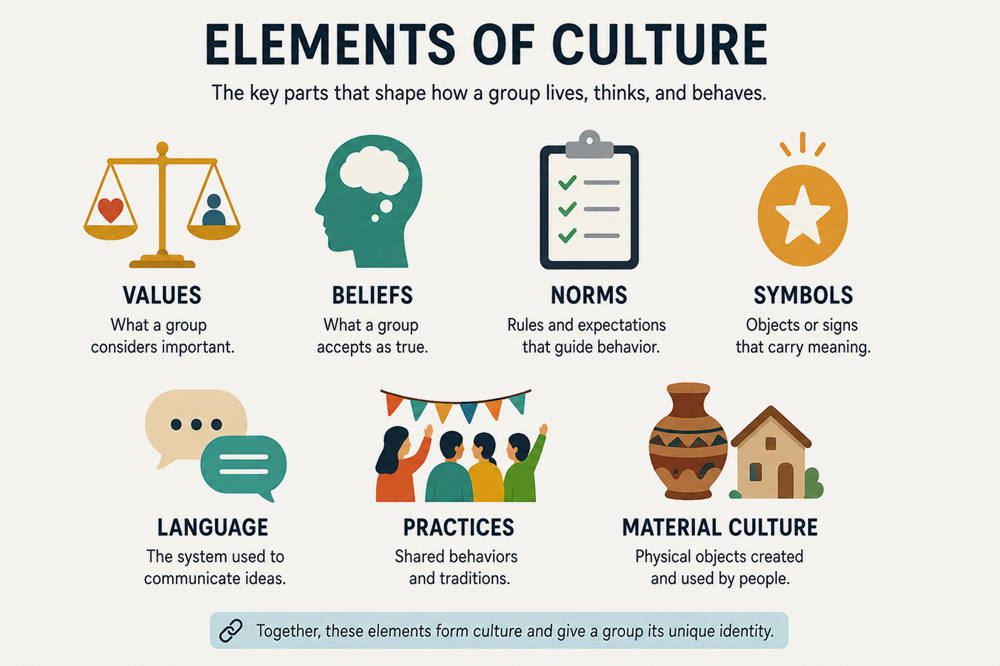
So, what are the elements of culture? They generally include values, beliefs, norms, symbols, language, cultural practices, and material artifacts. Sociologists may group these elements somewhat differently, but they all help explain how a group develops a shared way of life.
What Are the Elements of Culture?
The elements of culture are the shared ideas, meanings, behaviors, and physical objects that help people function as part of a group or society.
Culture is much broader than traditional clothing, food, music, or holidays. Those are visible expressions of culture, but underneath them are beliefs about what is true, values about what matters, rules about acceptable behavior, and symbols that carry shared meanings.
The OpenStax introduction to culture describes culture through shared values, beliefs, norms, language, symbols, practices, artifacts, identities, and collective memories.
These parts are closely connected. A cultural value can shape a social norm, while a belief may influence a tradition. Even an ordinary physical object can become meaningful because of the ideas attached to it.
Here are the main elements of culture and how each one works.
1. Values
Values are the principles and ideas a group considers important or desirable.
They influence what people admire, encourage, protect, or work toward. Values can affect family life, education, work, relationships, government, and many other parts of society.
Examples of cultural values can include:
- Family loyalty
- Independence
- Education
- Equality
- Hard work
- Hospitality
- Community responsibility
- Respect for elders
- Personal achievement
Suppose a society places a strong value on education. Families may encourage children to complete higher levels of schooling, and academic achievement may receive considerable respect.
In a culture that strongly values family responsibility, people may be expected to help relatives, care for older family members, or involve family members in important decisions.
Values help establish what a group considers important, but they do not mean that every person within that culture agrees on everything. OpenStax provides a useful explanation of the relationship between cultural values, beliefs, and norms.
2. Beliefs
Beliefs are ideas that people accept as true.
They often develop alongside cultural values, but the two are not identical. A value describes what people consider important, while a belief describes what they think is true about life, society, or the world.
For example, someone may value hard work and believe that persistent effort improves a person’s chances of success.
Beliefs can relate to:
- Religion
- Family
- Health
- Nature
- Education
- Success
- Authority
- Work
- Life and death
People learn many beliefs through their families, schools, communities, religions, media, and other social influences.
Beliefs can also change. New experiences, scientific knowledge, technology, migration, education, and contact with other groups can influence the way people understand the world.
3. Norms
Norms are the rules and expectations that guide behavior within a culture.
They help you understand what is considered acceptable in different situations. Some norms are formally written down, while others are simply learned through everyday interaction.
You probably follow dozens of norms without consciously thinking about them.
Waiting your turn in line is a norm. Speaking quietly in a library is another. Expectations about how you behave at a wedding, funeral, classroom, workplace, or religious service can also come from cultural norms.
Sociologists commonly distinguish between several types of norms.
Folkways
Folkways are everyday customs that help social interactions run smoothly.
Examples might include:
- Greeting people in an expected way
- Waiting your turn
- Following table manners
- Wearing appropriate clothing for an occasion
- Saying “please” and “thank you”
Ignoring a folkway may seem rude, awkward, or unusual, but it usually does not result in serious punishment.
Mores
Mores are norms connected with stronger moral expectations.
Violating a more is generally considered more serious than ignoring an everyday custom because the behavior touches on ideas about right and wrong.
What counts as a more can vary considerably between cultures.
Laws
Laws are formal rules created and enforced through governments and legal systems.
Traffic laws are an easy example. A society may value public safety and turn that value into formal rules involving speed limits, driver’s licenses, road signs, and traffic signals.
Laws are therefore part of a wider cultural system rather than completely separate from it.
4. Symbols
Symbols are objects, gestures, signs, sounds, or other things that carry a shared meaning.
The important part of a symbol is not simply what it physically is. Its cultural meaning comes from what people understand it to represent.
Common symbols include:
- National flags
- Wedding rings
- Religious objects
- Traffic signs
- Medals
- Logos
- Clothing
- Gestures
A wedding ring, for instance, is a physical object. In many cultures, however, it also represents marriage or commitment.
A flag is another good example. Its material may be ordinary fabric, but people can associate it with national identity, history, political ideas, or shared experiences.
Symbols only work when people understand their meanings. That also means the same gesture or object can mean different things in different cultural settings. OpenStax’s discussion of symbols and language in culture explains how societies attach shared meanings to objects, signs, gestures, and words.
5. Language
Language is the system people use to communicate ideas and meanings.
It is one of the most important ways culture is passed from one generation to another. Language can involve spoken words, writing, signs, gestures, and other shared symbols.
Through language, people can pass along:
- Family stories
- Historical knowledge
- Traditions
- Religious teachings
- Social rules
- Humor
- Values
- Skills
Without some form of language, preserving complicated cultural knowledge would be much more difficult.
Language also contributes to identity. Accents, slang, sayings, regional expressions, and styles of speech can connect people to particular communities, generations, professions, or places.
Language changes along with culture too. New technology, entertainment, social movements, and everyday experiences continually introduce new words and meanings.
6. Customs and Cultural Practices
Cultural practices are the things people in a group commonly do.
They put cultural ideas into action and can include traditions, ceremonies, routines, and everyday behaviors.
Examples include:
- Holiday celebrations
- Wedding traditions
- Religious ceremonies
- Funeral customs
- Family gatherings
- Greeting practices
- Food traditions
- Music and dance
- Coming-of-age ceremonies
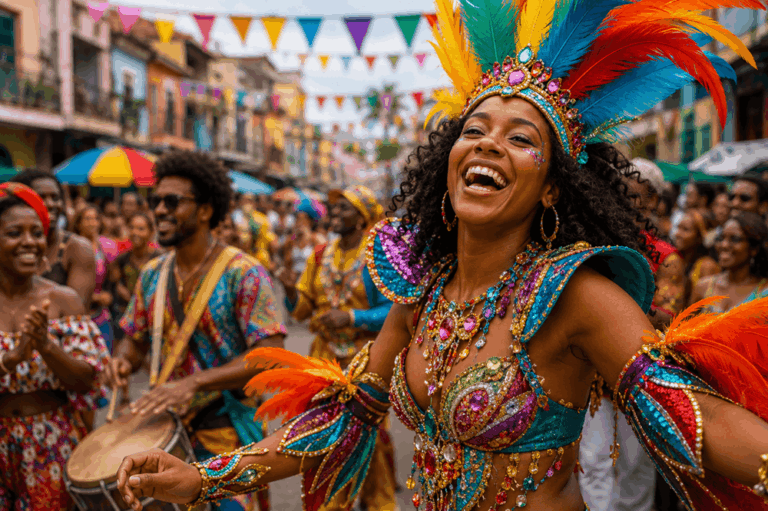
A greeting offers a simple example. In some places, people commonly shake hands. Elsewhere, people may bow, hug, or use another familiar greeting.
The behavior is learned through culture rather than being the only natural way to greet another person.
Cultural practices often express deeper values and beliefs. A large family celebration, for example, may reflect the importance placed on family connections, tradition, or community.
Practices are not necessarily permanent. Families and societies can change traditions over time or adapt them as new generations and influences emerge. UNESCO’s work on intangible cultural heritage similarly recognizes living practices and traditions as cultural forms that continue to evolve rather than remaining frozen in the past.
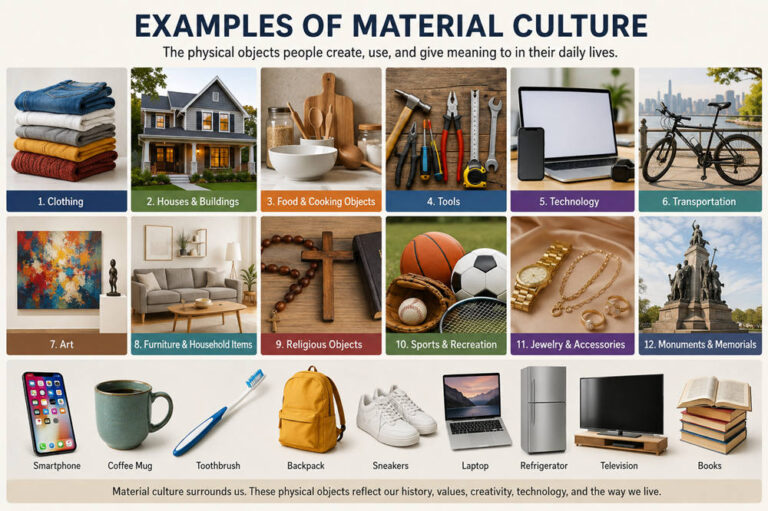
7. Material Culture and Artifacts
Culture also includes the physical things people create, use, and value. Sociologists generally refer to these objects as material culture or artifacts.
Examples include:
- Clothing
- Buildings
- Tools
- Books
- Art
- Furniture
- Technology
- Vehicles
- Jewelry
- Musical instruments
These objects can reveal a great deal about how people live.
Think about a smartphone. It is a physical object, but its widespread use can reflect cultural patterns involving work, relationships, entertainment, photography, shopping, news, and communication.
Traditional clothing can also tell you something about a culture’s history, environment, religion, social roles, or ideas about identity.
Objects frequently carry meanings beyond their practical use. That is why an item can belong to material culture while also functioning as a cultural symbol.
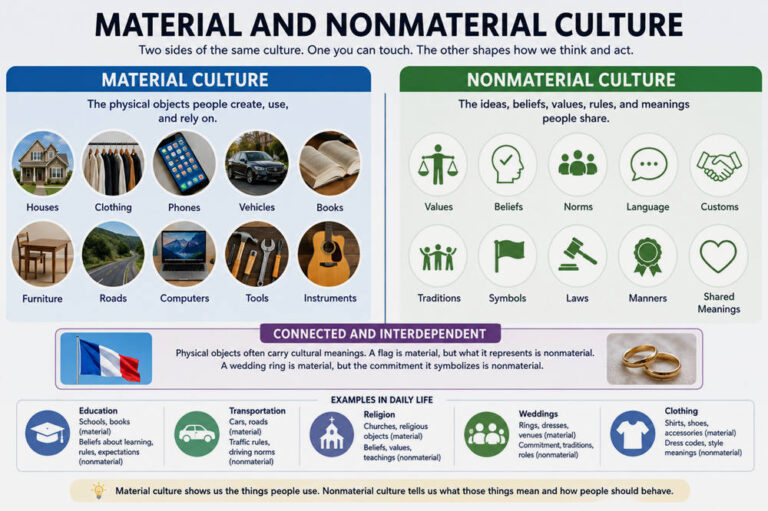
Material Culture vs. Nonmaterial Culture
A useful way to understand culture is to separate material culture from nonmaterial culture.
Material Culture
Material culture includes things you can physically see or touch, such as:
- Houses
- Clothing
- Technology
- Tools
- Art
- Vehicles
- Books
Nonmaterial Culture
Nonmaterial culture includes the ideas, expectations, and meanings shared by people.
Examples include:
- Values
- Beliefs
- Norms
- Language
- Traditions
- Attitudes
The distinction between material and nonmaterial culture is useful because it shows how physical objects and cultural ideas often work together.
A wedding ring is material culture because it is a physical object. The ideas of commitment and marriage associated with it belong to nonmaterial culture.
A religious building is another example. The building itself is material, while the beliefs, traditions, and meanings connected to it are nonmaterial.
How the Elements of Culture Work Together
You can see how these elements connect by looking at something familiar, such as a wedding.
A wedding may involve a value placed on family or commitment.
People may share a belief that marriage carries religious, legal, or personal importance.
There may be norms about what guests wear and how people behave during the ceremony.
A ring can serve as a symbol of commitment.
Language appears in vows, speeches, prayers, invitations, and conversations.
The ceremony and reception are cultural practices.
Clothing, rings, decorations, food, and other physical items are part of material culture.
None of these elements operates completely on its own. Together, they create the larger cultural meaning of the event.
The same pattern can be seen in holidays, sporting events, religious celebrations, family traditions, school ceremonies, and workplace customs.
Why the Elements of Culture Matter
The elements of culture help people develop a shared understanding of social life.
They teach people what certain actions mean, how they are generally expected to behave, which ideas are valued, and how to communicate with others.
Culture can help people:
- Share meanings
- Communicate effectively
- Pass knowledge between generations
- Preserve traditions
- Express group identity
- Establish expectations for behavior
- Organize everyday social life
Understanding cultural elements can also help explain why behavior differs between groups.
Something that seems completely normal to you may seem unusual to someone who grew up with different norms, symbols, or customs. Looking at the cultural context makes those differences easier to understand.
UNESCO uses a broad understanding of culture and its role in society, covering material, intellectual, emotional, and social dimensions rather than limiting culture to arts or heritage alone.
Final Takeaway
The main elements of culture include values, beliefs, norms, symbols, language, cultural practices, and material artifacts. Together, they shape how people communicate, behave, understand their surroundings, and share a way of life.
You can see them in almost every part of daily life—from the language people speak and the traditions they follow to the rules they observe and the objects they give special meaning.