Human Development and Family Studies Explains How People and Families Change Over Time
People keep changing throughout life, and those changes are shaped by more than age alone. Family relationships, friendships, school, culture, work, community, and major life experiences all play a part.
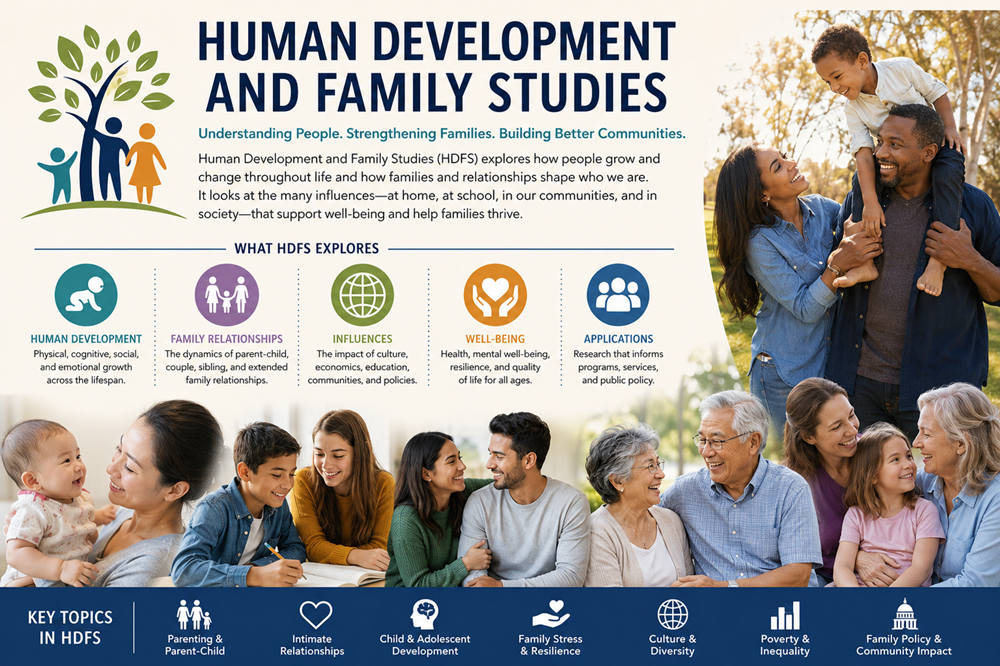
Human development and family studies (HDFS) examines these connections. The field looks at how people develop from infancy through older adulthood, how families and close relationships change over time, and how the world around us affects both individuals and families.
What Is Human Development and Family Studies?
Human development and family studies brings together two closely related subjects.
Human development focuses on how people grow and change throughout life. This includes emotional, social, cognitive, and behavioral development from infancy through older adulthood.
Family studies focuses on families and close relationships. It examines how family members interact, communicate, support one another, handle conflict, divide responsibilities, and respond to changes in their lives.
Putting the two together gives HDFS a broader view of development. Instead of studying a person as though they exist separately from everyone else, researchers consider the relationships and environments surrounding that person.
The National Council on Family Relations describes Family Science as the scientific study of families and close interpersonal relationships. It also emphasizes a systems perspective, which recognizes that families are connected systems rather than collections of completely independent people.
For example, losing a job may directly affect one parent, but its effects can spread through the household. Finances may change, stress may increase, routines may shift, and relationships between parents and children may be affected. HDFS looks at those connections.
Human Development Across the Lifespan
One of the central ideas in HDFS is that development lasts a lifetime.
Childhood receives plenty of attention because so much development happens quickly during the early years. However, adolescence, adulthood, and aging also bring meaningful changes in relationships, responsibilities, behavior, identity, and well-being.
Infancy and Early Childhood
Infancy and early childhood involve rapid growth in language, movement, thinking, emotional regulation, and social interaction.
HDFS researchers may study relationships between young children and caregivers, parenting practices, early learning, childcare, family routines, and children’s emotional development.
The goal is not simply to determine whether a child reaches a milestone at a certain age. Researchers also want to know how home life, caregiving, schools, peers, and cultural surroundings contribute to development.
Childhood and Adolescence
As children become more independent, their social world expands.
School, friendships, teachers, extracurricular activities, technology, and community experiences can become increasingly influential. Family relationships remain important, but the way children relate to parents and siblings often changes.
Adolescence adds questions about identity, independence, decision-making, emotional development, romantic relationships, and preparation for adulthood.
Current child and adolescent development research at the University of Illinois, for example, examines young people within settings such as families, childcare programs, schools, peer groups, geographical communities, and cultural environments.
Adulthood
Development does not suddenly stop when someone becomes an adult.
Adults continue to take on new roles and adjust to changing circumstances. They may enter long-term relationships, become parents, change careers, care for relatives, experience divorce, relocate, or face financial and health challenges.
HDFS examines how adults adjust to these experiences and how close relationships affect their well-being.
Relationships themselves also develop. A couple’s relationship after several months together may look very different after marriage, parenting, career changes, financial pressure, or decades spent together.
Older Adulthood
Later life brings its own developmental changes.
Researchers may examine retirement, independence, health, caregiving, social connections, bereavement, relationships with adult children, and relationships between grandparents and grandchildren.
Aging is particularly relevant to family studies because changes affecting an older adult often involve other family members. Adult children may become caregivers, spouses may adjust responsibilities, and several generations may need to make decisions together.
Family Relationships Are a Central Part of HDFS
Families can strongly influence how people experience different stages of life, which is why relationships are a major part of human development and family studies.
Parent-Child Relationships
Parent-child relationships begin early but continue changing for decades.
During childhood, parents may provide care, guidance, discipline, emotional support, and resources. Adolescence often requires parents to balance guidance with a teenager’s growing independence.
The relationship changes again when children become adults.
HDFS studies both sides of these relationships. Parents influence children, but children also influence their parents. This back-and-forth influence is one reason researchers often look at the family as a system.
Couples and Intimate Relationships
Close adult relationships can affect emotional health, family stability, parenting, daily routines, and many other areas of life.
Researchers may examine communication, commitment, conflict, relationship satisfaction, intimacy, separation, and the ways outside pressures affect couples.
Financial difficulties, work demands, health problems, and parenting responsibilities, for example, may influence how partners interact with each other.
Siblings and Extended Family
Parents, children, and romantic partners are not the only relationships that matter.
Siblings, grandparents, grandchildren, and extended relatives can provide companionship, care, financial help, advice, traditions, and emotional support. These relationships can also involve disagreement, competition, or complicated expectations.
Their importance may change throughout life. Siblings who were not especially close as children, for example, may work together later to care for an aging parent.
What Influences Human and Family Development?
HDFS does not assume that everyone develops in exactly the same way.
People live within different families, neighborhoods, cultures, economic circumstances, schools, and social systems. Those differences can shape opportunities, pressures, relationships, and everyday experiences.
Family Environment
The home environment can affect routines, expectations, communication, emotional support, and opportunities.
Family structure alone does not tell the whole story. Researchers also look at the quality of relationships, available resources, stability, stress, and how family members respond to challenges.
Schools, Peers, and Social Relationships
As people move through life, relationships outside the immediate family become increasingly important.
Teachers, classmates, friends, coworkers, romantic partners, neighbors, and community groups can all contribute to a person’s social world.
For children and teenagers in particular, school and peer experiences can interact with what is happening at home.
Culture
Culture can influence expectations surrounding parenting, marriage, independence, gender roles, caregiving, aging, and family responsibilities.
HDFS therefore studies families across different cultural backgrounds instead of treating one family pattern as universal.
Economic Conditions
Income and financial stability can shape many parts of family life, including housing, childcare, education, healthcare, transportation, food security, and access to activities.
Financial pressure may also place stress on relationships.
For this reason, some HDFS research specifically examines poverty, inequality, family resources, and the ways economic conditions interact with development. The University of Illinois includes diverse families, poverty, inequality, and social justice among its major areas of HDFS research.
Communities and Social Systems
A family is also affected by what exists outside the home.
Neighborhood safety, childcare availability, schools, healthcare, workplaces, public transportation, community organizations, laws, and social policies can all influence everyday family life.
Looking at these wider influences helps explain why similar families may have very different experiences depending on where and how they live.
Common Areas Studied in Human Development and Family Studies
HDFS covers many subjects, but most fit within a few broad areas:
- Child and adolescent development
- Adult development and aging
- Parenting and parent-child relationships
- Marriage and intimate relationships
- Family stress and resilience
- Health and well-being
- Culture and family diversity
- Poverty and inequality
- Family policy and community influences
These subjects often overlap.
For example, a study of teenage health could involve adolescent development, parenting, peer relationships, culture, school conditions, and economic resources at the same time.
That overlap is part of the point. Human development rarely has one simple cause.
Current HDFS research areas at the University of Illinois include child and adolescent development in context, diverse families and inequality, health and well-being across the lifespan, and interpersonal and intimate relationships.
How Human Development and Family Studies Is Used in Real Life
HDFS research is useful because it can turn observations about people and families into practical knowledge.
Research on early childhood can help improve childcare and youth programs. Studies of parenting may contribute to parent education and family-support programs. Research on relationships can help identify communication and conflict patterns associated with healthier families.
The field can also help professionals understand what allows families to cope with difficult circumstances.
Rather than looking only for problems, Family Science often uses a strengths-oriented approach. Researchers and practitioners consider what families already do well and what resources can help them become more resilient. Prevention is another important part of the field, with attention given to reducing problems before they become more serious.
HDFS findings can also inform community programs and public policy. Research might reveal how childcare access affects working parents, how neighborhood conditions affect young people, or how certain policies place different pressures on families.
The goal is not to create one model of what every family should look like. Instead, researchers study the conditions and relationships that can support well-being across many kinds of families.
Why Human Development and Family Studies Matters
Human development and family studies helps explain something we experience every day: people affect families, and families affect people.
A child’s development can change family routines. A parent’s work situation can affect the household. A strong relationship can provide support during difficult periods. Financial stress, illness, cultural expectations, school experiences, and community conditions can influence several family members at once.
By studying these connections across the lifespan, HDFS gives us a clearer picture of how people grow, how relationships change, and what helps individuals and families adapt and thrive. That combination of human development, families, and relationships is what makes human development and family studies a distinct and useful field.