Operations Leadership Development Program Guide for Building a Strong Career in Management
An operations leadership development program gives you hands-on business experience while preparing you for larger leadership responsibilities. Instead of staying in one entry-level position, you usually move through different assignments, work with multiple teams, and learn how day-to-day operations connect across a company.
These programs are especially useful if you want a career in operations management but have not chosen a narrow specialty yet. Depending on the employer, you might gain experience in manufacturing, supply chain, logistics, quality, process improvement, customer operations, or people management.
What Is an Operations Leadership Development Program?
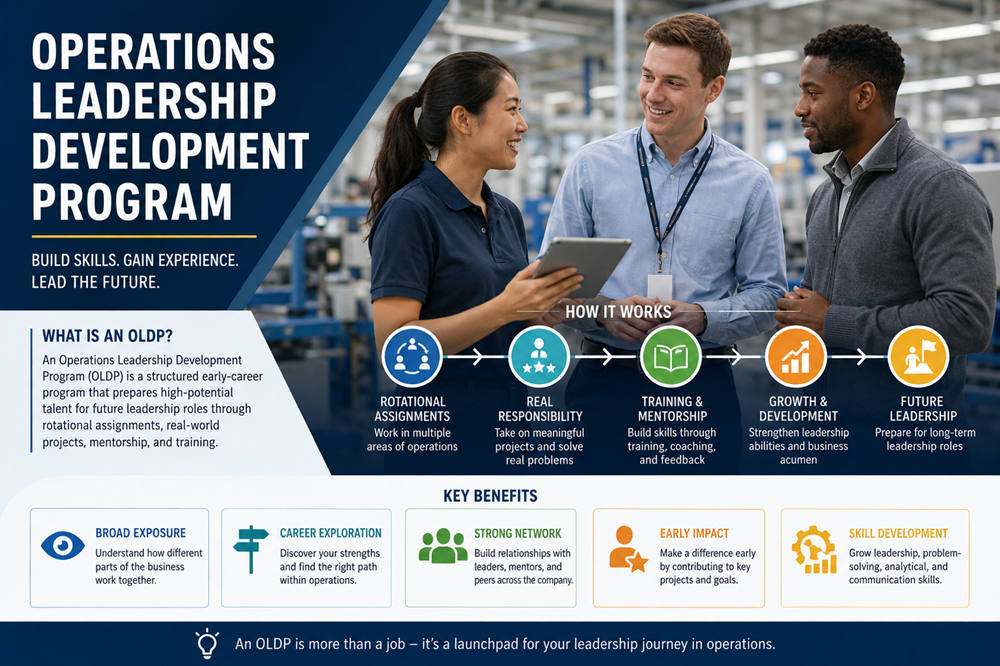
An operations leadership development program, often called an OLDP, is a structured early-career program designed to develop future operations leaders.
There is no single OLDP model used by every company. Employers create their own versions, so program length, job rotations, qualifications, locations, and final placements can differ. Programs such as Johnson & Johnson’s Global Operations Leadership Development Program illustrate how rotations can be combined with mentorship and structured learning.
The Cigna Group Operations Leadership Development Program, for example, currently runs across multiple years and uses extended rotations. Thermo Fisher Scientific’s Operations Leadership Development Program also uses multiple assignments that can include technical and people-management experience.
What these programs generally have in common is a mix of real work and structured development. You are not simply attending leadership classes. You are expected to contribute to business operations while learning how to lead.
How an Operations Leadership Development Program Works
The details depend on the employer, but most programs are built around several core elements.
Rotational Assignments
Rotations allow you to work in different parts of operations instead of learning only one job.
Possible assignments may involve:
- Manufacturing
- Supply chain
- Logistics and distribution
- Procurement
- Quality
- Production
- Process engineering
- Continuous improvement
- Operations planning
- Customer operations
Thermo Fisher, for example, lists opportunities involving areas such as manufacturing engineering, process engineering, quality, supply chain, distribution, production leadership, and process improvement within its operations development program.
A rotation may last several months or more than a year. When one assignment ends, you move into another area with a new team, manager, and set of responsibilities.
That variety helps you understand how different parts of the organization affect one another.
Real Operational Responsibility
A good leadership development program should involve more than observing experienced managers.
You may be responsible for improving a process, analyzing performance, coordinating a project, solving a production problem, supporting frontline employees, or supervising a team.
The goal is to give you practical experience making decisions and handling real responsibilities rather than treating leadership as something you learn only in a classroom.
Training and Mentorship
Many programs combine job rotations with formal development.
You might attend leadership workshops, complete business projects, receive coaching, or work with a mentor.
Some employers also build continuous improvement methods into their operations training. These approaches focus on finding practical ways to improve quality, efficiency, reliability, and existing processes over time.
The goal is to help you understand not only how to complete operational tasks but also how to manage people, make decisions, and improve business performance.
Skills You Can Develop
One of the biggest advantages of an operations leadership program is the range of skills you can build in a relatively short period.
Leadership and Communication
Operations managers work with many types of people, from frontline employees and technical specialists to customers and senior executives.
During a rotational program, you may learn how to:
- Give clear instructions
- Handle disagreements
- Coach employees
- Present ideas to managers
- Lead meetings
- Give and receive feedback
- Communicate problems quickly
Leadership does not always mean having direct reports. You may also need to influence coworkers from other departments who do not report to you.
The broader responsibilities of general and operations managers often involve coordinating daily operations, people, resources, and different parts of an organization, which explains why communication and decision-making matter so much in these programs.
Problem-Solving and Process Improvement
Operations work constantly presents practical problems.
A shipment may arrive late. Production may fall behind schedule. A process may create unnecessary delays. Customer complaints may increase.
You learn to identify the cause of a problem instead of repeatedly fixing its symptoms.
You may also work on projects designed to reduce waste, improve quality, shorten processing times, increase productivity, or make work safer. Tools used in quality and process improvement can help teams understand processes, identify causes, analyze information, and track improvement efforts.
Project Management and Data Skills
Operations decisions often depend on numbers.
You might work with information related to:
- Productivity
- Labor
- Inventory
- Delivery times
- Quality
- Costs
- Customer service
- Production output
You may also manage projects that involve deadlines, budgets, multiple departments, or measurable performance targets.
That combination of project and analytical experience can be useful even if you later move into a different part of the business.
Who Is a Good Fit for an Operations Leadership Development Program?
You do not have to know exactly which operations job you want before applying.
In fact, rotational programs can be particularly useful when you know you want to work in business operations but want to explore several areas first.
You may be a good fit if you:
- Enjoy solving practical problems
- Want to lead people eventually
- Learn quickly in unfamiliar situations
- Like working with different teams
- Are comfortable taking responsibility
- Can adapt when priorities change
- Want broad business experience
- Are open to feedback
Employers may recruit graduates from business, engineering, supply chain, logistics, operations, data, and related fields, although eligibility differs from program to program.
Always check the actual job posting rather than assuming every OLDP has the same degree or experience requirements.
Benefits of an Operations Leadership Development Program
An OLDP can give you broader exposure than a traditional entry-level job.
You Learn How the Business Fits Together
If you work only in purchasing, you may understand purchasing extremely well without seeing everything that happens after an order is placed.
Rotations give you a wider view.
You begin to see how procurement affects production, how production affects inventory, how inventory affects distribution, and how all of those decisions eventually affect customers and costs.
That broader perspective can help you make better decisions when you move into leadership.
You Can Explore Different Career Paths
Your first job after college does not always make it obvious what you want to do for the next ten years.
Rotations let you test different types of work.
You might enter the program interested in supply chain and discover that you prefer quality management. You may start in engineering and realize that leading production teams suits you better.
That experience can make choosing your next role easier.
You Build Relationships Across the Company
Moving between assignments exposes you to more employees, managers, mentors, and departments than you would normally meet in one role.
Those relationships can help you learn how different parts of the company operate and give you a stronger internal network.
They can also become valuable when you eventually need advice, information, or support from another department.
You Can Gain Responsibility Earlier
Some rotational programs deliberately place participants in challenging assignments rather than waiting years before giving them meaningful responsibility.
That does not mean you are guaranteed a management title immediately after the program.
It does mean you may start practicing leadership, project management, and decision-making earlier than you would in a narrowly defined entry-level position.
Challenges to Consider
An operations leadership development program is not automatically the right choice for everyone.
You May Have to Relocate
Some companies operate programs across multiple facilities or cities.
Location flexibility can be part of rotational programs because different assignments may take place at different facilities or business units.
Relocation can be a major consideration if you have family commitments, housing restrictions, or a strong preference to remain in one location.
You Have to Keep Adapting
Rotations are useful because they expose you to new situations, but that also means repeatedly leaving roles just as you become comfortable.
A new rotation may bring a different manager, workplace culture, set of systems, and team.
If you enjoy variety, that can be exciting. If you prefer stability and deep specialization, it may become frustrating.
Performance Expectations Can Be High
Companies invest in these programs because they are trying to develop strong future employees.
You may be expected to learn quickly, take ownership of projects, handle feedback well, and show measurable progress.
You should expect development opportunities, but you should also expect accountability.
Your Final Job May Not Be Decided in Advance
Rotational programs can expose you to several possible career directions, but your permanent placement may depend on company needs, available openings, your interests, and your performance.
That uncertainty is worth considering before joining.
What Happens After the Program?
Completing an operations leadership development program does not automatically make you a senior manager.
Your first permanent position may still be an analyst, advisor, engineer, supervisor, specialist, or another developing leadership role.
Over time, however, the experience can support career paths such as:
- Operations management
- Production leadership
- Manufacturing management
- Supply chain management
- Logistics
- Quality management
- Procurement
- Continuous improvement
- Project management
- Plant or site leadership
Operations management itself covers a broad range of responsibilities. The U.S. Department of Labor’s O*NET profile includes roles such as operations manager, operations director, general manager, department manager, and plant superintendent within the broader occupation.
Think of the program as a foundation rather than a guaranteed shortcut to a particular title.
How to Prepare for an Operations Leadership Development Program Application
A strong application should show that you can do more than earn good grades or understand operations terminology.
Understand the Company’s Operations
Learn what the company makes or provides and how its operations support the business.
A healthcare operations program may involve very different problems from one based in manufacturing, distribution, or consumer products.
Knowing the business also helps you give better answers during interviews.
Read the Program Requirements Carefully
Before applying, check:
- Program length
- Rotation locations
- Degree requirements
- Graduation dates
- Relocation requirements
- Work authorization requirements
- Available functions
- Expected start date
- What happens after graduation from the program
Do not assume requirements are the same simply because two employers both use the term OLDP.
Prepare Specific Leadership Examples
You do not need previous management experience to demonstrate leadership.
Examples can come from:
- Internships
- College projects
- Part-time jobs
- Volunteer work
- Student organizations
- Athletics
- Previous full-time jobs
Focus on the result.
Instead of saying, “I helped improve a process,” explain what you changed and what happened afterward.
For example, perhaps you reorganized a workflow and reduced processing time by 15%, helped a team finish a project ahead of schedule, or found an error that was increasing costs.
Specific results make your experience easier for an interviewer to understand.
Prepare for Problem-Solving Questions
You may be asked how you handled conflict, fixed a process, worked under pressure, dealt with an unfamiliar problem, or persuaded others to support an idea.
Use examples that clearly show:
Situation → what you needed to accomplish → what you did → result.
The important part is showing how you think and act when something does not go according to plan.
Ask About Post-Program Placement
Before accepting an offer, find out what normally happens when the rotations end.
Useful questions include:
- How are permanent roles chosen?
- Can participants express location preferences?
- What jobs did recent graduates move into?
- How much input do participants have in their final placement?
- How many people remain with the company after finishing?
Those answers can tell you whether the program matches your long-term goals.
Is an Operations Leadership Development Program Worth It?
An OLDP can be worth considering if you want a future leadership role and prefer learning through several real-world assignments instead of immediately specializing in one job.
It may suit you particularly well if you:
- Want broad exposure before choosing a specialty
- Enjoy solving operational problems
- Want early leadership responsibility
- Are comfortable changing teams or assignments
- Are willing to relocate if necessary
A traditional entry-level job may make more sense if you already know exactly which technical specialty you want to develop, need to remain in one location, or prefer building deep expertise in one role from the beginning.
The program name alone should not determine your decision. Look closely at the actual rotations, responsibilities, mentorship, locations, and post-program opportunities. Those details will tell you whether an operations leadership development program gives you the experience you need for the kind of operations career you want.