Which NIMS Management Characteristic Includes Developing and Issuing Assignments?
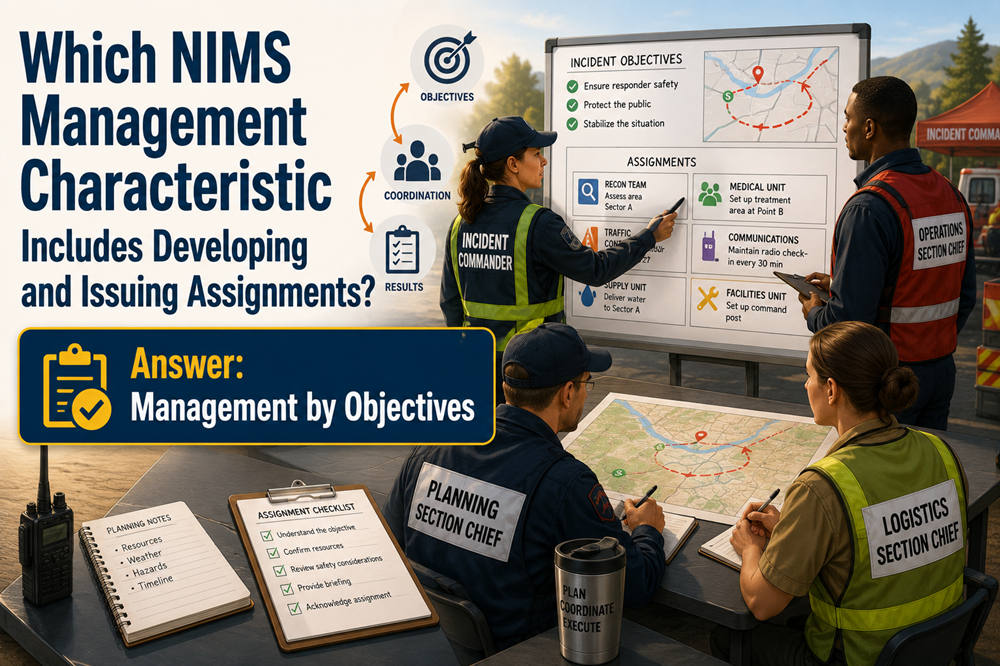
The NIMS management characteristic that includes developing and issuing assignments is Management by Objectives.
Management by Objectives gives everyone involved in an incident a clear sense of direction. Leaders establish what needs to be accomplished, identify the work required, and assign that work to the right people or teams.
According to FEMA training materials, this characteristic includes developing and issuing assignments, plans, procedures, and protocols to support incident management.
What Is Management by Objectives?
Management by Objectives is a structured way to organize an emergency response around clearly defined goals.
During a large incident, responders may need to handle evacuations, medical emergencies, road closures, public warnings, resource requests, and safety concerns at the same time. Without clear objectives, teams may duplicate work, miss important tasks, or use resources in the wrong places.
Management by Objectives helps prevent that confusion. Incident leaders decide what the response must accomplish and then turn those goals into practical assignments.
The process typically includes:
- Establishing overall incident objectives
- Creating specific and measurable goals
- Identifying strategies and tasks
- Developing and issuing assignments
- Directing personnel and resources
- Tracking progress and documenting results
Each assignment should support an established incident objective.
Why Assignments Are Part of Management by Objectives
An incident objective explains what needs to be accomplished. An assignment explains who will do the work and what they are expected to do.
For example, imagine that a neighborhood is being threatened by flooding. An incident objective might be:
Evacuate residents from the affected area before water levels become dangerous.
That objective sets the desired result, but responders still need specific instructions. Incident leaders may issue assignments such as:
- Send rescue teams to designated streets.
- Direct buses to evacuation pickup points.
- Assign police officers to control traffic.
- Set up a temporary medical treatment area.
- Release evacuation instructions to the public.
These assignments divide a large objective into manageable tasks. They also help responders understand where they should go, what they should accomplish, and who is supervising their work.
What Makes an Incident Objective Useful?
Objectives should be clear enough to guide real decisions. A broad statement such as “improve public safety” does not tell responders exactly what success looks like.
A more useful objective would be:
Close all roads leading into the hazardous area within one hour.
This objective identifies a specific result and provides a deadline. Leaders can then assign personnel, vehicles, signs, and other resources to complete the work.
Clear objectives also make it easier to measure progress. At the end of the operational period, incident leaders can determine whether the roads were closed as planned or whether more action is needed.
How Assignments Support an Organized Response
Clear assignments help keep the response coordinated. Personnel know what they are responsible for and how their work connects to the larger mission.
A useful assignment may identify:
- The task that must be completed
- The person or team responsible
- The location of the work
- The available resources
- Important safety concerns
- The expected completion time
- The appropriate supervisor
Assignments may change as the incident develops. A fire may spread in a new direction, weather may affect operations, or additional resources may arrive. Incident leaders can update objectives and issue new assignments based on current conditions.
This flexibility allows the response to remain organized without becoming rigid.
Management by Objectives vs. Incident Action Planning
Management by Objectives is sometimes confused with Incident Action Planning because both involve objectives, tactics, and assignments.
The simplest distinction is:
- Management by Objectives establishes the goals and directs the work needed to reach them.
- Incident Action Planning records and communicates the objectives, tactics, assignments, and supporting information.
An Incident Action Plan may include safety messages, maps, communication procedures, resource information, and assignments for an operational period. FEMA describes Incident Action Planning as the process used to capture and communicate this information. You can review the distinction in FEMA’s ICS training material.
The two characteristics work together, but they are not identical. For a test question that asks which characteristic includes developing and issuing assignments, the correct choice is Management by Objectives.
Similar NIMS Characteristics
Several other NIMS characteristics support the assignment process, but they do not directly answer the question.
Accountability
Accountability helps leaders track personnel, resources, responsibilities, and activities. It includes practices such as check-in, incident action planning, resource tracking, and maintaining an appropriate span of control.
Chain of Command and Unity of Command
Chain of Command establishes a clear line of authority. Unity of Command means that each person reports to one designated supervisor.
These principles help personnel understand who gives them assignments and where they should report their progress.
Dispatch and Deployment
Under Dispatch and Deployment, personnel and resources respond only when requested or properly dispatched. Responders should not arrive independently and begin working without authorization or an assignment.
Incident Action Planning
Incident Action Planning communicates the objectives and assignments for an operational period. It supports Management by Objectives by putting the planned work into an organized format.
Final Answer
Management by Objectives is the NIMS management characteristic that includes developing and issuing assignments, plans, procedures, and protocols.
It connects the incident’s main objectives with the specific work assigned to personnel, helping everyone understand what must be done and how their role supports the overall response.