Major Activities of the Planning Section Include What?
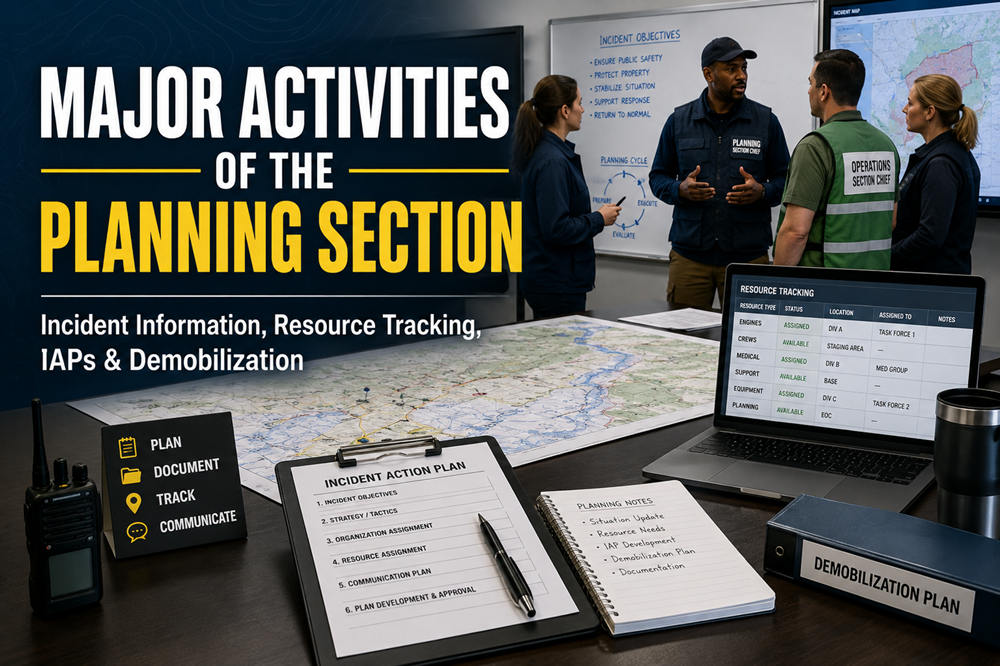
The major activities of the Planning Section include preparing and documenting Incident Action Plans, managing incident information, maintaining situational awareness, tracking assigned resources, keeping incident records, and developing demobilization plans.
Within the Incident Command System, the Planning Section gives incident leaders the information they need to understand current conditions and prepare for what may happen next. It organizes reports from the field, monitors resources, supports planning meetings, and turns approved objectives and strategies into a clear plan for each operational period.
What Is the Planning Section?
The Planning Section is one of the four General Staff sections in the Incident Command System. The other sections are Operations, Logistics, and Finance/Administration.
Each section has a different purpose:
- Operations carries out tactical assignments.
- Logistics provides supplies, facilities, communications, and other support.
- Finance/Administration manages costs, contracts, time records, and claims.
- Planning collects information, tracks resources, prepares plans, and maintains documentation.
The Planning Section does not usually direct field teams. Instead, it helps Incident Command and the Operations Section make informed decisions based on reliable information.
1. Preparing and Documenting the Incident Action Plan
One of the Planning Section’s most important responsibilities is preparing and documenting the Incident Action Plan, commonly called the IAP.
An IAP explains how the incident will be managed during a specific operational period. Depending on the incident, an operational period may last several hours, one shift, or an entire day.
The plan normally includes:
- Incident objectives
- Tactical assignments
- Assigned personnel and equipment
- Safety information
- Communications procedures
- Medical arrangements
- Maps and weather information
The Planning Section does not create the plan alone. Incident Command establishes the objectives, while the Operations Section develops the tactics and work assignments. The Planning Section gathers this information, organizes it, and produces the final plan.
A well-prepared Incident Action Plan helps ensure that everyone understands the priorities, their responsibilities, and how different teams will work together.
2. Collecting and Evaluating Incident Information
The Planning Section collects information from field personnel, technical specialists, government agencies, weather services, maps, reports, and other reliable sources.
This information may cover:
- The size and location of the incident
- Current hazards
- Damage to property and infrastructure
- Evacuations and road closures
- Weather conditions
- Progress toward incident objectives
- Changes that may affect response operations
Collecting information is only part of the job. Planning personnel must also evaluate it.
Reports from the field may be incomplete, delayed, or inconsistent. The Planning Section compares information from different sources, checks its reliability, and identifies details that could affect safety or operations.
For example, planners may need to determine whether a wildfire is moving toward homes, whether floodwater is expected to rise, or whether more medical resources will be required.
3. Maintaining Situational Awareness
Situational awareness means having an accurate understanding of what is happening during an incident.
The Planning Section maintains this awareness by organizing and displaying important information in a form that incident leaders can use quickly. This may include situation maps, status boards, weather reports, damage assessments, operational summaries, and resource displays.
Information must be updated as conditions change. A map or status report that was accurate several hours ago may no longer reflect what personnel are facing in the field.
By maintaining current information, the Planning Section helps leaders recognize new risks, measure progress, and adjust the response when necessary.
4. Tracking Incident Resources
The Planning Section tracks personnel, teams, vehicles, equipment, and other resources assigned to the incident.
Resources are generally recorded as:
- Assigned: Currently performing an incident task
- Available: Ready to receive an assignment
- Out of service: Temporarily unable to perform an assignment
This information is usually maintained by the Resources Unit.
Accurate resource tracking helps incident leaders know what is available, where each resource is located, and how it is being used. It also reduces the risk of teams being overlooked, assigned twice, or sent to the wrong place.
Resource information supports both current operations and future planning. When planners understand what resources are already committed, they can better identify shortages and estimate what may be needed during the next operational period.
5. Supporting the Operational Planning Cycle
Incident planning continues throughout the response. It is not completed once at the beginning.
The Planning Section supports a repeating process in which incident leaders:
- Review current conditions.
- Establish or update objectives.
- Develop strategies and tactics.
- Identify required resources.
- Approve assignments.
- Prepare the IAP.
- Brief personnel.
- Evaluate the results.
This process is often represented by the Planning P, a visual model used in larger or more complex incidents.
The Planning Section Chief helps organize meetings, keeps the planning process on schedule, and ensures that approved decisions are included in the next Incident Action Plan.
6. Forecasting Future Conditions
The Planning Section must look beyond what is happening at the moment. It also considers how the incident may develop.
Future planning may involve estimating:
- How weather could affect operations
- Whether the affected area may expand
- When additional resources will be needed
- How long response activities may continue
- Whether current strategies will remain effective
- What problems could interrupt operations
Planners may also develop alternative strategies and contingency plans. These plans help the organization respond quickly if conditions change or the original approach is no longer effective.
For example, if severe weather may block an evacuation route, planners can identify another route before the problem occurs.
7. Maintaining Incident Documentation
The Planning Section maintains the official records created during the incident.
These records may include Incident Action Plans, maps, situation reports, resource records, activity logs, meeting notes, safety messages, photographs, and major decisions.
The Documentation Unit usually organizes and safeguards these materials.
Complete documentation is important for several reasons. It creates a record of what happened, what decisions were made, and how resources were used. These records may later support:
- After-action reviews
- Reimbursement requests
- Legal or administrative reviews
- Investigations
- Training
- Improvements to emergency plans
Without organized documentation, important information may be lost after personnel leave or the incident ends.
8. Developing the Demobilization Plan
Demobilization is the organized release of personnel, equipment, facilities, and other resources when they are no longer needed.
The Planning Section develops the demobilization plan, often through a Demobilization Unit.
The plan may explain:
- Which resources will be released first
- Where personnel must check out
- How equipment will be inspected and returned
- What records must be completed
- How personnel will travel home or to another assignment
- Whether rest requirements must be met before departure
Demobilization planning should begin before the incident is over. Releasing resources without a plan can create confusion, increase costs, and leave the incident without enough personnel to complete the remaining work.
Units Within the Planning Section
The size of the Planning Section depends on the incident. A small event may require only a Planning Section Chief, while a large emergency may need several specialized units.
Common units include:
Resources Unit
Tracks the status and location of incident personnel and equipment.
Situation Unit
Collects, evaluates, organizes, and displays information about current and expected conditions.
Documentation Unit
Maintains incident records and prepares the final documentation package.
Demobilization Unit
Develops and coordinates the release of incident resources.
Technical Specialists
Provide expert knowledge in areas such as weather, hazardous materials, engineering, public health, mapping, or structural safety.
Not every incident requires each unit. One person may perform several planning functions when the response is small.
Why the Planning Section Matters
Incident leaders must make decisions in conditions that may be stressful, dangerous, and constantly changing. They need more than individual reports from the field. They need information that has been checked, organized, and connected to the incident’s objectives.
The Planning Section provides that structure. It helps the response organization understand current conditions, use its resources effectively, document its decisions, and prepare for the next stage of the incident.
In simple terms, the Planning Section helps answer three questions:
- What is happening now?
- What personnel and resources are available?
- What should the organization prepare to do next?
Its work keeps the response coordinated, informed, and focused on established objectives.