
Organizational Leadership Degree: Courses, Careers, Salary, and How to Choose
An organizational leadership degree explores how people cooperate, make decisions, handle conflict, and respond to change within organizations. It combines leadership studies with subjects such as communication, organizational behavior, ethics, strategy, and employee development.
The degree can support work in human resources, training, project coordination, organizational development, nonprofit administration, and related fields. However, it does not qualify someone automatically for senior management. Career outcomes depend on the program’s curriculum, the student’s previous experience, and the professional skills developed alongside the degree.
What Is an Organizational Leadership Degree?
Organizational leadership is the study of how people influence and coordinate work inside groups and institutions. It looks beyond the behavior of individual leaders to examine workplace systems, team relationships, organizational culture, and the conditions that affect performance.
The National Center for Education Statistics defines organizational leadership as a field that applies leadership skills in business, government, nonprofit, and educational settings. Its definition includes organizational planning, leadership dynamics, finance, team building, communication, conflict resolution, and management skills.
This broad scope allows the subject to be applied in corporations, government agencies, schools, healthcare systems, charities, community organizations, and other settings where people must work toward shared goals.
“Organizational leader” is not usually a standard job title. Graduates generally use the degree within a specific function, such as human resources, employee learning, project work, consulting, program administration, or operations.
What Do You Study in an Organizational Leadership Program?
Curricula differ by institution. Some programs are based in business schools, while others draw more heavily from communication, psychology, sociology, education, or professional studies. Reviewing the required courses is therefore more useful than judging a program by its title alone.
Leadership Theory and Ethics
Leadership courses examine how people gain influence, establish direction, exercise authority, and make decisions under uncertain conditions. Students may compare leadership models and consider why an approach that works in one situation may fail in another.
Ethics introduces questions about power, accountability, fairness, transparency, and competing stakeholder interests. It encourages students to evaluate leadership decisions by their effects on employees, customers, communities, and the organization itself.
Organizational Behavior and Culture
Organizational behavior examines how individuals and groups act at work. Common topics include motivation, decision-making, power, job satisfaction, group norms, organizational structure, and employee engagement.
Courses on workplace culture explore how routines, incentives, leadership behavior, hiring practices, and unwritten expectations shape an organization. Students learn to distinguish between the values an organization claims to hold and the behavior its systems actually encourage.
Communication, Conflict, and Team Dynamics
Students may study interpersonal communication, listening, persuasion, negotiation, facilitation, and mediation. These skills are important when people have different priorities, professional backgrounds, or interpretations of the same problem.
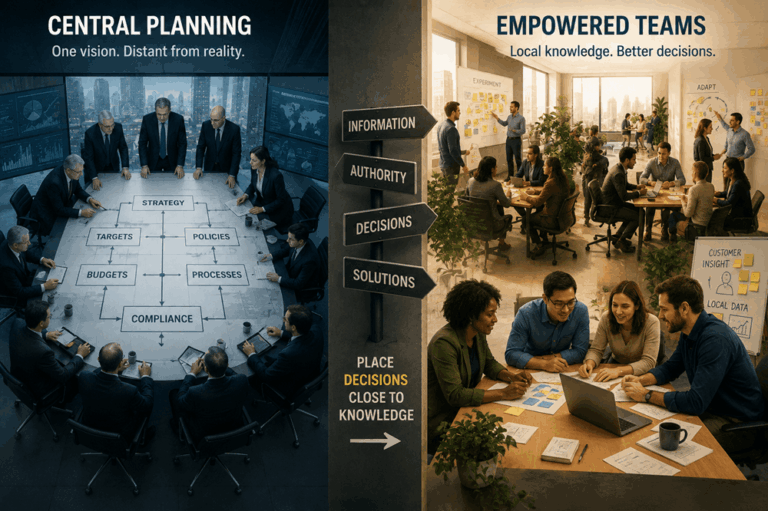
Team-focused coursework considers how groups divide responsibilities, establish trust, share information, make decisions, and manage disagreement. It may also examine the circumstances in which teams benefit from clear central direction or more distributed forms of leadership.
Strategy and Organizational Change
Strategic leadership connects broad goals with practical choices. Students may learn how to define a problem, identify stakeholders, assess alternatives, allocate resources, and translate an intended direction into a workable plan.
Organizational change courses examine what happens when a company or institution introduces a new process, structure, technology, or strategy. They consider resistance, communication, implementation, and the unintended consequences that can emerge during major transitions.
Employee and Organizational Development
This area may include coaching, mentoring, workforce development, workplace learning, performance evaluation, and succession planning. The emphasis is on building organizational capability rather than simply measuring employees after work has been completed.
Many programs conclude with a capstone, case analysis, or organizational project that requires students to apply several of these subjects to a realistic workplace challenge.
Bachelor’s, Master’s, and Doctoral Degrees in Organizational Leadership
Organizational leadership is available at several academic levels. Each serves a different purpose, and the highest degree is not necessarily the best choice for every career goal.
Bachelor’s Degree
A bachelor’s degree provides a broad foundation in leadership, communication, organizational behavior, and management. It may be offered as a Bachelor of Arts, Bachelor of Science, Bachelor of Applied Science, or another professionally oriented degree.
Undergraduate programs may suit students beginning their careers, employees seeking broader preparation for leadership responsibilities, or working adults returning to complete a degree. Some are designed to accept substantial transfer credit from previous college study.
The degree may satisfy the educational requirement for certain specialist, coordinator, and administrative positions. Employers may still expect internships, relevant work experience, technical ability, or knowledge of a particular industry.
Master’s Degree
A master’s program generally offers more advanced study in strategy, organizational change, team effectiveness, ethics, and leadership practice. Many are designed for professionals who can connect classroom ideas with situations they have already encountered at work.
Graduate programs may offer concentrations in areas such as change management, strategic communication, executive leadership, nonprofit leadership, human resources, or organizational development.
A master’s degree can strengthen preparation for greater responsibility, but it does not replace the experience required for most senior positions. Employers normally evaluate a candidate’s record of managing projects, people, budgets, or organizational initiatives alongside academic qualifications.
Doctoral Degree
Doctoral programs are intended for advanced organizational research or practice. They may support careers in higher education, consulting, executive development, organizational research, or specialized leadership roles.
A PhD usually emphasizes original academic research and theory development. A professional doctorate, such as an EdD or another applied leadership doctorate, generally focuses more heavily on using research to address complex organizational problems. Program structures vary, so applicants should examine the research requirements carefully.
Certificates and Concentrations
A certificate may provide focused study in conflict resolution, employee development, nonprofit leadership, organizational change, coaching, or a similar area without requiring another full degree.
Some institutions allow certificate credits to count toward a later graduate degree. Students should verify that policy before enrolling rather than assuming that the credits will transfer automatically.
Organizational Leadership vs. Business Administration
Organizational leadership and business administration overlap, but their typical emphasis differs. Organizational leadership concentrates more heavily on people, culture, communication, influence, and change. Business administration generally provides broader preparation across the functions involved in operating an organization.
| Area | Organizational Leadership | Business Administration |
|---|---|---|
| Primary focus | People, teams, culture, influence, and organizational change | Business functions, operations, resources, and markets |
| Common subjects | Leadership, communication, ethics, conflict, and organizational behavior | Accounting, finance, marketing, economics, operations, and management |
| Typical perspective | How people behave and coordinate within organizations | How organizations manage activities, money, products, and services |
| Potential strength | Greater attention to workplace relationships and organizational development | Broader preparation across technical business functions |
| Potential limitation | May provide less depth in accounting, finance, analytics, or operations | May devote less time to culture, conflict, and leadership psychology |
The boundary is not absolute. A business administration program may offer a leadership concentration, while an organizational leadership degree may include finance, project management, or business strategy.
A student interested in accounting, financial analysis, marketing analytics, or supply chain operations may benefit from a more specialized business program. Someone more interested in employee development, workplace communication, team effectiveness, or organizational change may prefer organizational leadership.
What Can You Do With an Organizational Leadership Degree?
Employers rarely recruit for organizational leadership as a single profession. They hire people to perform particular functions. Graduates therefore need to connect the degree with a recognizable area of work.
Specialist and Coordinator Roles
Depending on their experience and complementary skills, graduates may pursue roles such as:
- Human resources specialist
- Training and development specialist
- Recruiting coordinator
- Employee engagement coordinator
- Project coordinator
- Program coordinator
- Nonprofit program associate
- Organizational development specialist
These positions allow employees to develop expertise in a specific function. A training specialist may assess learning needs and design employee programs. A project coordinator may maintain schedules, documentation, and communication. A human resources specialist may work in recruiting, employee relations, benefits, or another part of the HR function.
Even specialist positions can require relevant experience. Training roles may favor candidates who have worked in teaching, communications, human resources, or the industry in which the training will be delivered.
Management and Consulting Roles
Positions with wider authority normally require a record of related professional work. Possible longer-term paths include:
- Human resources manager
- Training and development manager
- Organizational development manager
- Learning and development director
- Program director
- Change management lead
- Management analyst or consultant
Progression usually occurs through a professional function. Someone may work as an HR specialist before becoming an HR manager, or move from employee training into learning and development management.
Management analysts also commonly bring several years of experience in the industry or business function they advise. Leadership education can support this work, but it does not substitute for knowledge of the organization, market, regulations, or technical processes involved.
The Value of Complementary Skills
The degree becomes more occupationally useful when paired with a practical specialty. Depending on the intended career, useful complementary areas may include:
- Human resources systems and employment practices
- Project planning, budgeting, and risk management
- Data analysis and performance measurement
- Instructional design and program evaluation
- Grant administration and nonprofit finance
- Knowledge of a specific industry or regulated field
This combination helps graduates show employers where they can contribute, rather than relying on leadership as a broad personal quality.
Salary and Employment Outlook
There is no single salary associated with an organizational leadership degree. Earnings depend on the occupation, experience level, industry, location, and amount of responsibility involved.
The figures below are national occupational medians from the U.S. Bureau of Labor Statistics Occupational Outlook Handbook. They are not starting salaries or earnings reported specifically for organizational leadership graduates.
Related Specialist and Analyst Occupations
| Occupation | 2024 Median Annual Pay | Projected Growth, 2024–2034 |
|---|---|---|
| Training and development specialist | $65,850 | 11% |
| Human resources specialist | $72,910 | 6% |
| Project management specialist | $100,750 | 6% |
| Management analyst | $101,190 | 9% |
These occupations differ substantially. Project management specialists coordinate budgets, schedules, and project details, while management analysts recommend ways to improve organizational efficiency. A relevant degree may support either path, but employers will also look for the skills and experience specific to the role.
Experience-Dependent Management Occupations
| Occupation | 2024 Median Annual Pay | Projected Growth, 2024–2034 |
|---|---|---|
| Training and development manager | $127,090 | 6% |
| Human resources manager | $140,030 | 5% |
The management salaries should not be treated as likely earnings immediately after graduation. Both occupations typically require related professional experience in addition to a degree.
How to Choose an Organizational Leadership Program
Programs with similar names may differ greatly in cost, academic depth, and practical value. Prospective students should evaluate what a program requires and how it connects with their intended career.
Verify the Institution’s Accreditation
Confirm the school’s status through the U.S. Department of Education’s accreditation database. The Department recognizes accrediting agencies that meet federal standards for evaluating the quality of colleges and educational programs.
Accreditation can affect eligibility for federal financial aid, the acceptance of transfer credits, admission to graduate study, and how other institutions or employers evaluate a credential.
Accreditation alone does not prove that a particular degree is the right choice. It is a basic screening step that should be followed by a closer examination of the program itself.
Compare the Curriculum With Target Jobs
Identify several occupations you may realistically pursue and review current job descriptions. Then compare their requirements with the program’s mandatory courses.
A student interested in human resources may need preparation in employment practices, workforce analytics, or HR technology. Someone interested in project work may need budgeting, scheduling, risk management, and project software. A future learning and development professional may benefit from instructional design and program evaluation.
This comparison can reveal whether organizational leadership provides enough preparation or should be combined with a concentration, minor, certificate, or industry-specific qualification.
Look for Applied Learning
Useful programs give students opportunities to work through realistic organizational problems. Examples include internships, consulting projects, simulations, case studies, field research, and capstones completed with employers or community organizations.
Working students may be able to apply assignments within their current workplace. This can produce concrete examples of analysis, communication, planning, and implementation that are useful in future job applications.
Calculate the Full Cost
Compare the total price rather than the advertised tuition rate. Include mandatory fees, books, software, travel, residency requirements, and the number of credits required for completion.
Students should also consider how long the program is likely to take and whether its schedule could reduce their working hours. A lower price per credit does not necessarily produce a lower total cost if the program requires more credits or extends the completion time.
Review Outcomes Carefully
Ask about completion rates, average time to graduation, internship participation, alumni roles, and the types of employers that have hired graduates. Career claims should be specific enough to evaluate rather than limited to a list of possible job titles.
The Department of Education’s College Scorecard can help students compare costs, debt, graduation rates, and available post-college earnings data. Some information is reported for an institution as a whole, so it may not represent the outcomes of students in one particular organizational leadership program.
Evaluate Online Programs Beyond Convenience
Online study can make a degree accessible to working adults, but delivery quality varies. Prospective students should determine whether classes are live or asynchronous, how often instructors interact with students, and how group projects are managed.
They should also examine access to academic advising, career services, library resources, tutoring, technology support, and internship assistance. An online student should receive more than recorded lectures and automated assignments, especially in a subject built around discussion, feedback, and collaboration.
Final Considerations
An organizational leadership degree is most useful when its people-centered curriculum complements practical expertise. It can help students understand culture, communication, conflict, teams, employee development, and organizational change, but employers will still expect evidence that candidates can perform a defined function.
Before enrolling, compare the program’s required courses, total cost, applied learning opportunities, accreditation, and graduate outcomes with the actual requirements of the work you intend to pursue. The capabilities developed through the program matter more than the word “leadership” in the degree title.