TMF688 Event Management API: Architecture, Resources, and Implementation Guide
Telecom platforms depend on many connected systems, including service ordering, network inventory, assurance, billing, customer management, and trouble-ticket applications. These systems need a reliable way to share events without creating a separate integration for every producer and consumer.
The TMF688 Event Management API provides a standardized interface for publishing events, organizing them into topics, and managing subscriptions. It is part of the TM Forum Open API ecosystem and is designed for event-driven communication between OSS/BSS platforms, microservices, ODA components, and partner systems.
TMF688 is not a calendar or conference-management API. It deals with technical and business events such as service outages, order updates, alarms, SLA violations, and resource state changes.
What Is the TMF688 Event Management API?
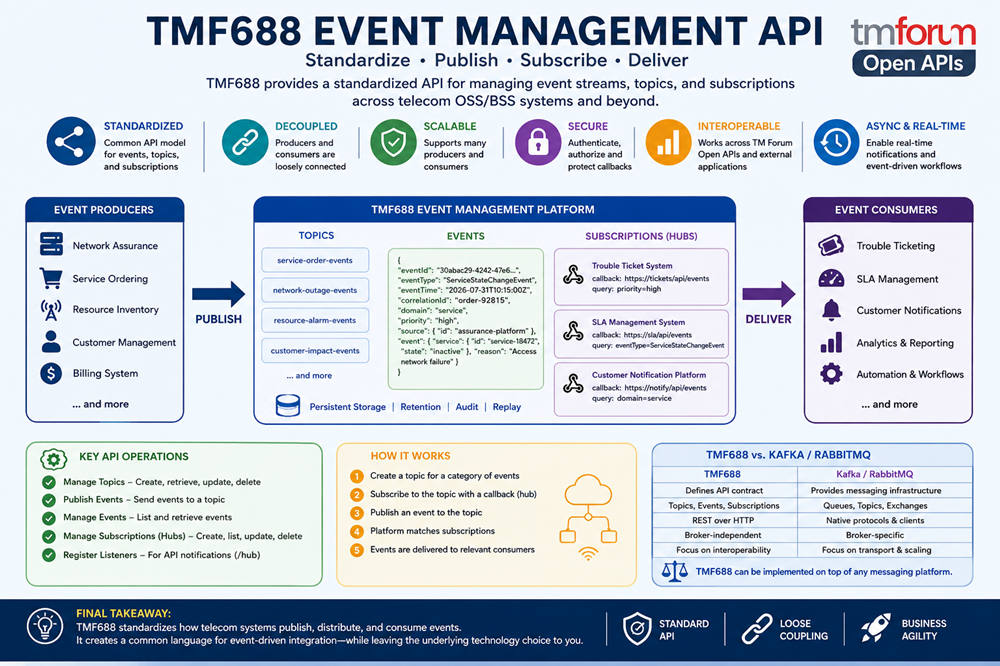
TMF688 defines a REST-based model for managing event streams. Producers can publish events to topics, while consumers can register callback endpoints to receive events that match their interests.
The public TMF688 Event API repository describes version 4.0.0 as the Event Streaming API. Its documented base path is:
/tmf-api/event/v4/
The API builds on the notification pattern used across many TM Forum APIs. Instead of limiting subscriptions to one domain API, TMF688 provides a broader interface that can support events from several applications and business areas.
A basic interaction looks like this:
- A topic is created for a category of events.
- A consumer subscribes to that topic.
- The consumer provides a callback URL.
- A producer publishes an event.
- The platform delivers the event to matching subscribers.
The producer does not need to know which applications will use the event. Consumers can also be added or removed without changing the producer’s core logic.
Why Organizations Use TMF688
Point-to-point integrations become difficult to manage as more systems are added. Each connection may introduce its own payload format, callback rules, security controls, and retry behavior.
TMF688 gives teams a common event-management contract.
Its main benefits include:
- A consistent structure for event publication and subscription
- Less direct dependency between producers and consumers
- Centralized management of topics and callback registrations
- Easier integration across service, resource, product, and customer domains
- Support for asynchronous workflows and automation
- Independence from a specific messaging product
For example, one service-outage event could be used by a ticketing platform, an SLA engine, a customer-notification service, and an operations dashboard. The producer publishes the event once, and each subscriber decides what to do with it.
Core TMF688 Resources
The API is mainly organized around three resources: Topic, Event, and Hub.
Topic
A topic groups related events into a recognizable stream.
Examples might include:
service-order-events
network-outage-events
resource-alarm-events
customer-impact-events
Consumers subscribe to a topic instead of requesting every event generated by the organization.
Topic names should represent stable business or operational areas. Naming a topic after a domain, such as service-assurance-events, is usually more useful than naming it after a particular software product.
Topics should also be specific enough to remain useful. A single topic containing every event from every system would create unnecessary traffic and make filtering harder.
TMF688 includes operations for creating, listing, retrieving, and deleting topics.
Event
An event records something that happened during a business or operational process.
Common examples include:
- A service order changed status.
- A network resource became unavailable.
- An alarm was raised.
- An SLA threshold was exceeded.
- A trouble ticket was opened.
- A customer-facing service was restored.
A TMF688 event generally contains a common envelope and an event-specific payload.
The envelope carries information used to identify, classify, and trace the event. Depending on the model being used, this may include:
eventIdeventTypeeventTimecorrelationIddomainprioritysourcereportingSystemrelatedParty
The event property contains the business or operational details.
Here is a simplified example:
{
  "eventId": "30abac29-4242-47e6-a0fb-2042ea2416ff",
  "eventType": "ServiceStateChangeEvent",
  "eventTime": "2026-07-31T10:15:00Z",
  "correlationId": "order-92815",
  "domain": "service",
  "priority": "high",
  "source": {
    "id": "service-assurance-platform"
  },
  "event": {
    "service": {
      "id": "service-18472",
      "state": "inactive"
    },
    "reason": "Access network failure"
  }
}
This is an illustrative example rather than a complete official payload. The exact structure depends on the event type, the originating TM Forum API, and any extensions used by the organization.
TMF688 allows clients to publish an event under a topic, list events within that topic, and retrieve an event by its identifier.
Hub and Subscription
A hub represents a subscriber’s registration.
When a consumer creates a topic-level hub, it normally provides a callback address where notifications should be delivered. It may also include a query that limits which events the consumer receives.
For example:
{
  "callback": "https://consumer.example.com/tmf688/events",
  "query": "eventType=ServiceStateChangeEvent"
}
A trouble-ticket system may subscribe only to high-priority outage events. An analytics platform may subscribe to a much wider set of events.
The API includes topic-level hub operations under paths such as:
/topic/{topicId}/hub
These operations manage subscribers associated with a particular topic.
The specification also includes root-level /hub operations. These follow the familiar TM Forum listener-registration pattern and are used to subscribe to notifications produced by the Event API itself. Although both patterns use the word “hub,” they serve different scopes and should not be treated as interchangeable.
Main TMF688 API Operations
The exact host address depends on the implementation, but the main resource paths include:
| Method | Endpoint | Purpose |
|---|---|---|
GET |
/topic |
List or search topics |
POST |
/topic |
Create a topic |
GET |
/topic/{id} |
Retrieve a topic |
DELETE |
/topic/{id} |
Delete a topic |
GET |
/topic/{topicId}/event |
List events within a topic |
POST |
/topic/{topicId}/event |
Publish an event |
GET |
/topic/{topicId}/event/{id} |
Retrieve an event |
GET |
/topic/{topicId}/hub |
List topic subscriptions |
POST |
/topic/{topicId}/hub |
Create a topic subscription |
GET |
/topic/{topicId}/hub/{id} |
Retrieve a subscription |
DELETE |
/topic/{topicId}/hub/{id} |
Remove a subscription |
POST |
/hub |
Register a listener for API notifications |
DELETE |
/hub/{id} |
Remove a listener registration |
These endpoints define how clients interact with the event-management layer. They do not prescribe how an organization must configure its internal broker, storage, partitioning, or delivery infrastructure.
Example: Handling a Service Outage
Consider a telecom provider with separate monitoring, ticketing, SLA, and customer-communication platforms.
1. An Outage Is Detected
The network assurance system discovers that an access-network failure has interrupted several customer services.
2. The Event Is Published
The assurance system publishes an event to a topic such as network-outage-events.
The payload includes information such as:
- A unique event ID
- The time the outage occurred
- The affected service or resource
- The severity
- The source system
- A correlation ID
- A brief reason for the failure
3. Subscriptions Are Evaluated
The event platform checks the active subscriptions for that topic.
The trouble-ticket application may accept every major outage. The customer-notification platform may accept only events that affect active customer services.
4. Matching Consumers Receive the Event
The platform sends the event to each matching callback endpoint.
5. Separate Workflows Begin
The ticketing system opens an incident. The SLA system starts measuring the interruption. The customer platform identifies affected accounts and prepares notifications.
Each consumer acts independently, while the assurance system remains focused on detecting and publishing the outage.
TMF688 and Other TM Forum APIs
Many TM Forum APIs already define notifications for their own resources.
A service-order API may publish an order-state-change event. An alarm-management API may publish an alarm event. A trouble-ticket API may notify consumers when a ticket is created or updated.
TMF688 does not replace those domain models. Instead, it can provide a shared layer for organizing and distributing events from several domains.
A common pattern is:
- The domain API defines the event’s meaning and payload.
- TMF688 provides the topic and publication interface.
- A hub records the consumer’s subscription.
- The event platform delivers matching notifications.
This approach keeps the event content tied to the correct business domain while making distribution more consistent.
TMF688 Compared With Kafka and RabbitMQ
TMF688 is sometimes compared directly with Kafka or RabbitMQ, but they operate at different levels.
| TMF688 | Kafka, RabbitMQ, or another broker |
|---|---|
| Defines a standardized API contract | Provides messaging infrastructure |
| Models topics, events, and subscriptions | Implements queues, exchanges, partitions, or broker topics |
| Uses TM Forum resource structures | Uses product-specific protocols and clients |
| Supports interoperability between systems | Handles transport, routing, storage, and scaling |
| Can hide broker-specific details | Provides native broker features |
An organization may place TMF688 in front of Kafka, RabbitMQ, a cloud event bus, or another messaging platform. An adapter can translate REST requests into the broker’s native operations.
This is an implementation option, not a requirement of the specification.
Teams should also recognize that a standardized REST interface may not expose every native broker feature. Consumer groups, offsets, partitions, replay controls, and delivery guarantees may still need to be managed inside the event platform.
Implementation Best Practices
The API contract is only one part of a reliable event system. Teams should also define how events are identified, secured, delivered, monitored, and recovered.
Use Unique Event IDs
Every event should have a dependable identifier. Consumers can use it to detect duplicate deliveries and avoid performing the same action twice.
Include Correlation IDs
A correlation ID makes it easier to trace one workflow across ordering, activation, assurance, billing, and customer-support systems.
Make Consumers Idempotent
A callback may receive the same event more than once, especially when delivery is retried. Processing an event twice should not create duplicate tickets, orders, payments, or notifications.
Document Payload Schemas
Do not place an unexplained JSON object inside the event property. Define required fields, data types, allowed values, and versioning rules.
Secure Callback Endpoints
Subscriptions and callbacks should use appropriate authentication, authorization, encryption, and payload validation.
Implementations should also validate callback addresses before accepting them. This reduces the risk of sending event data to an untrusted or unintended endpoint.
Keep Callback Handling Efficient
A callback should validate and acknowledge an event quickly. Longer business processes can continue asynchronously after the event has been accepted.
Define Failure Handling
The specification does not prescribe one retry policy. Organizations should decide how many delivery attempts to make, how failures are logged, and how undelivered events are reviewed or replayed.
Monitor Delivery Health
Useful operational measures include:
- Published event volume
- Successful delivery rate
- Callback response time
- Retry count
- Failed subscriptions
- Event-processing delay
Monitoring should cover both the event platform and its consumers. A successful callback response does not always mean the consumer completed its work correctly.
Common Implementation Mistakes
A few design problems appear repeatedly in event-management projects.
Treating TMF688 as the Message Broker
TMF688 defines the external API model. It does not provide the complete transport, persistence, scaling, or recovery strategy by itself.
Creating Topics That Are Too Broad or Too Narrow
A topic containing every organizational event becomes noisy. Creating a separate topic for every minor event type makes governance difficult.
Topics should reflect stable domains and practical subscription needs.
Publishing Entire Business Objects
Events should describe what changed and provide enough context for consumers. Repeatedly publishing large copies of complete resources creates oversized messages and increases the risk of inconsistent data.
Ignoring Duplicate or Out-of-Order Delivery
Consumers should not assume that every event arrives once or in perfect order. The platform’s delivery guarantees and the consumer’s processing rules must be clearly documented.
Using Unversioned Custom Payloads
Custom extensions will change over time. A versioning strategy helps prevent one producer update from breaking several consumers.
Leaving Old Subscriptions Active
Unused callbacks create delivery failures, wasted processing, and security concerns. Subscriptions should have clear owners and should be removed when no longer needed.
Including Too Much Sensitive Data
Events may be distributed to several systems. Only include the customer, account, payment, or operational data that subscribers genuinely need.
When Is TMF688 a Good Fit?
TMF688 is most useful when an organization has several event producers and consumers, especially across OSS/BSS or TM Forum domains.
It is a strong fit when a company:
- Uses multiple TM Forum Open APIs
- Needs asynchronous communication between systems
- Wants consistent event and subscription structures
- Needs to reduce custom point-to-point integrations
- Supports several consumers for the same event
- Wants a broker-independent API layer
- Is building cross-domain automation
For a small integration between two tightly connected services, a direct callback or an existing message contract may be simpler. TMF688 becomes more valuable as the event ecosystem grows.
Final Takeaway
The TMF688 Event Management API gives telecom teams a standard way to publish events, organize them into topics, and register subscribers.
Its role is to create a consistent interface between systems. The underlying broker, retry policy, storage model, security controls, and monitoring strategy remain implementation decisions. When those parts are designed well, TMF688 can reduce custom integrations and make event-driven telecom platforms easier to expand and manage.