When the 50/30/20 Rule May Not Be the Best Saving Strategy for You
The 50/30/20 rule is popular because it gives you a simple way to divide your money. But simple does not always mean suitable. The 50/30/20 rule may not be the best saving strategy when your essential expenses are high, your income changes from month to month, you have high-interest debt, or you need to save faster for an important goal.
It works best as a starting point. Your actual budget should reflect what you earn, what you have to pay, and what matters most financially.
What Is the 50/30/20 Rule?
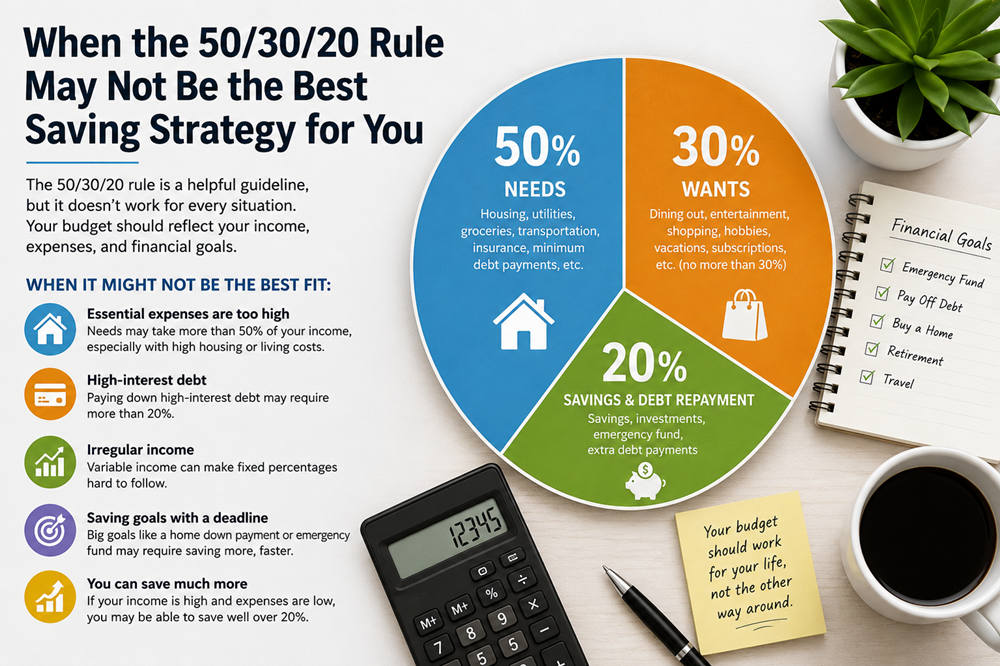
The 50/30/20 rule divides your take-home income into three broad categories:
- 50% for needs, such as housing, food, utilities, transportation, insurance, and other essential bills
- 30% or less for wants, such as dining out, entertainment, hobbies, vacations, and optional subscriptions
- 20% for savings and debt repayment
The Consumer Financial Protection Bureau presents this kind of percentage budget as a rule of thumb rather than a requirement. Its budgeting materials also encourage people to create personal spending rules that fit their circumstances.
For example, someone bringing home $4,000 per month might aim for roughly $2,000 in needs, up to $1,200 in wants, and $800 toward savings or debt.
The problem is that your real expenses may not fit those numbers.
When Might the 50/30/20 Rule Not Be the Best Saving Strategy?
There are several situations where following the percentages too closely can make budgeting harder rather than easier.
When Your Essential Expenses Take More Than 50% of Your Income
The rule assumes that half of your take-home pay will cover your basic needs.
That may be unrealistic if you have high housing costs, childcare expenses, medical bills, transportation costs, insurance premiums, or other unavoidable expenses.
Suppose you bring home $4,000 per month and your rent is $1,800. Once you add utilities, groceries, transportation, insurance, and other required expenses, your needs could easily exceed $2,000.
Trying to force those expenses down to exactly 50% does not necessarily make sense.
Instead, calculate what your essential costs actually are. If needs currently consume 60% of your income, start there and decide how to use the remaining 40%.
You can still look for ways to reduce expenses over time, but your budget should begin with realistic numbers rather than an ideal percentage. CFPB guidance similarly emphasizes creating a spending rule that works for your own financial situation.
When You Have High-Interest Debt
The 50/30/20 approach may also be too relaxed if you are carrying credit card balances or other high-interest debt.
Imagine paying a high interest rate on a credit card while continuing to use close to 30% of your income for optional spending. In that situation, reducing some wants and putting more money toward the debt may improve your finances faster.
Investor.gov recommends paying off high-interest debt first as part of preparing for longer-term saving and investing.
That does not mean you should automatically send every available dollar to debt. Keeping some emergency savings can help prevent you from relying on credit again when an unexpected expense appears. Investor.gov also recommends combining debt management with emergency saving and regular long-term investing.
The right balance depends on your interest rates, emergency savings, minimum payments, and other obligations.
When Your Income Changes From Month to Month
A percentage budget is easiest to use when your paycheck is predictable.
It can be more difficult if you are:
- Self-employed
- A freelancer
- Paid primarily through commissions
- A seasonal worker
- Working irregular hours
- Earning a large portion of your income from tips
If you bring home $6,000 one month and $3,500 the next, building your lifestyle around the higher number can create problems during slower periods.
One practical approach is to build your basic budget around a conservative monthly income figure. During stronger months, extra money can go toward an income buffer, savings, debt repayment, taxes, or long-term goals.
This gives you more breathing room when earnings fall.
You can still use percentages, but they should work around your cash flow rather than forcing every month to look identical.
When You Need to Reach a Savings Goal Quickly
Saving 20% of your income can be a strong habit, but there are times when you may want to save substantially more.
You might be:
- Building an emergency fund
- Saving for a home down payment
- Preparing for parental leave
- Planning a move
- Paying for education
- Saving for a major purchase
- Trying to reach financial independence sooner
Consider someone who brings home $5,000 per month and needs $12,000 for a goal within six months.
If that person has no additional debt payments and puts the full 20% toward the goal, they would save $1,000 per month, or $6,000 after six months.
That is only half of the target.
If their essential expenses allow it, cutting discretionary spending and saving a larger share temporarily may be more useful than sticking to the standard percentages.
Investor.gov recommends identifying your financial goals and creating a savings and investment plan based on those goals.
A deadline can change what an appropriate savings rate looks like.
When You Can Comfortably Save Much More Than 20%
The 20% figure is not a maximum.
If your income is high relative to your living expenses, you may be able to save 30%, 40%, or more without giving up anything important.
For example, suppose you bring home $10,000 per month but need only $4,000 for essential expenses and $1,500 for discretionary spending.
There is no reason to increase optional purchases simply because the 50/30/20 formula allows more room for wants.
You could direct the extra money toward:
- Retirement accounts
- Investments
- A home purchase
- Education savings
- Paying off debt
- Building a larger financial cushion
- Other long-term goals
This is an important distinction: the wants category is an allowance, not a target you need to reach. The CFPB’s version of the rule specifically describes wants as no more than 30% of take-home pay.
The same general idea appears in other budgeting systems. Fidelity describes its budgeting guideline as a flexible starting point rather than a one-size-fits-all rule.
How to Adjust the 50/30/20 Rule to Fit Your Situation
You do not have to abandon the idea completely. You can use the basic framework while changing the percentages to match your finances.
Start With Your Real Essential Expenses
Write down what you actually spend each month on housing, food, utilities, transportation, insurance, healthcare, childcare, and required payments.
Do not start by assuming these costs must equal 50%.
If your real needs consume 58% of your take-home pay, use that as the starting point and work with what remains.
Understanding how much money is coming in and going out each month is also a basic part of building a financial plan.
Decide What Needs Your Money Most Right Now
Your biggest financial priority may change over time.
If you have expensive credit card debt, extra repayment may come first.
If you have no emergency savings, building a cash reserve may be more urgent.
If your finances are stable and you are preparing for retirement, increasing long-term savings might matter more.
You do not need the same percentages at every stage of life.
Cut Optional Spending When a Bigger Goal Matters More
The wants category generally gives you the most room to adjust.
You may be able to reduce restaurant spending, entertainment, subscriptions, vacations, or nonessential shopping for a period without touching essential bills.
This does not require eliminating everything enjoyable. It simply means deciding which purchases matter less than your current financial goal.
Review Your Budget After Major Life Changes
A budget that worked last year may stop making sense after a major change.
A new job, marriage, child, move, home purchase, or shift to self-employment can significantly change both income and expenses.
Fidelity recommends revisiting your budget regularly, particularly when major life events change your cash flow.
The Main Takeaway
The 50/30/20 rule may not be the best saving strategy when its percentages do not match your financial reality.
It can be less useful when essential expenses consume more than half your income, high-interest debt needs urgent attention, your income is unpredictable, you are working toward a time-sensitive savings goal, or you have enough income to save far more than 20%.
Use the rule if it helps you organize your money, but do not treat 50%, 30%, and 20% as numbers you have to hit exactly. A budget built around your actual expenses and financial priorities will usually be more useful than forcing your money into percentages that do not fit.